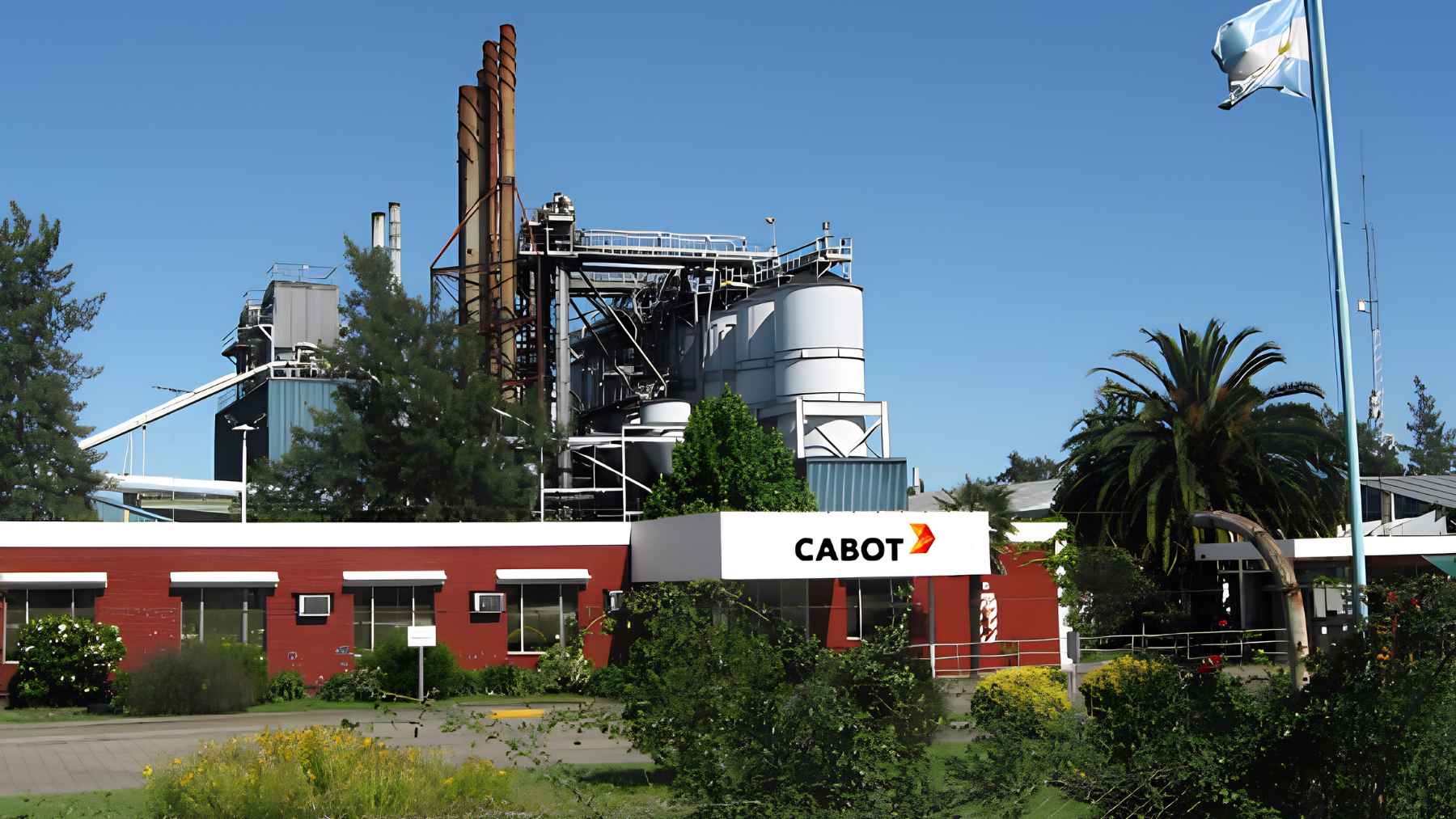
An industrial site that helped supply South America’s tire and rubber businesses for more than six decades is now going through a planned shutdown. Cabot Corporation says it expects to cease all operations at its carbon black plant in Campana, Buenos Aires Province, by the end of 2026 as part of a wider effort to bring production capacity closer to current demand.
The move puts about 150 jobs at risk and will stop a long-standing domestic source of a material hidden inside ordinary black tires. It also begs a less obvious environmental question: when an emissions-intensive product stops being manufactured locally, does its footprint go with it, or does it simply move to another factory and a longer freight route?
Cabot’s decision
Cabot formally committed to the restructuring on May 1. Its quarterly filing says the Campana shutdown will be completed by Dec. 31, while selected manufacturing plants in Botlek, Netherlands, are also due to be closed, subject to local consultation. Cabot expects approximately $79 million in pre-tax charges as a result of the plan.
Among those charges are $11 million for severance and post-employment benefits, $45 million for accelerated depreciation, and smaller amounts for asset impairment, demolition, site clearing, environmental-related costs, and post-closure operations.
Chief Executive Sean Keohane suggested the changes would “better align production with demand conditions” and support a more efficient network, with approximately $22 million in annual fixed-cost savings once fully implemented.
This was not simply a sales collapse
Cabot’s figures reveal a more complicated picture than one factory slowing down due to falling orders. Reinforcement Materials volumes rose 3% worldwide in the latest reported quarter, but the segment’s revenues before interest and taxes fell 29% because lower profit per ton far outweighed the volume gain.
That points to pricing, margins, product mix, competition, and the location of Cabot’s manufacturing capacity as well as demand. Cabot still reached $904 million in quarterly sales and $68 million in net income, meaning its filing does not describe a company-wide collapse. For Campana, however, the corporate math reached an all-too-common conclusion.
Why carbon black matters
Carbon black is a fine carbon powder used to reinforce rubber, especially in tires, and is also found in plastics, inks, and coatings. Cabot says its Campana site served customers mainly across South America and directly employed more than 90 people. It is one of those industrial components consumers rarely see but depend on every time they drive.
Argentine business association ENAC described the facility as the country’s only producer of carbon black. As such, tire and rubber manufacturers are likely to become more dependent on imported material unless another local supplier pops up. A delayed ship or a sudden currency spike can then become a factory-floor headache.
About 150 jobs are at stake
Official and local employment counts are not exactly aligned. Cabot’s location page lists more than 90 employees, while a Campana municipal resolution says approximately 150 jobs are on the chopping block and describes them as direct positions. Other local accounts divide the larger total into about 90 direct employees and 60 contracted service jobs.
For Campana, that difference is no small factor. A major industrial payroll supports stores, suppliers, transportation companies, and household spending far beyond the plant property. After more than 60 years of operation, specialized skill also leaves with the workforce, and replacing that capability is much more complicated than removing machinery.
Argentina’s industry was already slowing
The shutdown hits during a weak manufacturing trend. Argentina’s official industrial production index fell 5.7% in May from a year earlier, with chemicals dropping 3.1%, rubber and plastics down 10.2%, and motor vehicles, bodies, trailers, and parts falling 15.9%.
Automakers report a similar squeeze. Vehicle production dropped 13.6% year over year in June and was down 18.3% through the first half of 2026, while first-half wholesale deliveries fell 23.7%. A carbon black plant does not live on the automotive industry alone, but weakness downstream swims up the supply chain.
The environmental burden may move
Carbon black is useful, but its production is hardly clean. The U.S. Environmental Protection Agency says the process can expel large amounts of sulfur dioxide, nitrogen oxides, and particulate matter, pollutants connected to acid rain, smog, haze, and serious health damage.
Closing the plant will therefore eliminate its local operating emissions once production stops, yet that is only part of the picture.
Campana had installed a steam turbine generator in 2024 that gathered excess thermal energy from its boilers and converted it into electricity, reducing dependence on outside power and the facility’s Scope 2 emissions. The plant was moving towards more energy efficiency less than two years before Cabot’s decision placed it on the closure list.
If Argentina replaces Campana’s production with imports, the carbon black will still have to be made somewhere. Depending on the replacement factories, energy sources, and shipping distances, the shutdown may shift part of the environmental damage rather than remove it. That is just an inference, but it will be the key ecological test while the supply chain changes.
What happens next
The immediate questions are practical. Workers and local officials will focus on severance, consultation, dismantling, and site responsibility, while tire and rubber companies will need to find replacement supplies, inventories, transportation, and access to foreign currency–a long checklist for an ingredient that seldom crosses the minds of drivers.
Cabot has set the end of 2026 as the operating deadline, but the economic ripples will be seen much longer. The real measure will be whether Campana can attract replacement industry, whether workers land comparable jobs, and whether imported carbon black comes with a lower or higher total environmental cost.
The official filing was published on Cabot Corporation’s investor relations website.