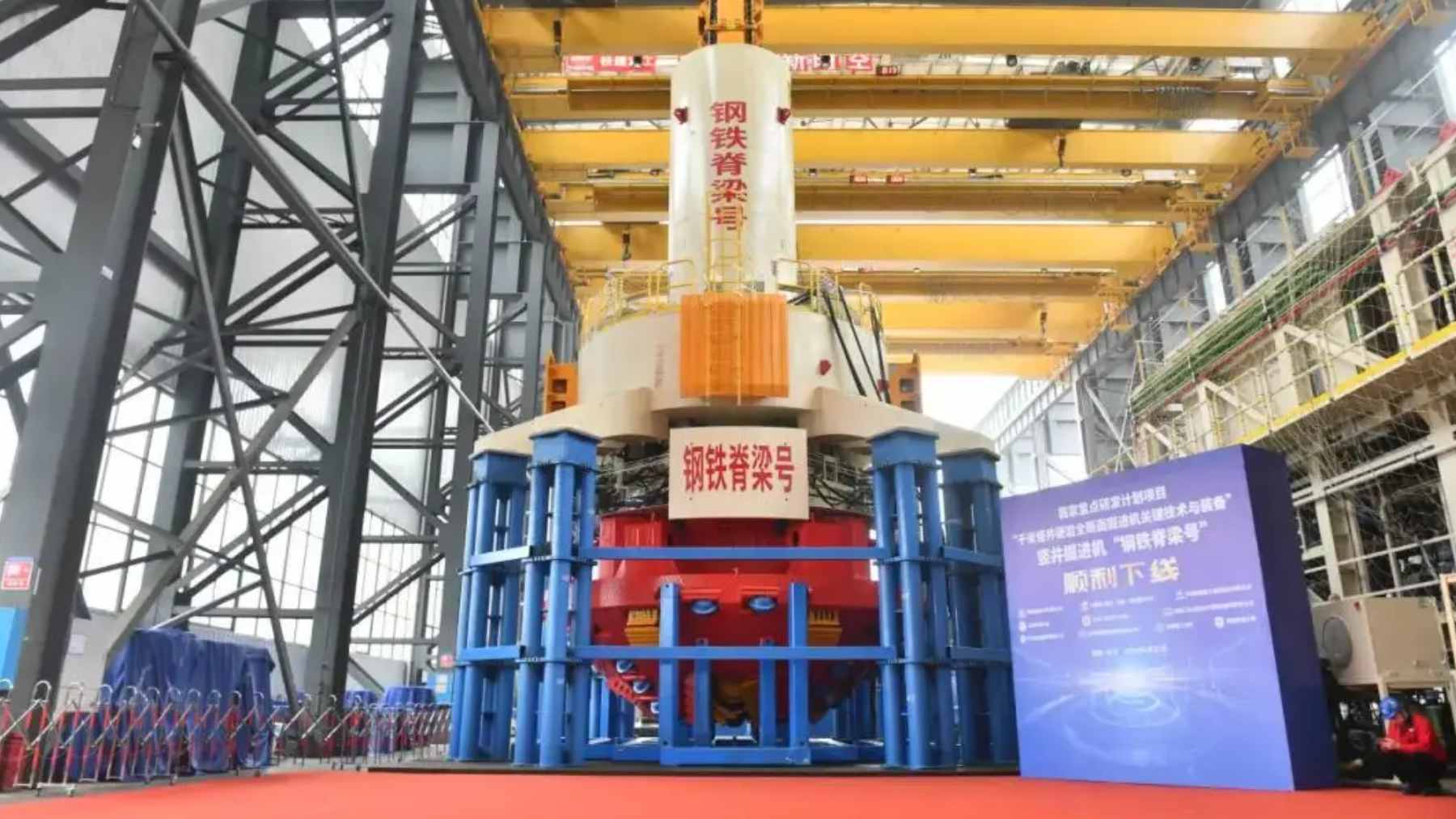
China has pushed one of its most unusual mining machines deep below the surface, and the message is hard to miss. The machine, called “Gangtie Jiliang” or “Steel Backbone,” has completed a 3,294-ft. hard-rock shaft at Ansteel’s Xi’anshan iron ore project in Liaoning Province, according to the latest project update.
This is not just another engineering trophy. As batteries, electronics, renewable energy, steelmaking, and defense supply chains all compete for raw materials, the race is moving farther underground. That raises a bigger question for the planet, too: can deeper mining be made safer and cleaner, or does it simply open the door to more extraction?
A machine built for deep rock
Public descriptions have compared “Steel Backbone” to an “underground aircraft carrier,” and it is easy to see why. The latest project update lists the full system at 328 ft. tall and roughly 2.2 million lbs., with the ability to work at depths of about 3,300 ft.
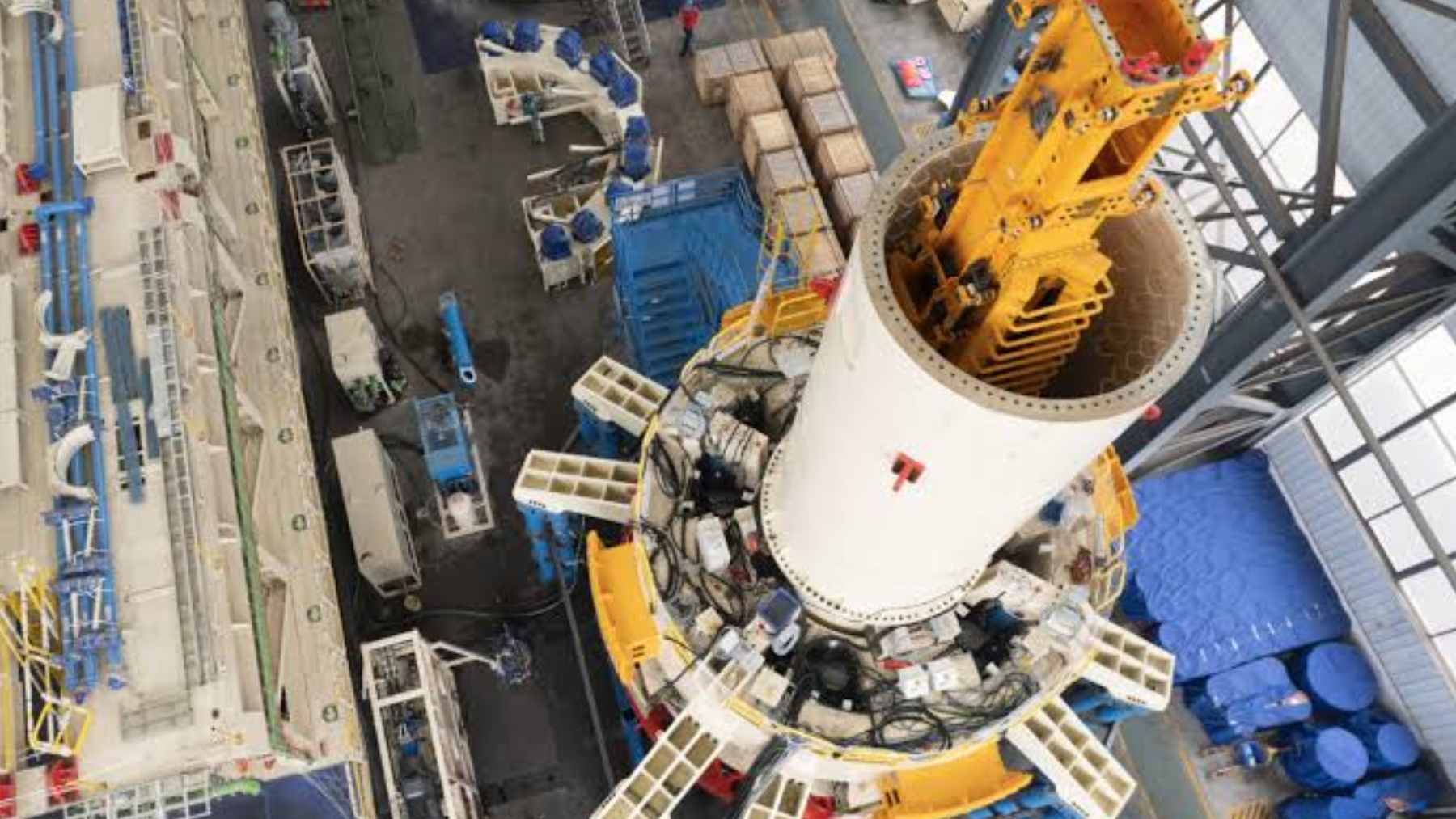
At the front is a cutterhead 26.6 ft. wide, designed to grind through very hard rock while the system handles excavation, support, and muck removal in one continuous process. Essentially, the machine is trying to turn one of mining’s most dangerous jobs into something more controlled and repeatable.
The location matters. Ansteel’s Xi’anshan mine is a roughly $3.25 billion underground iron ore project that is expected to produce about 33 million tons of ore and 11 million tons of concentrate a year once operating, according to China’s government portal.
The pencil sharpener idea
One of the strangest parts of this story starts with something found on a desk, not in a mine. Engineers reportedly drew inspiration from a pencil sharpener after a test machine met rock with compressive strength of about 20,300 psi and suffered heavy wear.
Instead of forcing every cutting tool straight into the rock, the team reduced the cutter angle to 15°. That small change helped reduce uneven wear, while a redesigned W-shaped cutterhead moved broken rock away from the center so the machine could keep driving downward. Simple idea, hard job.
Getting the rock out
Digging the shaft is only half the battle. Once rock is broken, it has to be removed quickly, or the machine can choke on the very material it just cut.
The development team compared the challenge to hauling trash out of a 300-story building with no elevator. Their answer was an 82-foot vertical discharge pipe and a system able to move about 160 cubic yards of broken rock an hour, roughly the load of 10 municipal dump trucks.
That detail may sound small, but it is central to the machine’s value. In a deep shaft, every pause costs time, money, and safety margin.
Safety below the surface
Deep shafts put workers and equipment under pressure from rock stress and groundwater. If the walls are not supported quickly, deformation and collapse can become serious risks.
“Steel Backbone” uses a support system that allows concrete lining work to continue as the machine advances. Its hydraulic formwork can be controlled from the surface, giving crews a way to reduce the amount of direct manual work needed near the active cutting area.
That does not make mining risk-free, but it does show why companies and governments are interested in these machines. More automation underground can mean fewer people standing where falling rock, water inflow, and equipment failures are most dangerous.
Why the mineral race is moving deeper
The timing is no accident. The International Energy Agency says demand for key energy minerals kept rising in 2024, with lithium demand up nearly 30% and demand for nickel, cobalt, graphite, and rare earths up 6% to 8%.
Looking ahead, the IEA projects lithium demand could grow fivefold by 2040 under stated policies, while graphite and nickel demand could double. Copper, already a huge market, is projected to grow by 30% over the same period as grids, construction, and electrification keep expanding.
That is where China’s strategy becomes clearer. A machine that can reach harder and deeper deposits is not only a mining tool. It is a supply-chain tool, especially at a time when countries are worried about who controls minerals, refining, and the technologies built from them.
The environmental question
There is a catch, of course. Mining technology can become safer and more precise, but it still produces waste rock, uses energy, affects water systems, and changes landscapes.
UNEP has warned that the clean energy transition needs more circularity, responsibility, and equity in mineral supply chains. It also says recycling and better product design can reduce the need for new extraction, especially because many energy-transition minerals can be recovered and reused.
The World Bank has made a similar point from another angle. It says production of minerals such as graphite, lithium, and cobalt could rise by nearly 500% by 2050, and that more than 3.3 billion tons of minerals and metals may be needed for wind, solar, geothermal power, and storage in a lower-carbon future.
What happens next
For China, the “Steel Backbone” project is a sign that deep mining is becoming a high-tech industry. The project has now passed a comprehensive performance evaluation, and its developers say the result lays the groundwork for wider industrial use.
For everyone else, it is a reminder that clean energy is not weightless. Every phone, battery, transmission line, turbine, and armored vehicle starts with material pulled from the ground.
The real test is whether the next generation of mining can be matched with tougher environmental rules, stronger recycling systems, and more transparent supply chains.
The press release was published on First Construction Machinery Network.