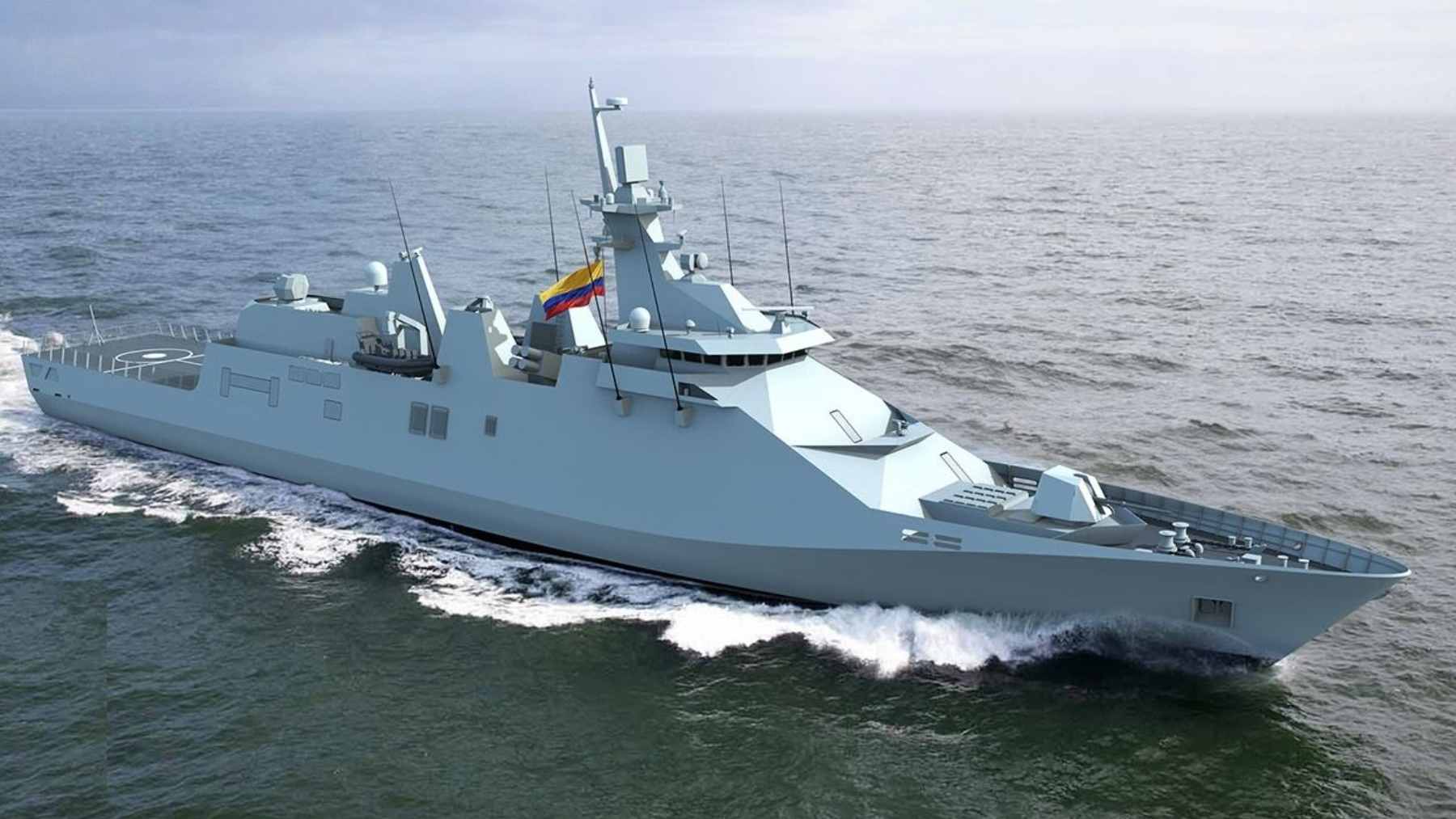
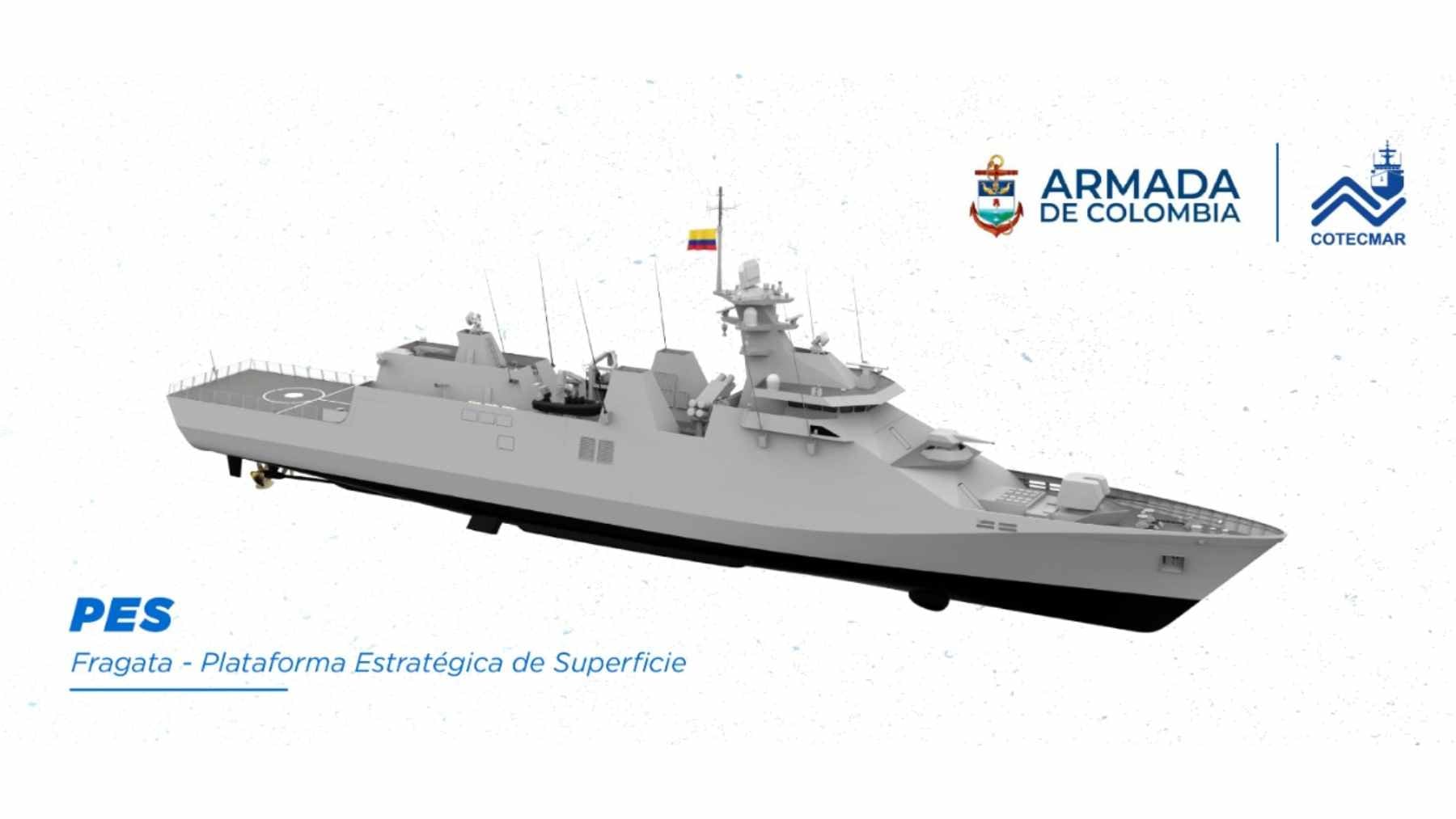
Colombia has started building its first national frigate, a move that pushes the country into a new phase of naval defense, shipbuilding technology, and maritime security. The vessel, known as the Strategic Surface Platform (PES), is being built by COTECMAR for the Colombian Navy and is expected to become the largest security and defense ship the country will have.
This is not just another military purchase. It is a test of whether Colombia can build, maintain, and eventually upgrade a complex warship at home, instead of depending almost entirely on foreign yards. And for a country with coastlines on both the Caribbean and Pacific, that matters far beyond the shipyard gate.
A ship built at home
The PES officially began construction at COTECMAR’s Mamonal facility in Cartagena, where the first steel cutting marked the start of the country’s most ambitious naval engineering project so far. COTECMAR said the frigate will be the first of its kind built in Colombia and will strengthen the national shipbuilding industry.
“From COTECMAR, we will keep moving forward, building the future and showing that Colombian naval engineering is world-class,” Vice Adm. Luis Fernando Márquez Velosa, then president of COTECMAR, said during the ceremony. It is the kind of statement that sounds ceremonial, but in this case, the steel is already being cut.
The ship will be built using a modular strategy, with its hull formed from 52 naval steel blocks. In practical terms, that means the frigate can be assembled in major sections, a method that helps organize complex work and gives engineers more control over quality during construction.
Why the size matters
The Colombian frigate will measure about 353 feet long, 46 feet wide, and have a draft of about 12.8 feet. That makes it a major step up for COTECMAR and for the country’s defense industry.
Size alone does not make a ship powerful. But it does create room for sensors, weapons, communications systems, helicopters, and future upgrades, all of which matter when a navy is trying to operate across wide maritime areas.
COTECMAR says the project will make Colombia the third Latin American country, after Mexico and Brazil, with the ability to build this type of complex naval platform. That is a big claim, but it also shows what is really at stake here. Prestige is part of it, sure. Capability is the bigger story.
Damen’s proven base
The Colombian frigate is based on Damen’s SIGMA 10514 model, a modular naval design already associated with ships built for other navies. Damen said its agreement with COTECMAR covers technical support and the supply of components for the PES construction effort.
That matters because Colombia is not starting from a blank page. It is combining foreign engineering support with local construction, a middle path that can reduce risk while still building domestic know-how.
Damen has described the project as an investment in local employment and technological development for Colombia’s maritime industry. At the end of the day, what it is trying to do is turn a defense acquisition into an industrial learning curve.
More than a warship
The PES is designed as a multi-mission platform, which means it is not limited to one specific battlefield role. It is expected to support anti-surface, anti-submarine, and air defense operations, while also helping with maritime surveillance and security tasks.
That is where the environmental angle quietly appears. The official statements do not describe the frigate as a “green” ship, and it would be misleading to frame it that way. But stronger maritime control can help a navy watch over sea lanes, ports, fisheries, and sensitive waters when illegal activity spills across borders.
Think of it like a patrol car on a very large, very wet highway. Most days, the work may be routine. But when something goes wrong, distance and response time suddenly matter a lot.
Technology on board
The project also has a strong technology component. Saab said it signed a contract with Damen Naval to act as combat systems integrator for the PES program, supplying systems that include the 9LV combat management system, CEROS 200 and EOS 500 fire-control directors, Sea Giraffe 4A air surveillance radar, and electronic warfare sensors.
That may sound like a liturgy of acronyms. In simpler terms, these systems help the ship detect threats, share information, track targets, and coordinate its response. A modern frigate is not just steel and engines anymore. It is a floating network.
For Colombia, this is also about interoperability. The more modern and standardized the systems are, the easier it becomes to train with partners, take part in combined exercises, and keep the ship relevant over a long service life.
Jobs and autonomy
COTECMAR says construction of the PES will generate about 1,500 direct jobs and another 4,000 indirect and induced jobs during the build period. The ship is expected to be formally delivered to the Navy in 2030.
Those jobs are not just about welding and assembly. A project like this pulls in engineers, logistics teams, systems specialists, suppliers, planners, and maintenance crews. It creates a small ecosystem around one very large ship.
That’s why local construction matters. Once a country knows how a platform is built, it is usually better positioned to repair it, modernize it, and train people around it. Not perfectly. Not overnight. But to a large extent, that is how defense industries grow.
A long road to 2030
There is still a long way to go before the frigate is ready for service. Cutting steel is an early benchmark, not the finish line. The harder phases include assembling the blocks, integrating systems, testing equipment, training crews, and testing the ship at sea.
Still, Colombia has passed a threshold that few countries manage. It has moved from planning a next-generation frigate to actually building one on national soil.
For the Colombian Navy, the PES is meant to modernize the fleet. For COTECMAR, it is a chance to prove that local shipbuilding can handle a platform of high technological complexity. And for the region, it is a signal that Latin America’s naval industry is no longer only about buying finished ships from abroad.
The official statement was published on COTECMAR.