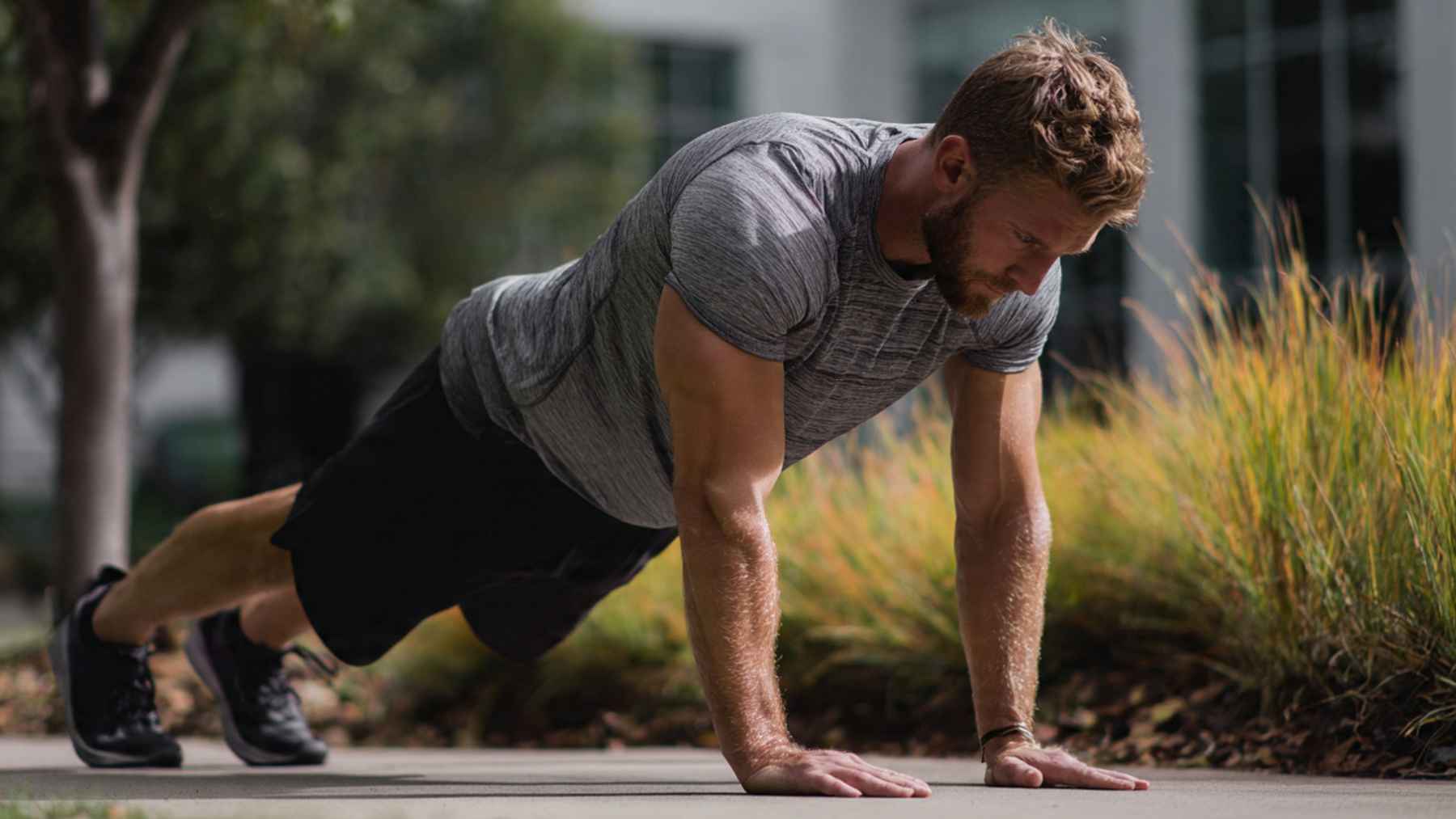
Have you ever finished a set of push-ups and wondered whether you trained properly or just moved fast? For building strength, the best rhythm is usually a controlled lower of two or three seconds, followed by a firm push back up in about one second.
That tiny timing change matters because a push-up is not just a chest exercise. It trains the chest, triceps, shoulders, core, and the ability to control your own body weight.
The best pace for strength
Harvard Health Publishing says standard push-up form can use a two-second descent and one-second return, and a slower four-second descent can be used for a harder tempo push-up.
The same guidance, reviewed by Dr. Edward Phillips, an assistant professor at Harvard Medical School, says speed, body angle, and hand placement can all change intensity.
It also notes that a standard push-up loads roughly 50 percent to 75 percent of body weight, while easier versions use roughly 36 percent to 45 percent.
In plain language, count “one, two” as you lower, then drive up on “up.” Need a little more challenge? Let the lowering phase last three seconds, as long as your back stays straight and your elbows stay under control.
What tempo really means
Tempo is the pace of a repetition. The lowering part is often called eccentric, which means the muscles are working while lengthening. The push back up is concentric, meaning the muscles shorten as they move you away from the floor.
That sounds technical, but it is simple. The slow part is the brake. The fast, clean part is the drive.
Why the slower descent matters
Time under tension is the amount of time your muscles stay loaded during a movement. A slower descent makes the chest, shoulders, and triceps keep working instead of letting gravity take over.
A 2014 study by Won-gyu Yoo of Inje University measured shoulder-blade muscle activity during push-up exercises done at different speeds.
The study concluded that proper selection of push-up speed may be necessary for selective strengthening of the serratus anterior, a muscle that helps keep the shoulder blade stable.
For most people, that does not mean crawling through every rep. The sweet spot is control without losing rhythm, because once your hips sag or your shoulders pinch, the rep is no longer doing the same job.
Hand placement is a small dial
Hand placement also changes the work. A 2016 paper by You-Sin Kim, Do-Yeon Kim, and Min-Seong Ha found that narrow hand placement raised activity in several muscles, including the triceps, while chest activity was greater in narrow and neutral positions than in a wider setup.
That is why simple rules can mislead. Close hands are not automatically better, and wide hands are not automatically safer. Your hands should train the target muscle without turning the wrists or shoulders into the weak link.
Form comes before big totals
The internet loves huge push-up challenges, including goals like hundreds of accumulated reps. Can 600 reps in one session be useful? Maybe, for a prepared athlete, but for most people it is a finish line, not a starting point.
A better plan is to stop one or two reps before form breaks. Keep the same lowering phase of two or three seconds and one-second press, then add reps slowly.
Pain is not a badge. Wrist strain, sharp shoulder pain, or a collapsing lower back means the setup needs to change.
Easier versions still count
Incline push-ups and knee push-ups are not cheating. They are like stabilizers on a pushbike and they have a job.
In practical terms, a kitchen counter, sturdy bench, or wall can become the first step. You still keep the line from head to hips, lower under control, and push the floor or surface away with intent.
Once those reps feel stable, lower the incline. The movement gets harder without changing the basic rules.
A simple test with limits
Push-ups also show up in health research because they are cheap and quick. A 2019 JAMA Network Open study of 1,104 active adult men found that higher push-up capacity was linked with lower cardiovascular disease events over ten years, though the authors said broader research was needed.
That does not mean push-ups are a medical test for everyone. It means they can be a useful snapshot. The main point here is simpler, so do fewer rushed reps and more honest ones.
How to use it today
For strength training, try three sets of as many clean reps as you can do without breaking tempo. Rest enough to make the next set look like the first. If your final reps turn into a floor flop, the set has already ended.
The best rep lasts about three or four seconds from top to top. Slow down on the way down, press up with purpose, and keep the body tight. Small change, real difference.
The official guidance and related research referenced here have been published by Harvard Health Publishing.