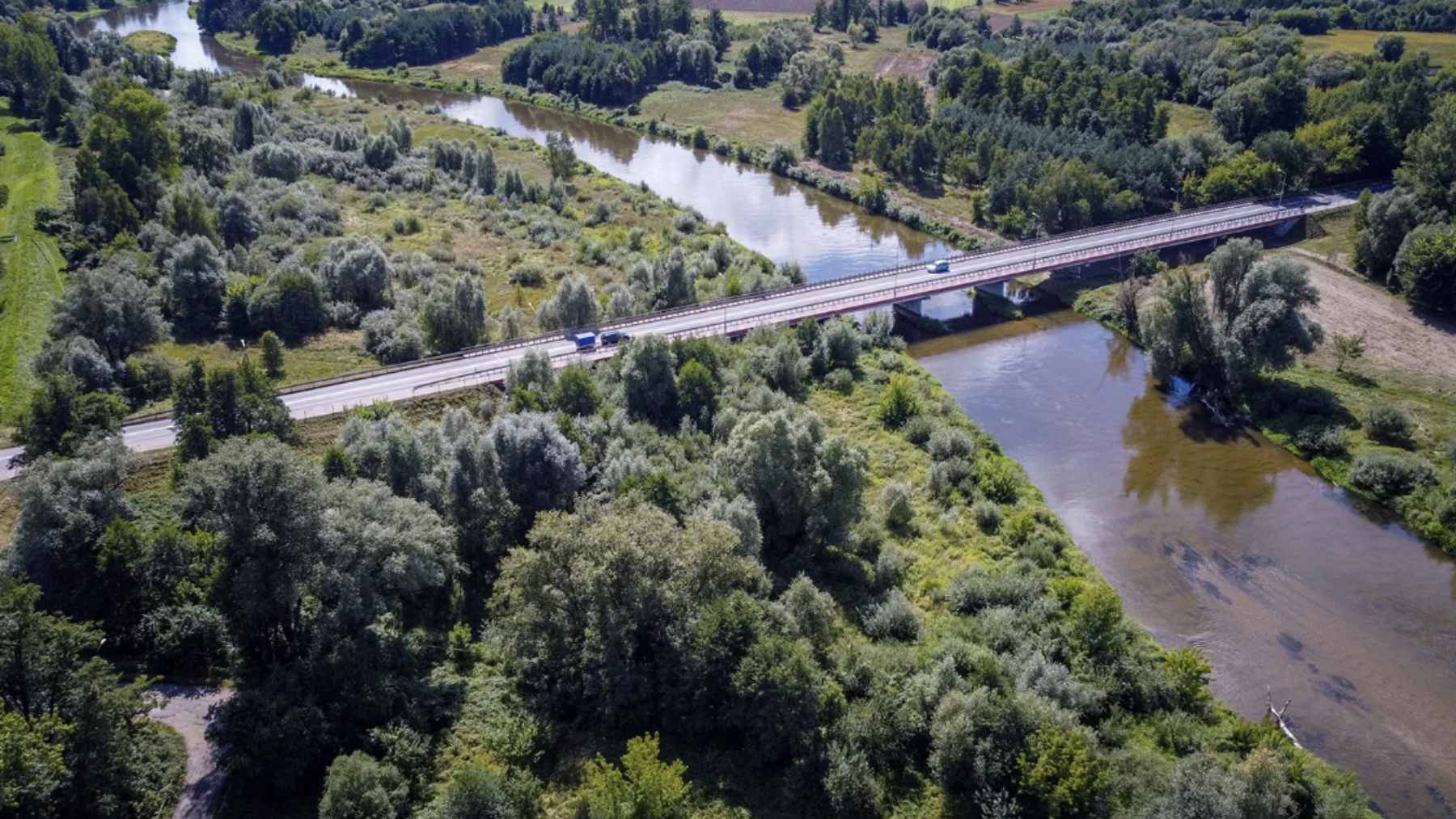
A small ferry crossing on Poland’s Warta River is set to be replaced by a major bridge designed for much heavier traffic, including loads linked to NATO standards. Konin County says it will receive about 174.5 million Polish zlotys, roughly $46.1 million, from the “Bridges for the Regions” program to build the crossing in Biechowy, between the municipalities of Kramsk and Krzymów.
On paper, this is a local road project. In reality, it is also a story about daily travel, defense readiness, regional business, and the environment meeting in the same place. The planned bridge will be more than 1,740 ft. long and 23 ft. wide, replacing a ferry that has long shaped movement across the river.
A ferry gives way
For residents near Biechowy, the Warta River is not just a scenic line on the map. It is a real barrier, one that currently requires a ferry crossing between Kramsk and Krzymów or a longer drive through nearby road networks.
That may soon change. The new bridge is expected to stand where the ferry now operates, creating a permanent road connection across the river and bringing a long-discussed project closer to reality.
Why does that matter? Because small crossings can decide how fast people reach work, schools, farms, clinics, and local businesses. A ferry can feel charming on a quiet day, but it is not the same as a reliable bridge when weather, schedules, or heavy vehicles enter the picture.
Built for heavy loads
The most striking detail is not just the size of the bridge, it is the standard it is being built to meet.
Project descriptions say the structure is intended to satisfy the highest load requirements under NATO standards. That does not turn a rural road into a military base, but it does mean the crossing is being planned with heavy transport and national resilience in mind.
Across Europe, bridges are increasingly viewed as part of security planning, not just public works. That means a crossing must be strong enough for emergency logistics, defense movement, and commercial freight without becoming a weak link.
The price tag
The estimated cost of the Biechowy bridge is more than 218 million Polish zlotys, or about $57.6 million at current exchange rates. Public funding is expected to cover 80% of that amount, while the remaining share will come from local and regional governments.
Konin County’s support package is one of two bridge projects that have already secured funding in the current round, according to local officials. Two other applications were accepted but still needed further arrangements between the Infrastructure Ministry and the Finance Ministry.
That public money is not landing in a vacuum. Poland is also preparing new calls for local road projects, with a wider road fund budget expected to rise to about 3 billion Polish zlotys, or roughly $792.6 million.
The environmental question
A bridge over a river always raises an environmental question. What happens to the waterway, the banks, the traffic pattern, and the quiet routines of nearby communities?
The available project information does not provide a specific emissions estimate for replacing the ferry. That matters, because not every infrastructure project should be sold as green just because it removes an old transport method.
Still, the environmental angle is real. If the bridge reduces detours, cuts waiting, and allows smoother local travel, it could change fuel use in everyday life. The final impact will depend on construction safeguards, traffic growth, and how carefully the river corridor is managed, however.

What drivers will notice
For drivers, the most immediate change will be predictability. Instead of timing a ferry or making a longer trip, they would have a fixed road crossing over the Warta.
The project is also expected to include access roads, one lane in each direction, a sidewalk, and a bicycle route. That last piece matters more than it might seem, because a bridge that only serves cars can divide communities even while connecting roads.
Local plans also point to a bigger road role later on. After construction, the crossing could become part of a regional road and eventually connect with National Road 92, improving access across eastern Wielkopolska.
Business and defense
For local businesses, a permanent bridge can mean shorter routes for deliveries and easier access to customers on both sides of the river. That is especially important in rural and semi-rural areas, where a few extra miles can affect costs more than people in large cities might realize.
For defense planners, the bridge’s load capacity is the headline. Heavy vehicles need reliable crossings, and weak bridges can slow logistics at exactly the wrong moment.
That is why this project sits in an unusual space. It is not only a convenience upgrade, it is a piece of civil infrastructure designed to serve ordinary residents while also fitting into a wider security network.
What happens next
Preliminary schedules suggest construction could begin in 2027 and finish in 2029. That leaves room for final paperwork, legal steps, contracting, and the practical work of building over a major river.
At the end of the day, the Biechowy bridge is a reminder that infrastructure is never just concrete and steel. It changes commutes, business routes, emergency planning, and the relationship between people and the landscape around them.
For now, the ferry still marks the crossing. If the project moves ahead as planned, it will be replaced by a permanent bridge built for a much heavier future.
The official statement was published on the Konin County website.