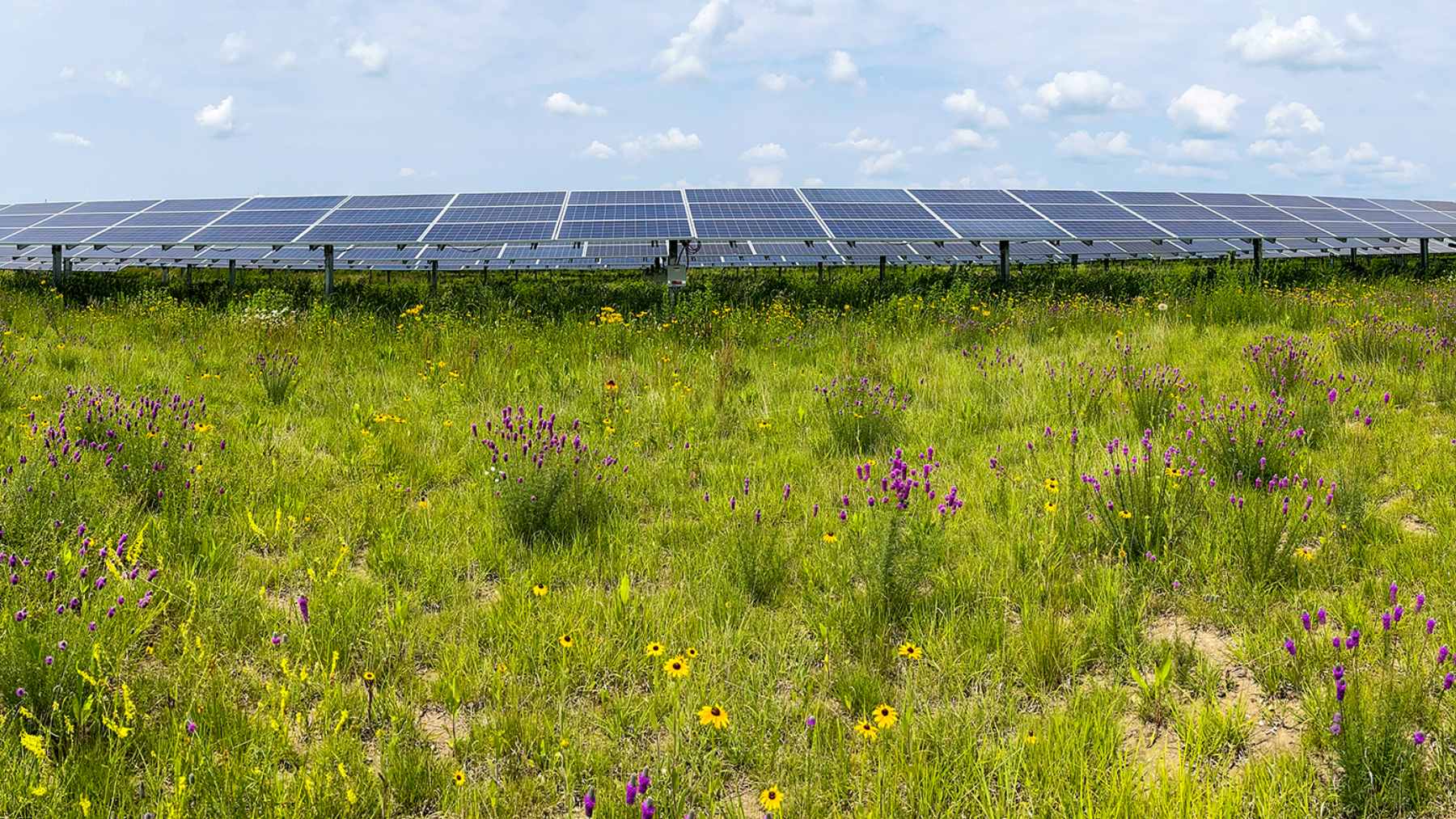
A pair of Minnesota solar farms has delivered a surprisingly simple lesson for the clean energy business. When the ground beneath solar panels is planted with native prairie grasses and wildflowers instead of being left as short turf or gravel, bees can come back fast.
In a five-year study led by Argonne National Laboratory and the National Renewable Energy Laboratory, native bee abundance at two southern Minnesota solar sites rose by more than 20 times, while total insect abundance roughly tripled.
The bees did not stay politely inside the fence, either. Researchers found higher bee visits to soybean flowers in nearby fields, a small but important sign that solar land can also act like working habitat.
Bees moved in fast
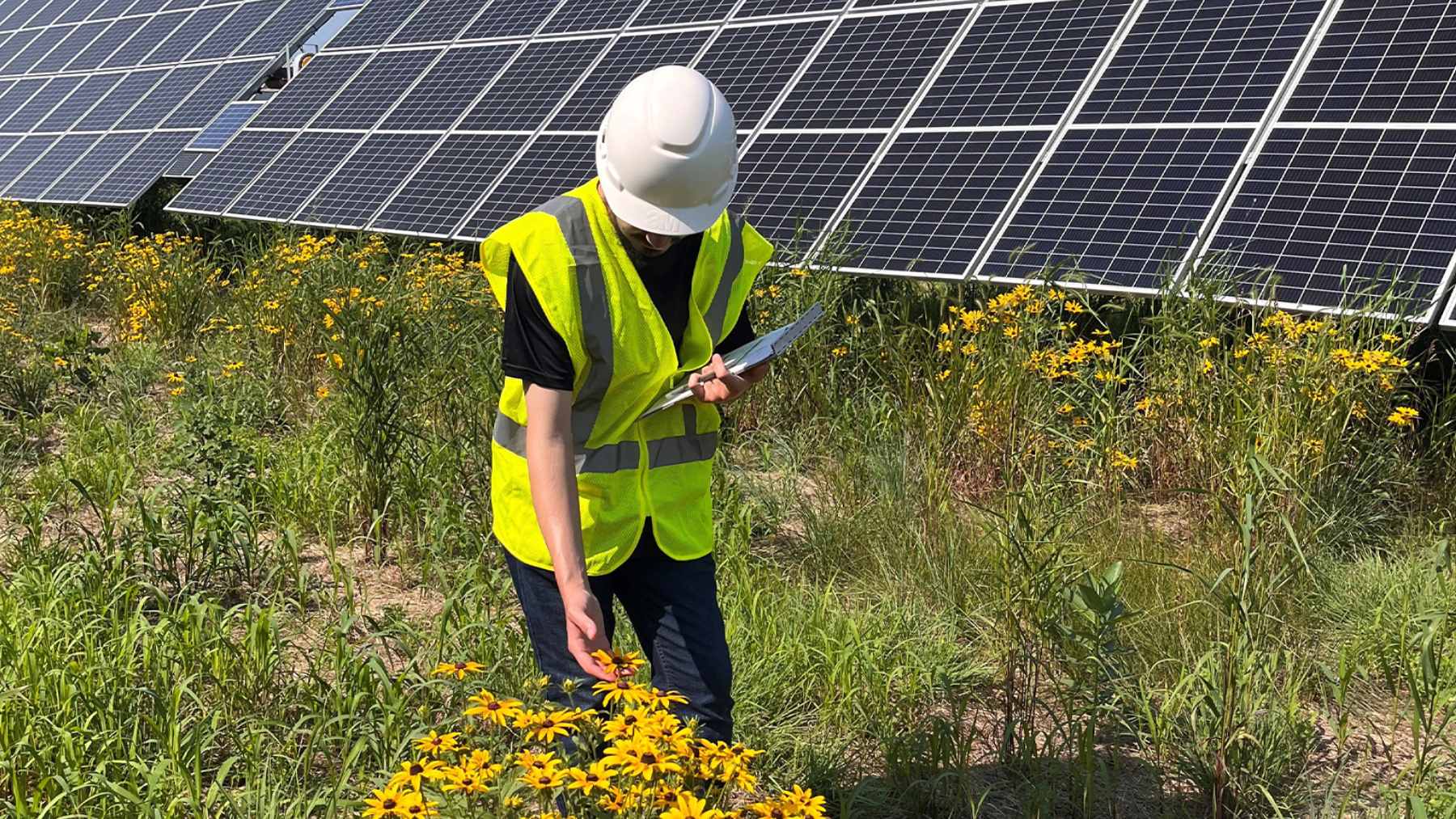
The study followed two utility-scale solar sites in agricultural landscapes from 2018 to 2022. Researchers counted insects, flowering plants, and bee visits across 358 transect observations, which is to say they kept walking the same test lines and recording what showed up.
The big shift came after native vegetation had time to establish. By the end of the study, the researchers reported a seven-fold increase in flowering plant species richness, a tripling of pollinators and beneficial insects, and the standout number, a more than 20-fold rise in native bees. That is not a small rebound.
There is a catch worth spelling out. The team measured bee visits to soybeans, not soybean yield gains, so this is not proof that the neighboring farmer harvested more. Still, the direction matters because the solar habitat appeared to push pollination activity beyond the project boundary.
Why this matters
The land question around solar power is getting louder. The U.S. Department of Energy says ground-mounted solar could need about 5.7 million acres by 2035 and as much as 10 million acres by 2050, which would equal about 0.5% of the contiguous United States.
That is why the ground under the panels is no longer a minor detail. In practical terms, millions of acres could either become fenced-off, low-value strips of land, or they could become something closer to a prairie patch with wires and steel above it.
Pollinators are not a side issue for food, either. The USDA says about 35% of the world’s food crops and three-fourths of flowering plants depend on animal pollinators to reproduce. That’s one of those statistics that lands differently when you are standing in the produce aisle.
Iowa added honey
A few hours south, Iowa State University and Alliant Energy have been testing the same broader idea at a 10-acre agrivoltaics site near Ames. The solar farm has 3,300 panels, a capacity of 1.375 megawatts, and can generate enough electricity for about 200 homes.
The university’s project is backed by a $1.8 million Department of Energy grant and is designed to study crops, energy output, and beekeeping together. Researchers have grown crops such as peppers, strawberries, summer squash, and other produce around the array while testing how different panel heights and layouts affect farming.
The honey number is hard to ignore. According to the American Society of Civil Engineers, adding native perennial flowering vegetation near colonies at the Iowa State agrivoltaics site led to a more than 400% increase in honey production, without interfering with farming or power generation.
Managed honeybees are not the same as native bees, but the lesson overlaps. Flowers change the economics of the ground.
The global pattern
The trend is not only showing up in the Midwest. A 2026 report jointly published by IRENA, CREEI, and IUCN said pollinator abundance in German agrivoltaic projects increased by 33% to 88% compared with areas without panels. That figure comes from modeling, not a person counting every bee in a field, so it should be read with some caution.
Still, it points in the same direction as the Minnesota field study. Solar panels can change shade, moisture, wind, and vegetation in ways that help some plants and insects, as long as the project is designed with that outcome in mind.
At the end of the day, this is not magic. Bees need food, nesting space, and fewer chemical shocks. A solar site planted with native flowers can offer all three, while a gravel pad offers almost none.
Not every solar farm helps
None of this happens automatically. Put panels over bare ground, mow everything flat, spray too aggressively, and critics are right to say the site does little for wildlife. A solar farm is not a habitat just because someone calls it green.
The Minnesota results came from deliberate restoration with grasses and forbs planted among and between solar arrays. The Iowa honey result came after researchers added native flowers close to the hives. A small difference on a site plan, a big difference for bees.
That’s the practical takeaway for developers and communities reviewing solar proposals. Ask what will grow under the panels, who will maintain it, and whether the seed mix fits the local ecosystem. The answer may matter almost as much as the megawatts.
Power above, prairie below
For utilities, this could become a useful selling point in rural areas where solar projects often face pushback over farmland. A project that produces electricity, supports pollinators, and may help nearby crops is easier to defend than one that looks like a fenced industrial lot.
For farmers, the message is more cautious but still promising. Solar habitat will not solve every pollination problem, and it will not replace careful land management across the wider farm landscape. It can, however, turn otherwise quiet acreage into a small ecological engine.
Power above, prairie below. That may be the next version of the solar farm, if developers decide the land under the panels is worth more alive than empty.
The study was published on Environmental Research Letters.