A town you can practically see across the river might still take an hour to reach by car, plus whatever you spend at the pump. Living near a border can be funny that way.
Officials in Portugal and Spain say a new international bridge over the River Sever will finally change that by linking Cedillo (Spain) with Montalvão in the municipality of Nisa (Portugal). The route could shrink by about 85 kilometers (around 53 miles), but is a shorter drive always a greener one? The latest permitting paperwork suggests the answer is complicated.
A bridge that cuts the detour
Spain’s official state bulletin has published the bilateral agreement that backs the project, framing it as a cross-border link for vehicles and people. The text also states the bridge is intended for pedestrians and bicycles, which turns this into more than just another road project.
The price tag is sizable for a rural crossing. Reporting in 20minutos cites about €5.17 million for works on the Spanish side and €19.25 million for the Portuguese side, or roughly €24.4 million ($28.6 million) in total.
Climate math in everyday terms
Cutting a long drive down to a shorter one is not glamorous, but it is one of the simplest ways to trim transport emissions. The European Court of Auditors has warned that transport accounted for almost 23% of EU greenhouse gas emissions in 2021, with passenger cars responsible for more than half of that figure.
Here is the rough math: using the European Environment Agency’s reported 2023 average for newly registered passenger cars (106.4 grams of CO2 per kilometer), skipping an 85-kilometer detour works out to about 9 kilograms (20 lbs.) of CO2 avoided per one-way trip, though real-world numbers vary by vehicle and driving conditions.
River engineering and the oak question
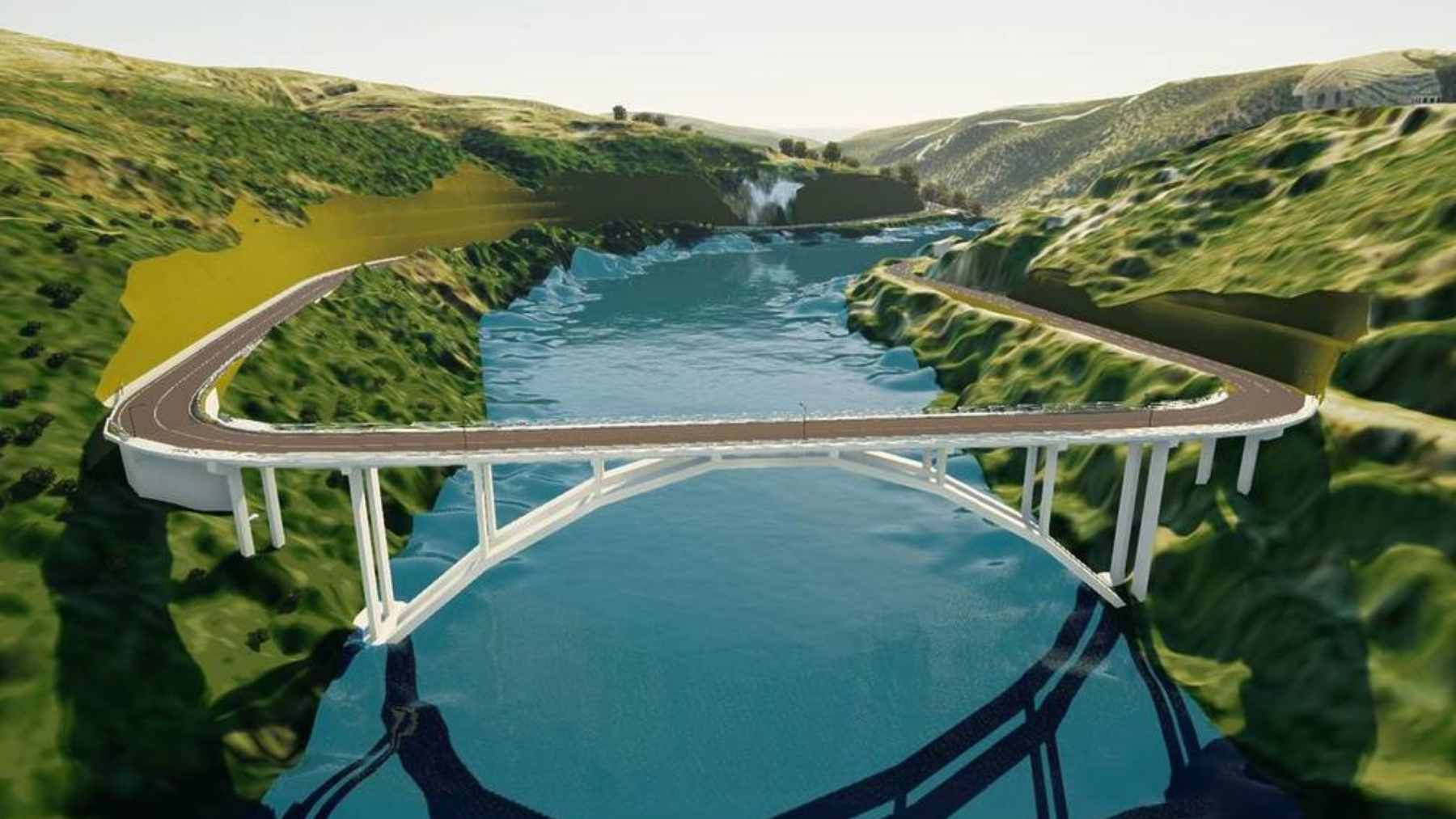
On paper, the design tries to be gentle on the water. Nisa’s municipal press note describes a roughly 160-meter (about 525-foot) bridge with twin concrete arches so builders can avoid placing pillars in the riverbed, plus sidewalks meant to carry a recognizable “Portuguese” touch.
The tougher environmental detail is on land. A Portuguese government order says the project requested authorization to cut 127 cork oaks and 525 holm oaks across 2.62 hectares (around 6.5 acres) to execute the bridge and its access works.
That order also spells out the mitigation framework. It points to a formal environmental impact assessment with a conditional favorable decision and a compensation plan that would replant cork oak and holm oak across 3.275 hectares under a 20-year arrangement, with monitoring and other conditions tied to the national forest authority.
Business wins and why they matter
The bridge is being sold as a practical fix for people who cross the border for work, services, or family. When a single errand stops requiring a long loop, local businesses can move goods faster and residents can save time on everyday trips, not just on holiday travel.
Portugal’s side is leaning on recovery funding (Portugal’s Recovery and Resilience Plan, often shortened to “PRR” locally). Nisa’s press note also references upgrades to Municipal Road 1139 and a new 700-meter connector corridor to reach the bridge, which is where construction impacts can spread unless conditions are tightly enforced.
Defense, emergencies, and dual-use infrastructure
Bridges have also become part of a bigger security conversation. The European Commission’s military mobility work explicitly highlights resilience and cyber protection for strategic dual-use infrastructure including bridges and tunnels, because crises do not wait for detours to clear.
Funding is following that logic across Europe. A Commission Q&A says the EU set aside roughly €1.7 billion under the Connecting Europe Facility for military mobility in 2021 through 2027, supporting 95 dual-use transport infrastructure projects across 21 member states.
The tech that keeps it green after opening day
Even a “shorter route” project has an upfront carbon footprint, especially when it relies on concrete. Researchers have noted that cement production accounts for roughly 7% to 8% of global CO2 emissions, which is why low-carbon cement mixes and smarter material choices are becoming part of the infrastructure debate.
Then there is maintenance. U.S. researchers at NIST have described how wireless sensors can continuously monitor bridge health, catching problems early so repairs can happen before a closure forces everyone back onto longer, dirtier detours.
The official statement was published on Diário da República.