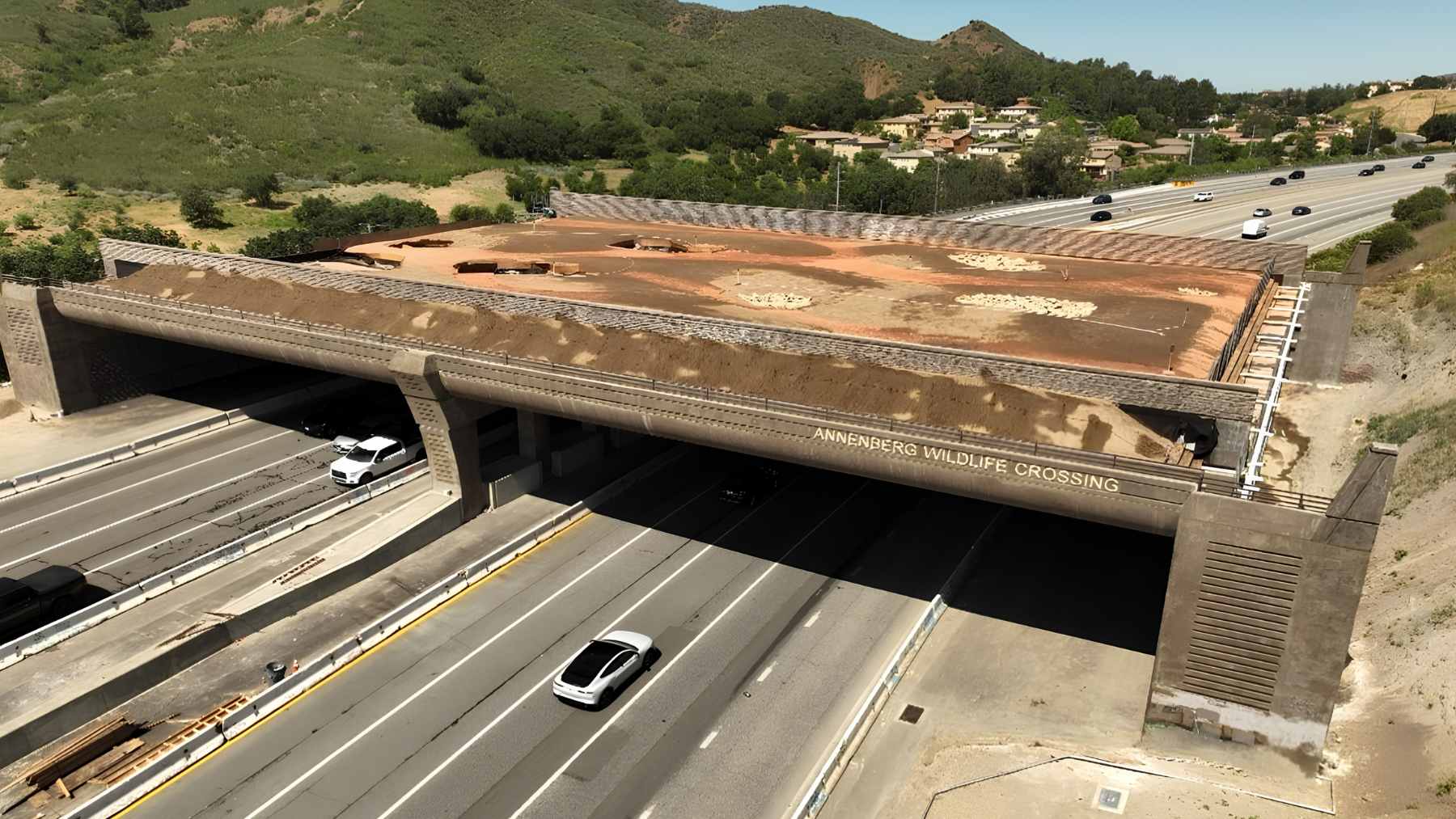
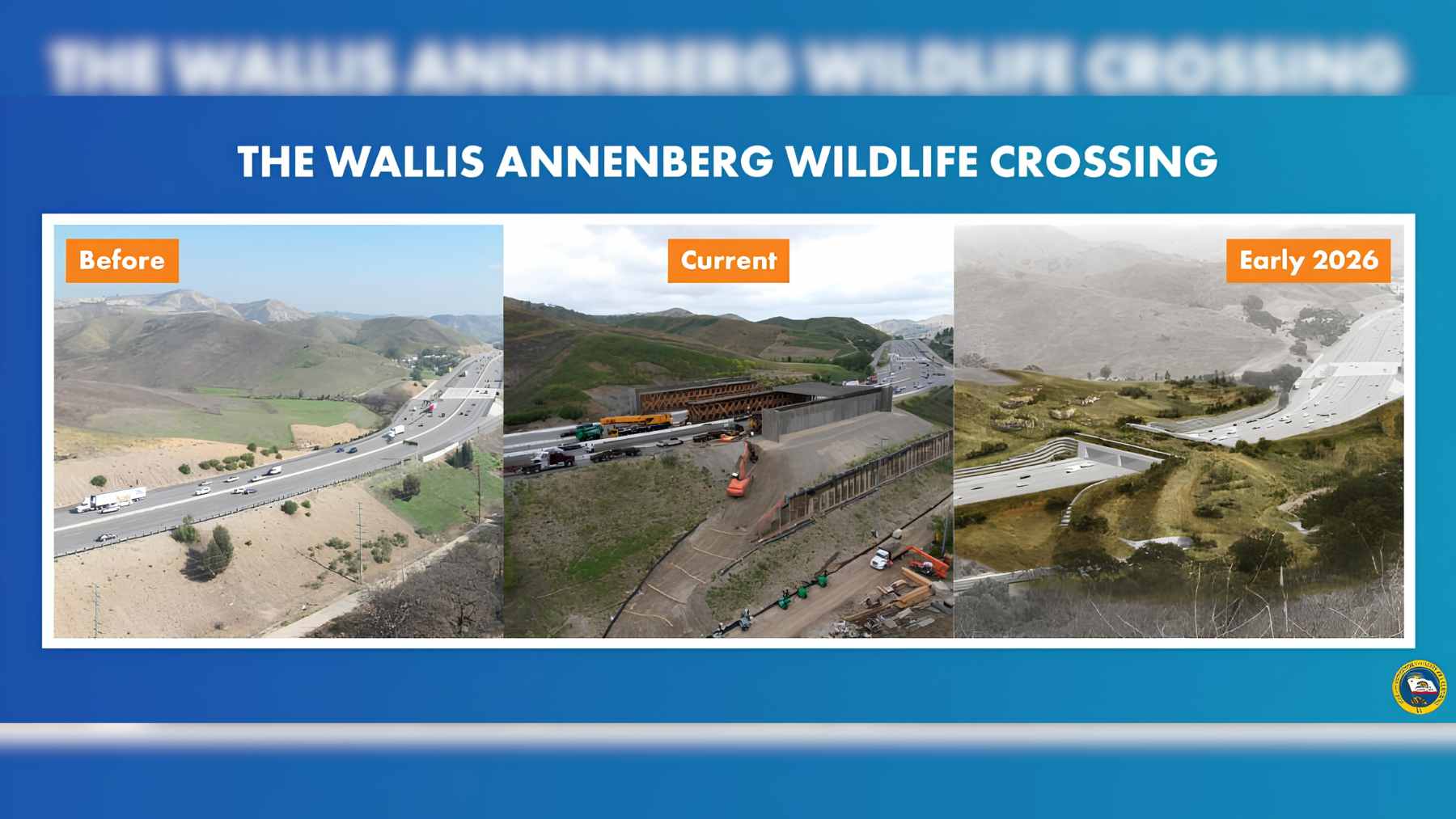
After years of delays and a loud online fight over costs, Southern California’s Wallis Annenberg Wildlife Crossing over U.S. 101 now has a ribbon-cutting date of Dec. 2, 2026.
Project partners bill it as the world’s largest wildlife crossing, built to reconnect habitat so mountain lions and other animals can move between the Santa Monica Mountains and nearby ranges without gambling with freeway traffic.
If you have ever crawled through stop-and-go traffic on the 101, the idea sounds almost unreal. Can a “living” bridge do more than look good in drone photos and actually change the fate of an ecosystem, while still passing the basic test of public trust?
An ecosystem over the 101
This is not a single slab of concrete with a few planters. Partners describe two connected structures that span the freeway and Agoura Road, totaling about 55,925 ft²., with the wider work area transforming roughly 13 acres.
The bridge also sits above a wall of sound and light, with the project team noting Liberty Canyon carries more than 300,000 vehicles a day.
That is why there will be no trails or public access on the crossing, and why the design leans on native plants, engineered soils, and noise and headlight mitigation instead of a traditional pedestrian overpass vibe. Even before it fully connects into surrounding open space, supporters say butterflies, birds, and small reptiles have already started showing up.
The business math behind $114 million
When the project broke ground on Earth Day 2022, it was expected to cost roughly $90 million and finish in 2025.
The latest estimate is about $114 million, with delays tied to unusually wet seasons, inflation, labor constraints, and the complexity of building habitat that wildlife will actually use. In May 2024, Gov. Gavin Newsom’s office said philanthropy had raised more than $34 million while California had provided $58.1 million.
Supporters also point to broader construction inflation, citing the Federal Highway Administration’s National Highway Construction Cost Index rising 67% since 2021. In everyday terms, when everything from groceries to the electric bill jumps, specialized concrete, steel, and skilled crews do not stay cheap, either.
Road safety is the quiet headline
Wildlife crossings are easy to frame as feel-good spending, especially if you look at crash data. The U.S. Department of Transportation has said there are more than one million wildlife vehicle collisions a year, and large animal crashes are linked to roughly 200 deaths and about 26,000 injuries annually, with economic costs above $10 billion.
These projects can pay back in ways drivers actually feel, from fewer wrecks to fewer insurance claims. Smart Growth America points to a Colorado corridor where a package of overpasses, underpasses, and fencing cut crashes by almost 90%, which is a reminder that a safer road is also an environmental policy.
Tech will judge the first paw prints
The big question is not whether the bridge looks like a hillside from above. It is whether animals treat it like one, and that means monitoring, lots of it, with reports that more than 50 cameras are expected on and around the crossing to track changes over time. As Beth Pratt joked, it could become “the most popular reality show that L.A. produces.”
That flood of footage is where conservation tech has quietly matured. Researchers increasingly use automated systems to detect and classify animals in images and video, and a 2024 paper on the open-source “Pytorch-Wildlife” framework describes how these tools can turn raw camera trap data into usable results at scale.
Defense planners are watching the same map
The military has its own reason to care about land connectivity, even if it rarely makes the front page. The Department of Defense’s REPI program says it has leveraged $1.7 billion since fiscal year 2003, with partners adding $1.5 billion more, to protect over 1.4 million acres around installations and ranges through conservation partnerships.
In the West, a REPI-backed partnership lists wildlife corridors alongside compatible energy development and border management as shared priorities.
The Department of the Interior has also highlighted joint Interior and defense investments that aim to preserve habitat and build climate resilience near military bases, which is a useful reminder that “nature-based solutions” are now part of readiness talk.
Dec. 2 is just when the measuring starts
To make the opening feel real, the project’s public campaign is even running a community vote on which animal will cross first. It is a small bit of fun, but it hints at the bigger truth that success will be counted in paw prints, not speeches.
For the ecosystem, the stakes are long-term, whether genetic exchange improves for isolated wildlife and whether safer movement reduces risky crossings elsewhere. For drivers below, it may still look like another commute, the same exhaust, the same brutal summer heat, and that is fine, because the best safety upgrades are the ones you do not notice.
The official statement was published on Caltrans.