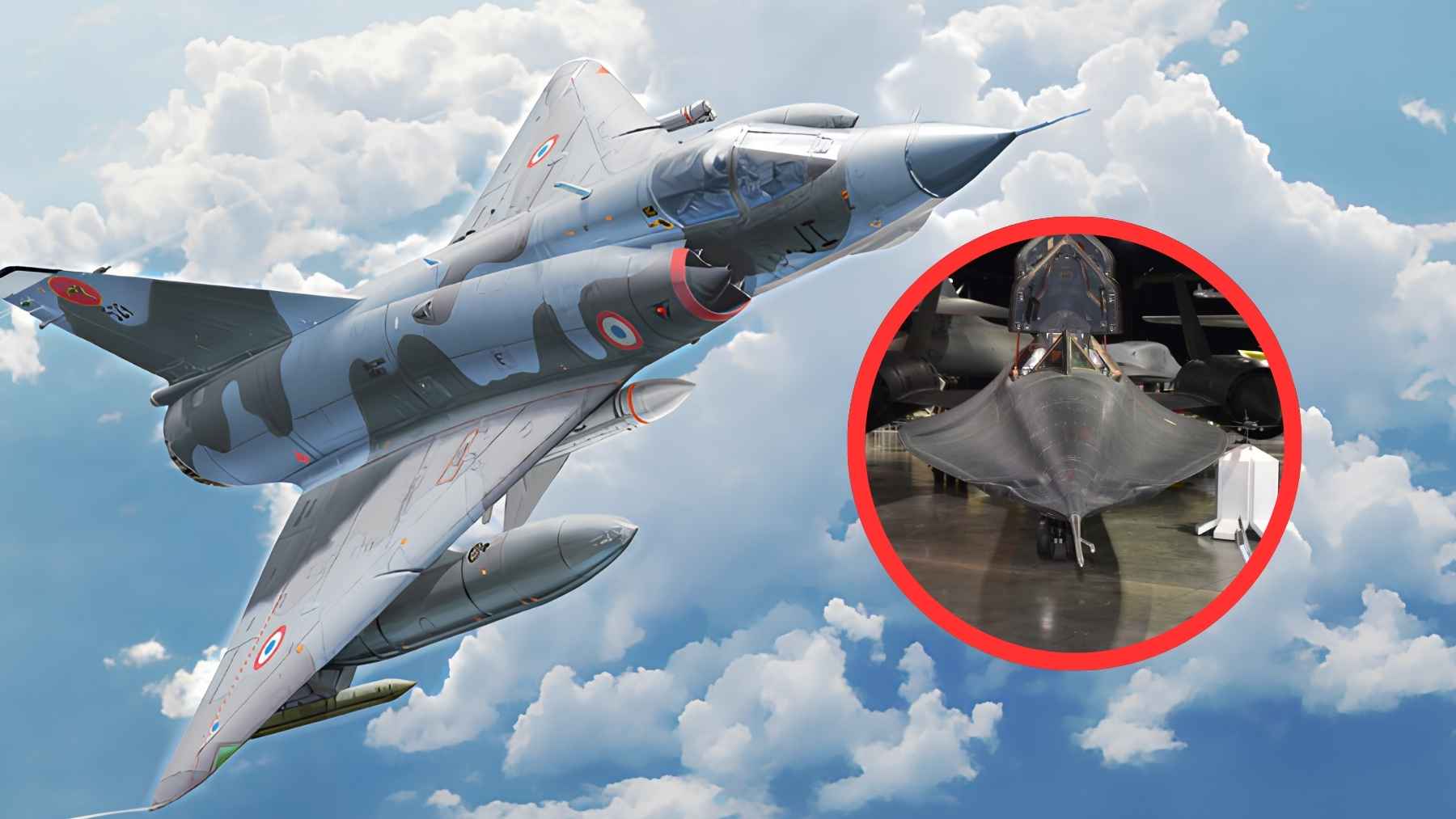
A French fighter slid alongside an American spy plane and asked for its diplomatic clearance number. According to former SR-71 pilot Lt. Col. William Burk Jr., the answer from the rear cockpit was not a number at all, but an obscene hand gesture.
Burk then lit the Blackbird’s afterburners and accelerated away from the Mirage III, ending a tense encounter after a reconnaissance run over Beirut. The moment sounds like something written for a movie, but the more revealing part is what happened before it, including missile tracking, an engine warning, multiple refuelings, and a route shaped by politics.
A mission born from the Beirut crisis
Burk’s account appears in Ben Rich’s memoir “Skunk Works.” He said the flight left RAF Mildenhall after the Marine barracks bombing in Beirut, with President Ronald Reagan seeking photographic coverage of suspected militant bases across the region.
France had reportedly refused permission for the SR-71 to cross its airspace on the planned outbound route. Burk said the crew therefore headed south past Portugal and Spain, crossed the Strait of Gibraltar, refueled over the western Mediterranean, continued toward Lebanon, and planned another tanker meeting near Malta before returning to England.
That route mattered. The Blackbird could fly faster than Mach 3, but its missions still depended on tankers, ground crews, intelligence specialists, overseas bases, and carefully negotiated access to national airspace.
Tracked by a Syrian SA-5
The most dangerous part of the mission came near Lebanon. Burk recalled that Syria had a Soviet-built SA-5 surface-to-air missile system west of Damascus, so the crew planned to remain above 80,000 feet and faster than Mach 3.
As the SR-71 entered Lebanese airspace, the reconnaissance systems officer reported that the defensive display showed the aircraft was being tracked. About 15 seconds later, the crew received indications of active guidance signals from the missile site, although Burk said they could not tell whether a weapon had actually been launched.
There was no time for a debate in the cockpit. Burk said they climbed, pushed the throttles, and offered a couple of “Hail Kellys,” a reference to legendary Skunk Works designer Kelly Johnson.
An engine warning changed the route home
After the pass over Beirut, a low oil pressure warning appeared for the right engine. The engine still seemed to be operating normally, but Burk reduced speed and altitude rather than treating the light as a harmless nuisance.
That decision created a new problem. Instead of following the longer approved route around France, the crew chose a direct path toward England and crossed French airspace without clearance, according to Burk’s recollection.
The crew had traded one risk for another. They moved away from the missile threat and shortened the trip home, but they also entered airspace where a French interceptor had every reason to investigate.
A Mirage appeared just 10 feet away
Burk said the SR-71 was almost across France when he looked left and saw a French Mirage III roughly 10 feet from his wing. The Mirage pilot contacted the Blackbird and asked for a diplomatic clearance number.
Burk told him to wait while he checked with the rear cockpit. His backseater replied, “Don’t worry about it. I just gave it to him,” before Burk realized that the response had been “the bird” delivered with a middle finger.
Then came the part that made the story famous. Burk selected afterburner and, in his words, “left that Mirage standing still,” with the SR-71 reaching the English Channel about two minutes later.
Why the Blackbird could pull away
The performance comparison was uneven once both aircraft were free to accelerate. The Mirage III was a highly capable Mach 2 interceptor, but the SR-71 was designed to sustain speeds above Mach 3 at altitudes beyond 80,000 feet.
Official U.S. Air Force figures list a maximum speed above 2,000 mph and a ceiling beyond 85,000 feet. In 1976, an SR-71 set records of 2,193.2 mph and 85,069 feet, numbers that help explain why hostile fighters and missiles struggled to catch it.
Its two Pratt & Whitney J58 engines were also unusual. The National Museum of the U.S. Air Force describes the J58 as the first engine designed to operate for extended periods with its afterburner and the first U.S. Air Force engine flight-qualified at Mach 3.
One detail in the memoir needs caution
The memoir prints the mission date as the fall of 1982 while also saying it followed the Marine barracks bombing. Official U.S. records date that bombing to Oct. 23, 1983, so those two details cannot both be correct.
The latest retelling places Burk’s flight in 1983, which fits the event he described. Still, the colorful encounter is presented as a first-person memoir rather than a reproduced mission log, and the provided material cites no French record confirming the exchange.
That distinction does not erase the story. It simply tells readers where the confirmed engineering and historical details end and where one crew’s memory begins.
More than a cockpit joke
The hand gesture is the part people remember, but the mission’s real lesson concerns the Blackbird’s entire operating system. Speed alone did not put cameras over Beirut, since the aircraft also needed tankers, overseas basing, route planning, diplomatic coordination, and crews trained to make rapid decisions under pressure.
Those repeated tanker hookups also reveal the hidden fuel and logistical footprint behind high-speed reconnaissance. The Blackbird’s performance was extraordinary, but it was never a one-aircraft story.
The latest retelling of Burk’s account was published on The Aviation Geek Club.