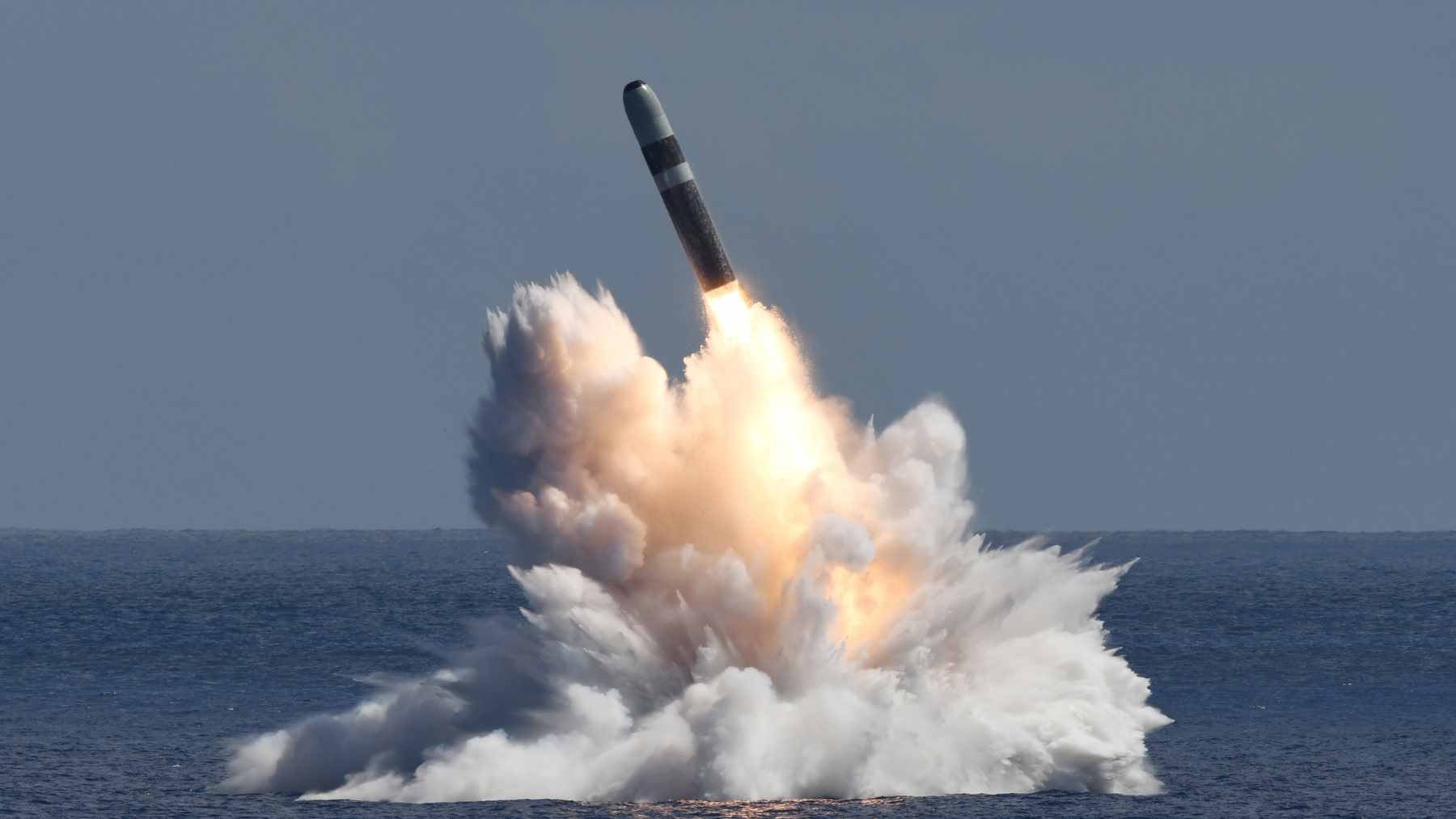
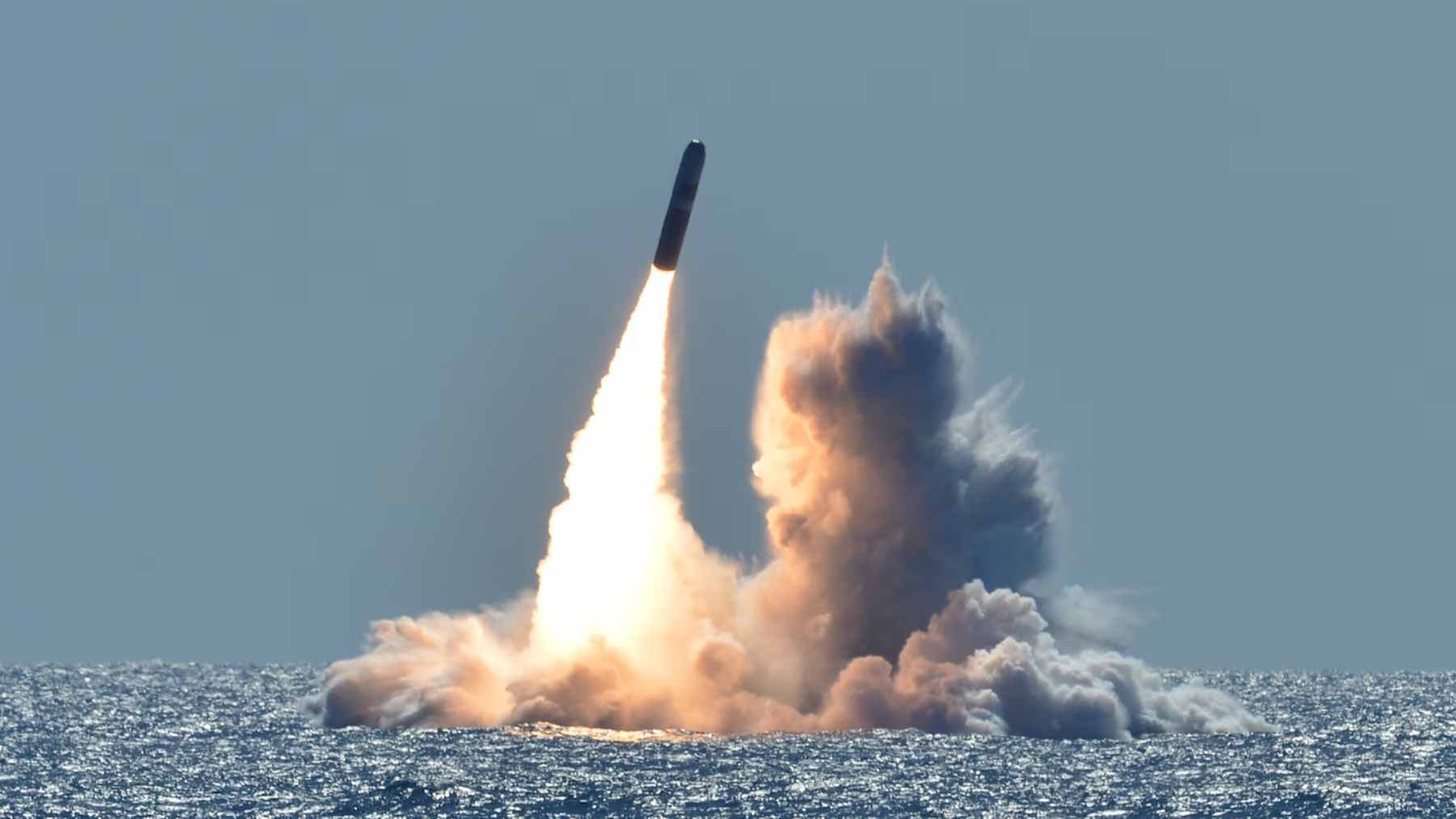
When a nuclear submarine launches a ballistic missile from below the waves, the obvious image is a rocket punching straight through seawater, but that is not really what happens. With the U.S. Navy’s Trident II D5, the crucial trick is that expanding gas pushes the missile out of its launch tube, and the boost phase begins only after it broaches the waterline.
That one detail explains why these weapons are often described as “dry” underwater launches. The missile is not being lit like a bottle rocket in the sea. It is being ejected first, protected and stabilized during the most delicate seconds of the event, then powered upward by its rocket stages.
The rocket waits
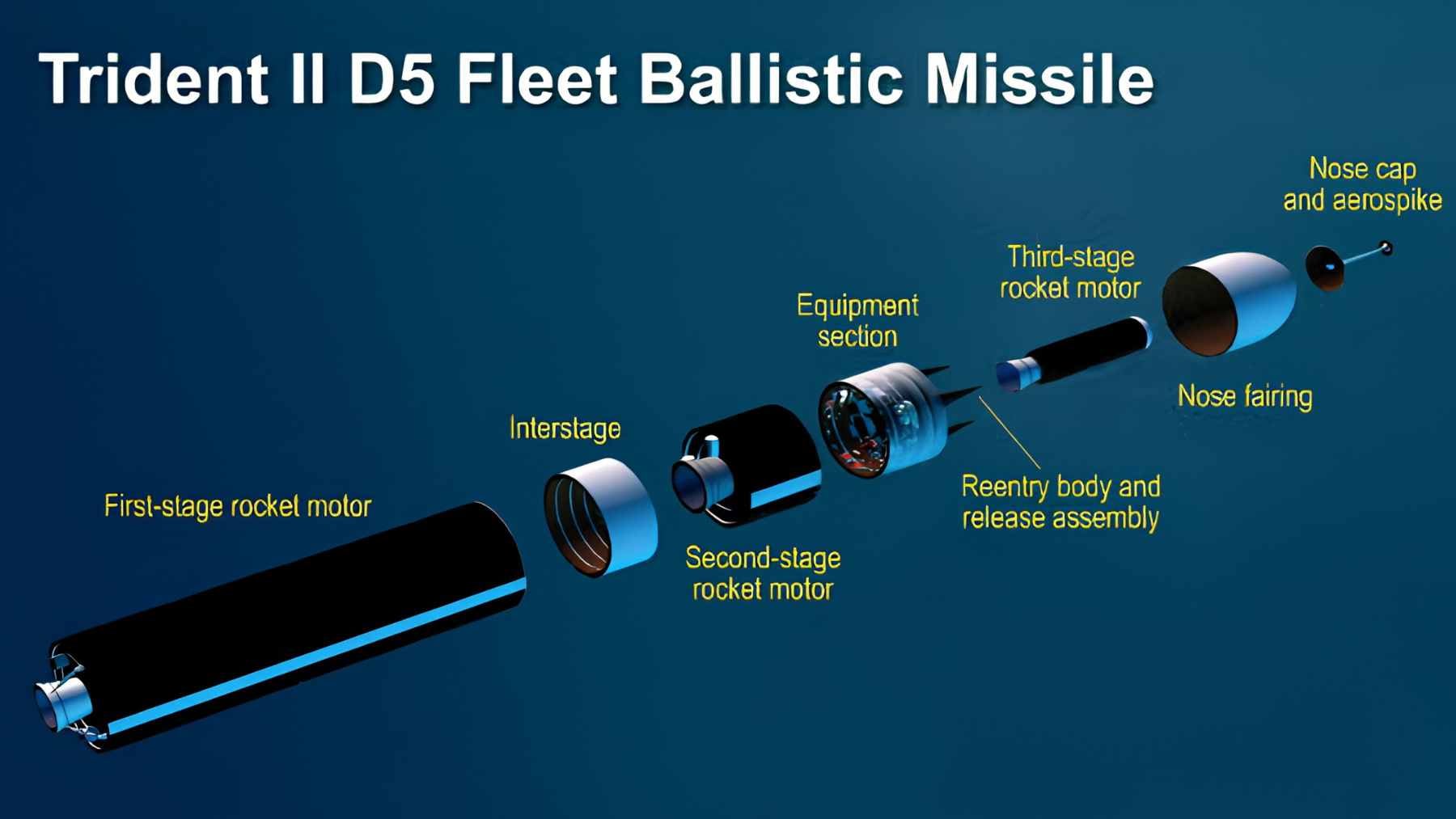
The Trident II D5 is a three-stage, solid-fuel, inertially guided submarine-launched ballistic missile. According to the Navy, it has a range of 4,000 nautical miles and can carry multiple reentry bodies.
So why not just ignite it underwater? Because seawater, pressure, and rocket exhaust are a terrible mix. The cleaner solution is to use expanding gas inside the launch tube to force the missile upward before the main rocket sequence begins.
That sounds simple, but it is not.
A controlled push
Public explanations often describe the missile as being wrapped in a gas pocket as it rises through the water. The key point is the same in the Navy’s official wording, which says the missile is launched by “the pressure of expanding gas” inside the tube.
In practical terms, this gives the submarine a way to launch without turning the surrounding ocean into a chaotic combustion chamber. The missile clears the submarine, breaks the surface, and only then begins the boost phase.
There is also a stability issue here. Any unwanted water inside the wrong part of the missile could add weight, damage systems, or alter the balance of a vehicle that must become controllable almost instantly.
Not a small machine
The scale makes the engineering even more striking. The Navy lists the Trident II D5 at 44 ft. long, 83” in diameter, and 130,000 lbs.
That is roughly the length of a city bus, but far heavier and far more complex. Imagine trying to launch something that size from a moving platform hidden under the ocean, while keeping the crew, submarine, and weapon system separated from unnecessary risk.
The Ohio-class submarines that carry the system are built around that mission. The Navy says each Ohio-class ballistic missile submarine now carries a maximum of 20 missiles, after four missile tubes were permanently deactivated under New START provisions.
The ocean matters
This is where the environmental angle enters the story. Submarine missile technology is often discussed in terms of deterrence and strategy, but the launch environment is the ocean itself. That means every test has to deal with air quality, biological resources, hazardous materials, waste, and public safety.
A 2025 Navy draft environmental assessment for Trident II D5 Life Extension and Life Extension 2 testing says sea-based tests would be unarmed, launched from more than 100 ft. below the sea surface, and conducted at least 50 nautical miles offshore of the U.S. mainland.
It also says test components would land in designated broad ocean areas at least 200 nautical miles from any landmass or island.
The same document says the proposed action would have “less than significant” impacts on the evaluated resource areas, including air quality, biological resources, hazardous materials and waste management, and public health and safety. Still, that does not mean zero footprint.
It means the Navy’s assessment found the expected impacts below the threshold it considered significant.
What happens after launch
During test flights, the Navy says the weapon system would fire from the submarine at depth, then ignite its first-stage motor after broaching the surface. The second and third motors would follow in sequence as the missile continues along a calculated ballistic path.
After burnout and separation, the spent motor casings and equipment section casing would land in the broad ocean area and sink. The assessment says all solid fuel propellant would be consumed before those casings hit the ocean surface, and the casings would not be recovered.
That is an important detail for readers who hear “dry launch” and imagine a perfectly clean process. The phrase mainly explains how the missile gets out of the sea before its rocket motors take over. It does not erase the environmental questions that come with testing large strategic systems over ocean ranges.
Why it still matters
The Trident II D5 entered service in 1990 and remains one of the central weapons in the sea-based leg of the U.S. nuclear deterrent.
The Navy says the life-extended D5 missiles were introduced to the fleet in early 2017 and will serve through the remaining service life of U.S. Ohio-class and U.K. Vanguard-class submarines, before also being carried by newer submarine classes.
At the end of the day, the “never gets wet” idea is best understood as a shorthand for a controlled launch sequence. The missile is not casually fired through the ocean. It is pushed out, separated from the submarine, brought into the air, and then accelerated.
That small timing difference is the whole trick. The sea hides the submarine, but the rocket waits for the sky.
The official environmental assessment was published on the U.S. Navy NEPA website.