Chile’s high-altitude Maricunga belt is suddenly at the center of a much bigger gold story. Flagship Minerals has reported a 2.1 million-oz. mineral resource at Isidora, Tiernan Gold is advancing a 9.8 million-oz. resource at Volcan, and Chilean President José Antonio Kast has backed Kinross’s proposed $3 billion Lobo-Marte development in the same part of the Atacama Region.
The numbers are striking, but one detail should be kept in mind. Flagship and Tiernan have not begun commercial extraction, and their resources are not the same as proven mineable reserves.
What is happening now is the slower, less glamorous work that decides whether gold in the ground can become a viable mine without clearing the environmental and technical hurdles ahead.
A gold belt moves into focus
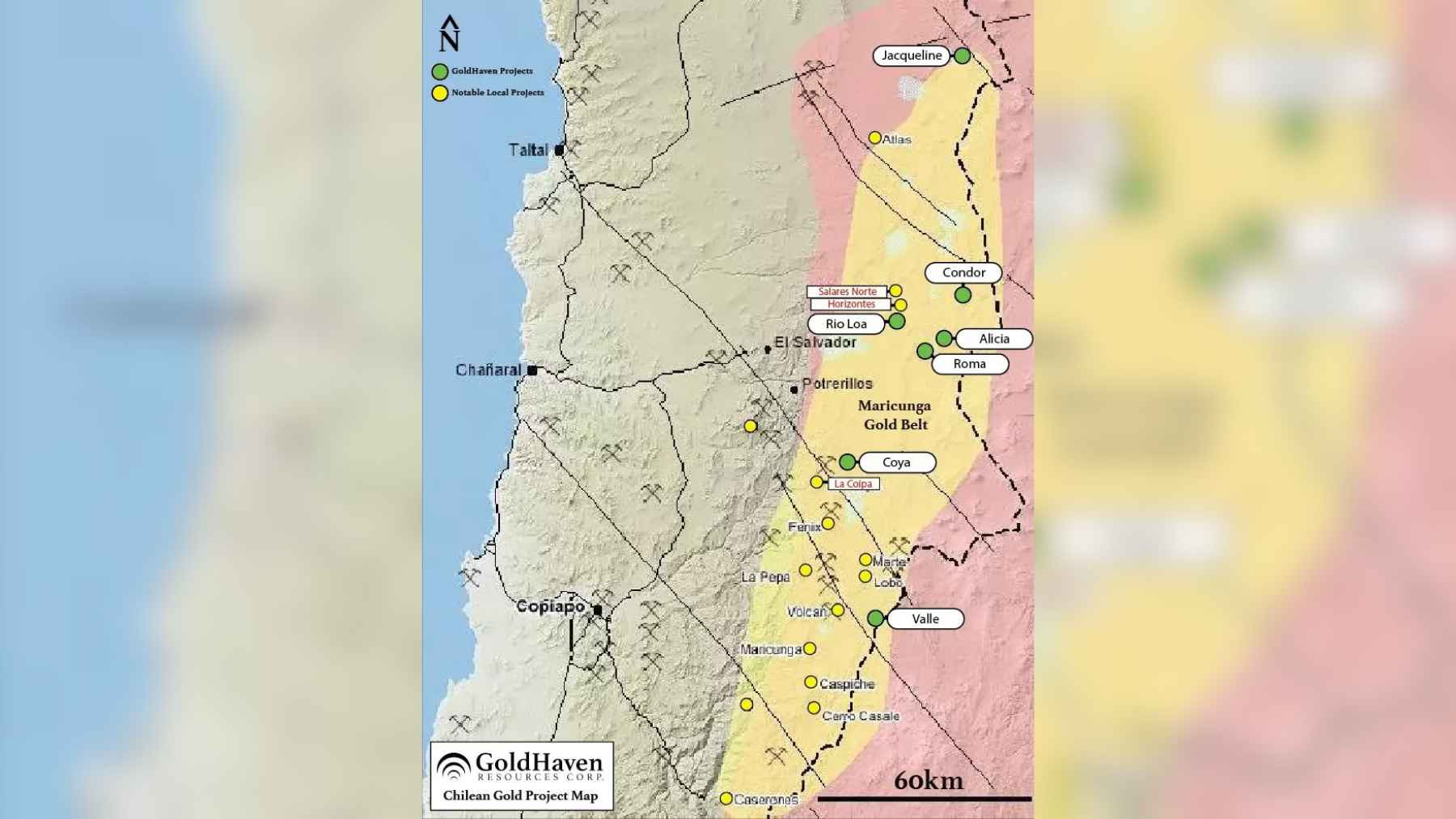
Maricunga is a mountainous mineral corridor 124 miles long and 31 miles wide, stretching through a remote part of northern Chile near the Argentine border. Copper usually dominates the country’s mining headlines, but this district has become increasingly important for large gold systems.
Now several projects are moving from geological promise toward engineering decisions.
Chile’s state copper commission, Cochilco, counted 104 exploration prospects in Atacama in 2025, including 71 that were active. That means the region held about 45% of Chile’s 158 active prospects, while the country’s total exploration budget reached $874.7 million and gold attracted $135.9 million. That is a crowded map.
Isidora holds 2.1 million ounces
Flagship’s first resource estimate for Isidora covers about 127 million tons of material grading and roughly 0.016 troy oz. of gold per ton.
The company calculates that this contains about 2.1 million oz. of gold, with 91% classified as measured or indicated. About 40% sits in oxide and mixed material that Flagship says may be suitable for heap-leach processing.
Managing director Paul Lock called the estimate a “transformational milestone,” although more testing is still needed before any construction decision.
Flagship has since completed four large-diameter drill holes totaling about 1,970 ft. and five trenches totaling roughly 1,969 ft. to support metallurgical studies. An updated resource estimate is targeted for late 2026 or early 2027, with the results expected to feed into pre-feasibility work.
Volcan builds its case
Tiernan’s Volcan project is larger on paper, with 9.8 million measured and indicated oz. contained in approximately 511 million tons. The company has hired Ausenco to lead its prefeasibility study and Deswik to work on open-pit design, while SGS is handling metallurgical testing.
It has also installed three stations to track weather, air quality, and dust after receiving authorization from Chile’s forestry agency.
A July update added an important piece of the puzzle. Tests on 36 samples found an average cyanide-soluble gold response of 75.1%, but Tiernan warned that the result should not be read as a forecast of actual heap-leach recovery. In other words, it is a “useful first read,” not a finished processing plan.
Lobo-Marte raises the stakes
Kinross’s Lobo-Marte proposal puts far more capital on the table. The project carries an estimated lifetime investment of $3 billion and would sit about 106 miles northeast of Copiapó at roughly 13,780 ft. above sea level. Chile’s government describes a 21-year schedule, including three and a half years of construction, 16 years of operation, and 2 years of closure.
President Kast’s public support gives the project political momentum, but it does not replace environmental approval. At that elevation, roads, equipment, worker safety, monitoring, and closure planning all become more demanding.
A presidential endorsement can open the door, but the review process still decides whether the project may walk through it.
The environment is the real test
Tiernan’s monitoring stations show why environmental work is beginning before a final mine design exists. Before drilling, regulators and communities need baseline information on dust, air quality, and weather before they can judge how much a future operation might change local conditions.
Metallurgical tests also matter because the way ore responds helps shape the eventual processing route and its operating controls.
A gold resource can sit neatly on a spreadsheet. A mine has to function in a real landscape, with high-altitude conditions, nearby communities, construction traffic, processing facilities, and a closure plan that lasts beyond the final ounce.
To a large extent, Maricunga’s next chapter will depend on whether developers can prove that their engineering and environmental commitments are as solid as their geology.
What happens next
Flagship is working toward more test results and an updated Isidora estimate, while Tiernan is moving into the next phase of metallurgy, engineering, and environmental studies at Volcan. Lobo-Marte faces a much larger and more public test as its proposed scale moves through Chile’s approval system.
None of those steps guarantees a mine, but each one will reveal whether Maricunga can support a new generation of gold projects.
For now, the district has the geology, the investor interest, and billions of dollars in possible development.
The latest press release was published on Tiernan Gold.