A private consortium wants to bring one of South America’s most symbolic rail links back to life with a 33.5-mile tunnel under the Andes. The proposal, known as the Corredor Bioceánico Longotoma, would reconnect Mendoza in Argentina with Chile’s Valparaíso region through a massive privately financed logistics system.
That sounds like the kind of headline that makes a map feel new again, but for now, this is still a proposal, not an approved construction project. The official record shows a presentation to Chilean authorities, a claimed $9.6 billion investment, and an ambitious pitch that mixes rail, ports, trade, and lower emissions.
A tunnel through the Andes
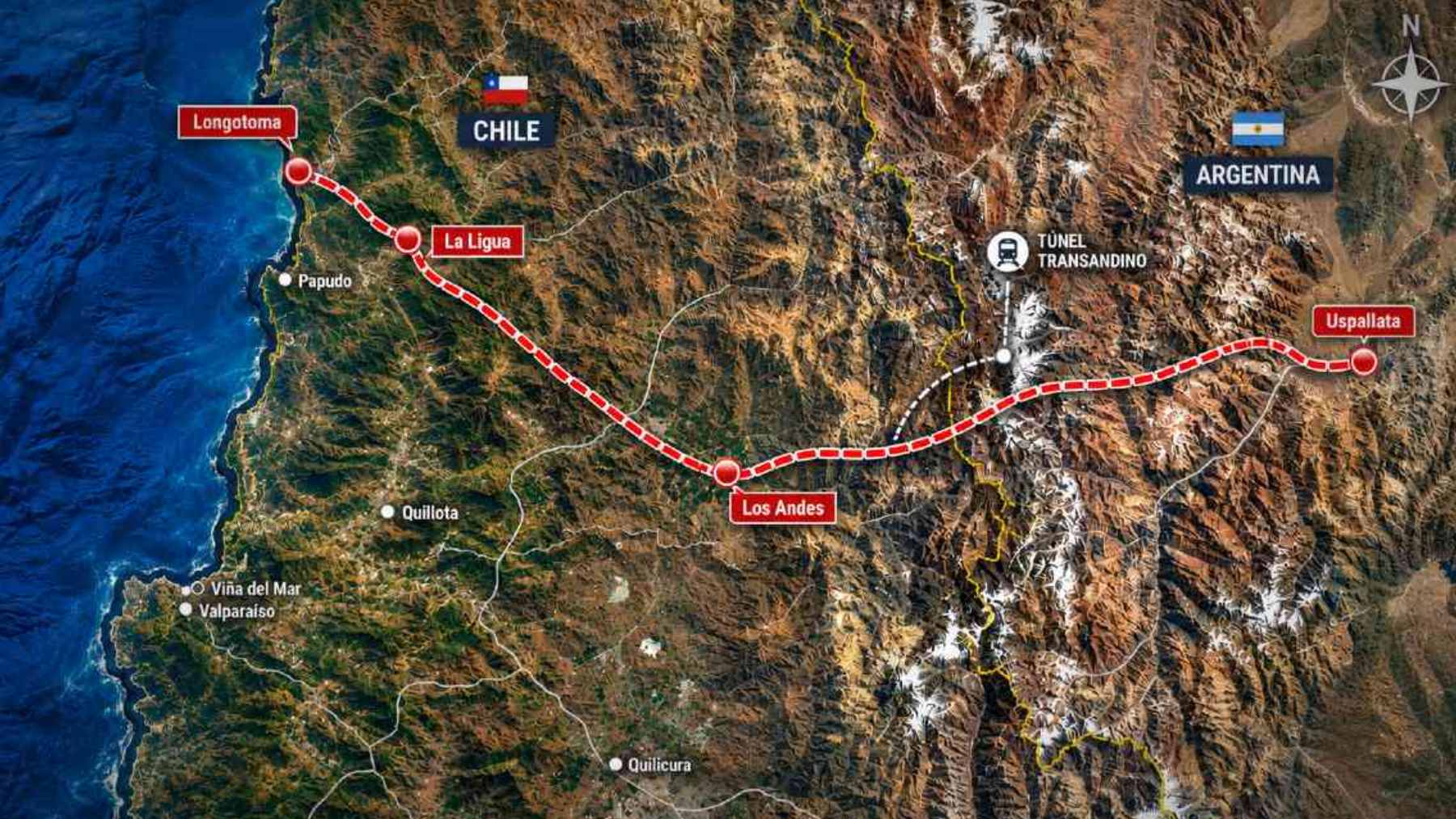
The core of the project is a twin-tube rail tunnel beneath the Andes, stretching about 34 miles between Uspallata in Mendoza and Los Andes in Chile. It would be part of a larger 261-mile electrified rail network between Mendoza and Longotoma.
According to the Chilean lobby registry, the plan also includes a 502-acre intermodal dry port in Los Andes and an underground maritime port in Longotoma, in the Valparaíso region. That is not just a tunnel, it is a whole logistics machine.
The investment is listed at $9.6 billion, with financing presented as private international capital linked to Beler S.A. and International Nusantara Investment Pte. Ltd. of Singapore. The big caveat is simple: money promised in a presentation is not the same thing as permits, environmental clearance, engineering approval, or shovels in the mountain.

Why this old railway matters
The historical weight is real. Chile’s National Archive explains that the Los Andes to Mendoza railway grew out of 19th-century efforts to connect Chile and Argentina by rail, with private companies and both governments involved in the process.
The line eventually became a symbol of cross-border movement, but its decline was long and painful. Passenger service ended in 1979, and freight survived only until 1984. That is why the new proposal has stirred nostalgia in towns that still remember the old stations.
Why bring it back now? Because the Andes remain a hard wall for trade. Trucks crossing the high mountain passes can face snow, closures, delays, and long lines that ripple through supply chains.
The snow problem
The strongest practical argument for the tunnel is reliability. A low-altitude underground route could reduce the impact of winter storms that often hit the Cristo Redentor and Los Libertadores corridor.
Anyone who has waited behind a stalled mountain crossing knows what that means. A shipment delayed by snow is not just a truck parked on a road. It can mean missed port slots, higher costs, spoiled planning, and more pressure on drivers.
That is why supporters present the tunnel as a year-round alternative for freight, passengers, and vehicles. It is similar in spirit to other large transport projects, such as the underwater tunnel being built between Denmark and Germany, where the promise is not only speed, but also a more predictable route.
A bi-oceanic bet
The project’s wider pitch is that Chile could become a Pacific outlet for agricultural exports from Argentina, Brazil, Uruguay, and Paraguay. In practical terms, grain and other bulk cargo could move across the continent toward Asia without relying so heavily on longer Atlantic routes.
This is part of a larger regional conversation. South America is also debating a Chinese-backed bi-oceanic railway that could connect Brazil’s interior with Peru’s Port of Chancay.
The Longotoma proposal sits in that same race to shorten distances between production zones and Asian buyers. For farmers, miners, port operators, and shipping firms, a few days saved can change the economics of an entire route.
The environmental promise
Supporters say the project could cut carbon emissions by shifting freight away from trucks and toward electrified rail. The lobby record claims a potential reduction of about 20 million tons of CO2 over two decades.
That claim is worth watching carefully. Rail can be cleaner than road freight, especially when trains are electrified and the power supply gets cleaner over time. But a tunnel through the Andes would also require huge amounts of concrete, steel, excavation, ventilation, and long-term maintenance.
That is the part often hidden behind the word “green.” As other megaprojects show, including China’s 83.4-mile Pinglu Canal, the environmental case depends on the full life cycle, not just the ribbon-cutting promise.
The approval question
The project’s backers have looked to the Treaty of Maipú, the 2009 integration agreement between Argentina and Chile, as a possible framework for binational processing. That matters because a tunnel of this scale cannot move forward as a normal local construction job.
Argentina’s official page on EBIFETRA describes the binational entity tied to the low-altitude Trans-Andean railway project and says viability must be evaluated from technical, economic, financial, environmental, and legal angles. In plain English, there is a lot of homework before anyone starts drilling.
That is why the most accurate reading is cautious. The consortium has presented a major private initiative, but there is no confirmed final approval, no public tender, and no official construction start.
High-speed claims need caution
Some reports have described the future line as “high-speed,” but that wording deserves care. The verified records describe an electrified rail network for freight, vehicles, and passengers. They do not clearly prove a high-speed passenger rail system in the strict technical sense.
That distinction matters. A freight-heavy mountain corridor has different design needs than a passenger high-speed rail line, especially when tunnels, gradients, safety systems, border controls, and heavy cargo are involved.
So, for readers, the safer phrase is “electrified rail corridor,” not “bullet train through the Andes.” It may sound less flashy, but it is closer to what the available documents support.
What comes next
The next steps are not glamorous. Geological studies, seismic risk analysis, environmental assessment, financing verification, binational coordination, and public scrutiny will decide whether this idea becomes a project with teeth.
There is also a strategic layer. The world is rethinking trade routes, from Mexico’s land-based Panama Canal alternative to new rail and port links across Asia and Latin America.
For now, the Andes tunnel proposal is best understood as a serious pitch with a very long road ahead. If it ever happens, it could reshape South American logistics, but the mountain will not move just because the numbers look impressive.
The official record was published on Chile’s Ley del Lobby site.