When that sticky summer heat rolls in, the same thought hits a lot of households and businesses at once: wouldn’t it be nice if solar panels could squeeze more electricity out of the very same sunlight, without needing a bigger roof or a bigger field?
Researchers in Japan and Germany now say they have demonstrated a lab system that does something close to that in spirit. In a paper published March 25 in the Journal of the American Chemical Society, the team reports a way to harvest more than one energy carrier from a single high-energy photon, a result that could eventually help solar devices waste less light as heat.
A quantum trick that turns one photon into more work
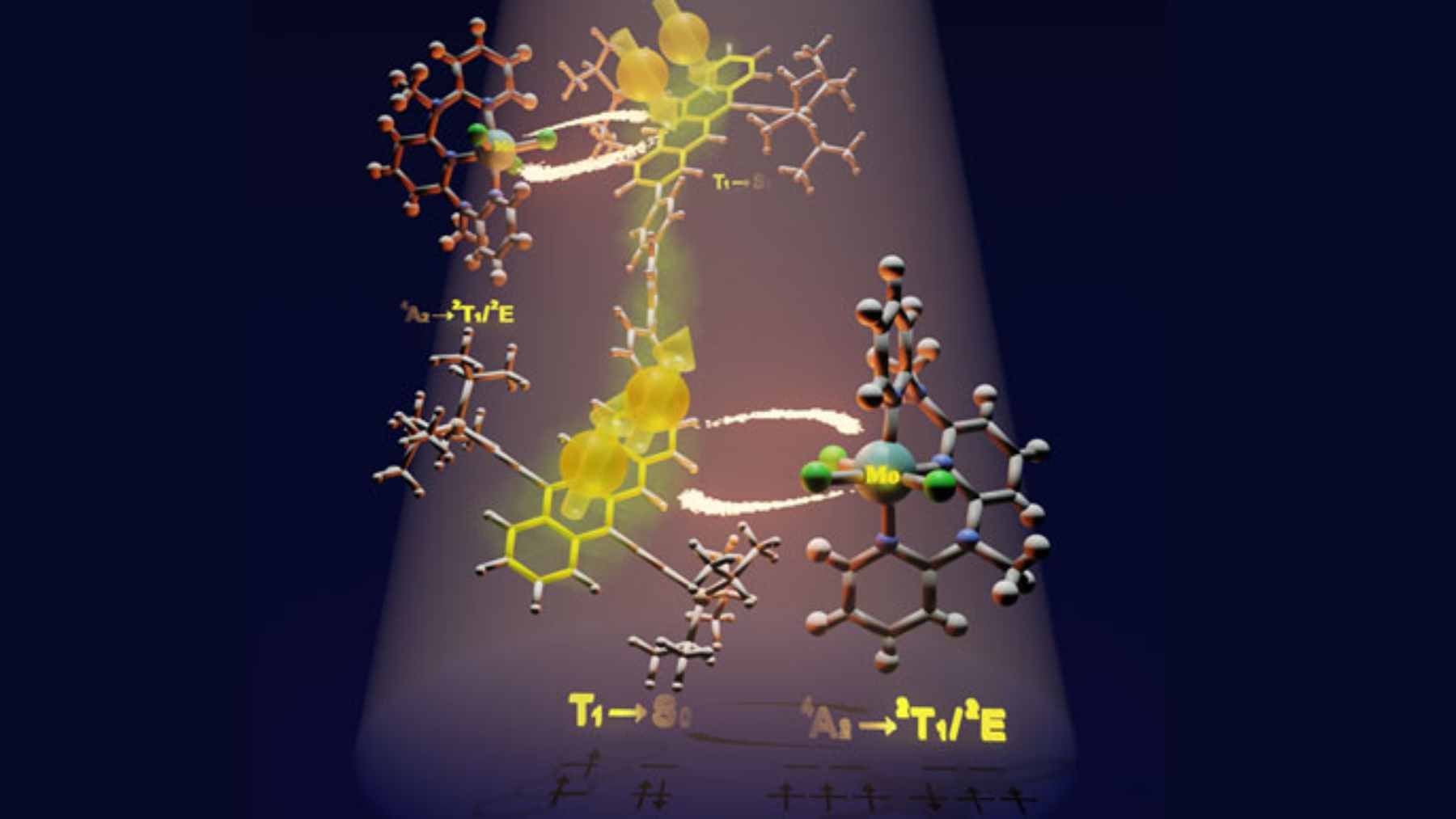
Kyushu University and Johannes Gutenberg University Mainz say they paired a singlet fission material with a molybdenum-based “spin-flip” metal complex that acts like a selective catcher for energy that usually slips away.
In tests using tetracene-based materials in solution, they report quantum yields around 130%, meaning roughly 1.3 of their metal complexes were excited per photon absorbed.
The engine behind the result is “singlet fission,” a process where one high-energy exciton can split into two lower-energy triplet excitons. In plain terms, it is a potential two-for-one deal on some parts of the solar spectrum.
What made this study stand out is how it tackled a known bottleneck, especially the way energy can be siphoned off before multiplication pays off. The researchers say careful energy-level design helped suppress Förster resonance energy transfer, which let the “spin-flip” emitter harvest the triplet excitons more cleanly.
Why “130%” is real science, not a miracle panel
That headline number can sound like free energy, but it is not. The team is talking about quantum yield, a count of excited carriers per absorbed photon, not overall panel efficiency measured in watts out versus watts in.
Solar still runs into a basic reality. Some sunlight has too little energy to be useful in a given material, while high-energy light tends to dump extra energy as heat. Kyushu University’s write-up points to the Shockley–Queisser ceiling for single-junction cells as the classic example of those unavoidable losses.
And yet, small gains matter. Fraunhofer ISE reports a shipment-weighted average efficiency of 22.7% for crystalline silicon wafer-based modules in Q4 2024, with top products in that group reaching 24.8% on datasheets.
The business story is about scaling from beaker to rooftop
The researchers are explicit that today’s result is proof-of-concept and was demonstrated in solution, not in a solid device like a rooftop panel. Their next step is to bring the singlet fission material and the spin-flip emitter together in the solid state, then evaluate whether the same clean energy handoff happens in a practical architecture.
That gap is where a lot of “next big thing” solar ideas stall. Interfaces get messy, oxygen and moisture find weak points, and manufacturing tolerances turn elegant chemistry into an engineering headache. Not glamorous, but it is the difference between a paper and a product.
The timing also raises the stakes. The IEA PVPS “Trends in Photovoltaic Applications 2025” report says global cumulative installed PV capacity surpassed 2,260 GW by the end of 2024, and new installations in 2024 were between 553 GW and 601 GW.
Defense and disaster planning care about efficiency, too
This is not only about climate targets or cheaper power in the long run. Military planners increasingly treat energy as an operational constraint, especially when logistics are contested and bases lean on vulnerable grid connections.
The U.S. Department of Defense’s Operational Energy Strategy flags “increasing risks to the assured delivery of power and fuel” and says the department is prioritizing energy demand reduction while adopting more efficient and clean energy technologies that reduce logistics requirements.
In practical terms, higher-output solar can help microgrids keep communications and critical systems running when storms or cyber incidents knock out broader power lines. And in forward settings, fewer panels for the same power can mean less transport, less setup time, and less fuel burned just to keep generators humming.
New solar chemistry brings new supply chain questions
There is also a quieter, more geopolitical angle that businesses will watch closely. This work relies on a molybdenum-based complex, and recent trade moves show that some molybdenum-related products can get swept into export controls tied to defense and advanced manufacturing.
Molybdenum is not a new industrial metal, but the global supply picture still matters when a technology scales. U.S. Geological Survey reporting notes global molybdenum production rose in 2024, and Reuters has reported that China accounts for a large share of production while also tightening controls on certain molybdenum-related exports.
For solar, the takeaway is simple and a bit unglamorous: breakthroughs that look like pure physics often become business stories about materials, manufacturing, and resilience once they leave the lab, and that is where the climate impact is ultimately decided.
The press release was published on Kyushu University.