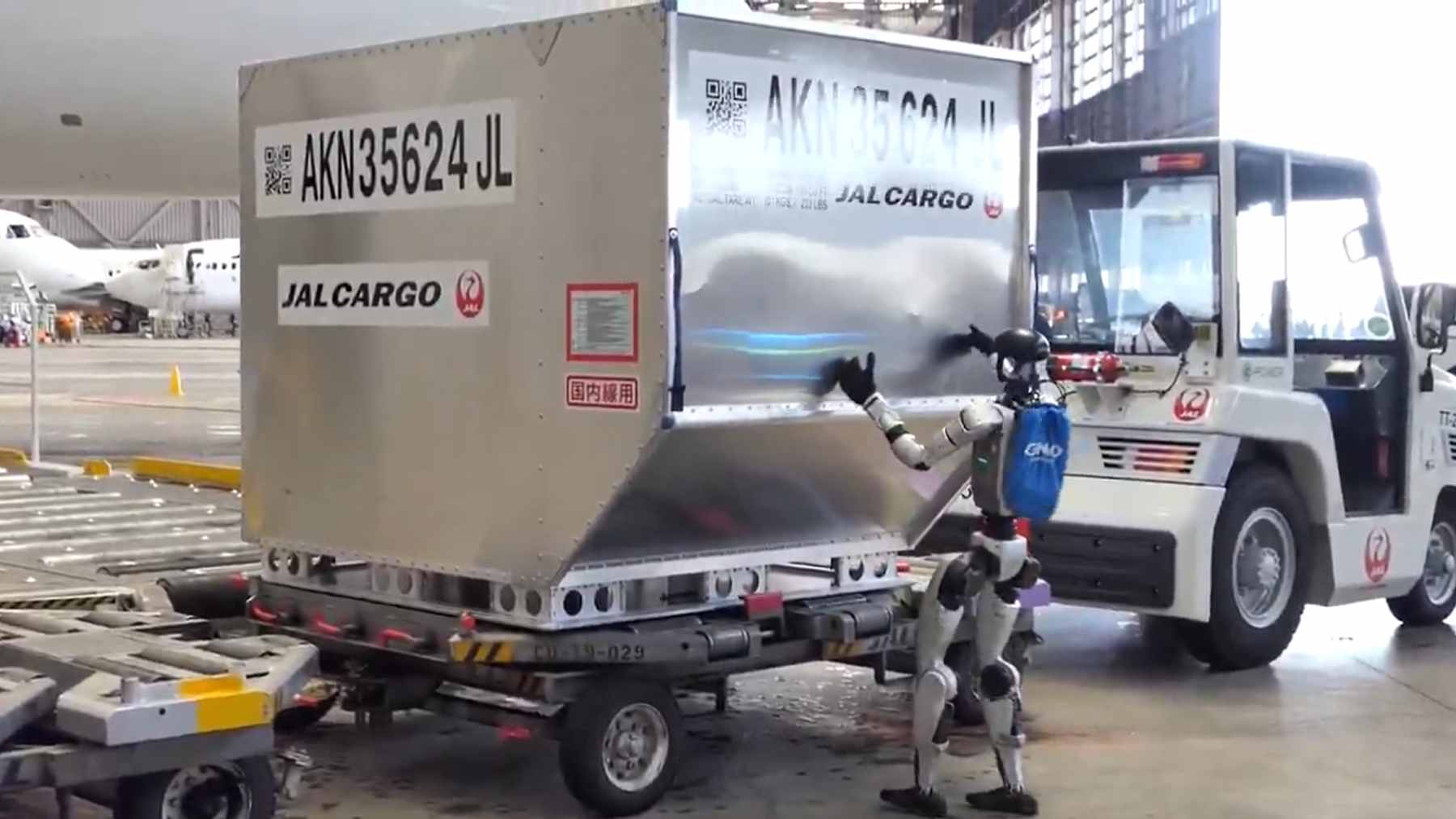
The next airport worker at Tokyo’s Haneda Airport may be about 4 ft. tall, battery-powered, and very carefully supervised. Japan Airlines is moving ahead with a planned trial of humanoid robots for ground handling work, starting in May 2026 and running through 2028.
This is not just a flashy robot story, it is a sign of how airlines are trying to keep airports moving as tourism rises, workers age, and aviation faces pressure to become more sustainable in the way it operates, not just in the fuel it burns.
Robots join the ramp
JAL Ground Service and GMO AI & Robotics Corporation say the project is Japan’s first demonstration experiment using humanoid robots at airports, based on the companies’ own research as of April 26, 2026. The trial will focus on Haneda Airport, one of the busiest gateways in the country.
The robots will be tested in general ground handling tasks such as loading and unloading baggage and cargo, with cabin cleaning also included in the scope of study. In other words, the machines are being tested in the busy space most passengers never see, where bags, carts, cargo containers, aircraft, and workers all have to move in tight coordination.
Why airports need help
To travelers, airports can look almost fully automated. You scan a boarding pass, watch a suitcase disappear on a belt, and assume the whole system runs like a machine.
Behind the scenes, it is far more physical. JAL and GMO said ground handling still relies heavily on human labor, especially around aircraft where workers operate ground support equipment in limited space and deal with baggage and cargo under strict safety demands.
Japan’s tourism boom is adding pressure. According to JTB Tourism Research and Consulting, using Japan National Tourism Organization data, Japan recorded 7,064,200 visits from overseas residents in January and February 2026 alone.
A human-shaped answer
Why humanoid robots instead of ordinary machines? The companies argue that a human-shaped robot can move through places already designed for people, without major changes to airport facilities or aircraft structures.
That matters because airports are not empty factory floors. They are full of narrow paths, changing schedules, traffic noise, exhaust fumes, warning signals, and workers trying to keep flights on time.
Still, the companies are not saying robots can take over everything. The plan is to verify where they can operate safely, then run repeated tests that simulate real airport conditions before any wider use.
The safety question
This is where the story gets more serious. A robot pushing cargo may sound simple, but the ramp is one of the most safety-sensitive parts of an airport.
JAL Ground Service will provide airport operations expertise, define business requirements, and evaluate safety standard compliance. GMO AI & Robotics will provide the humanoid robots and develop the motion programs needed for airport work.
Reports from the media demonstration also stressed that safety management will remain a human responsibility. That is the key point–robots may help with lifting, moving, and cleaning, but judgment around aircraft safety is still in human hands.
What this means for sustainability
JAL and GMO describe the project as a way to build a more “sustainable operational structure” through labor savings and workload reduction. That is useful language, but it needs some caution. This is not a direct climate fix.
Aviation’s biggest environmental challenge remains fuel. The International Energy Agency says aviation accounted for 2.5% of global energy-related carbon dioxide emissions in 2023, with emissions reaching over 1 billion tons of carbon dioxide as travel recovered after the pandemic.
So no, humanoid robots will not make jet engines clean. What they may do, to a large extent, is help airports handle growth with less physical strain on workers and fewer operational bottlenecks, also key benefits, even if it is only one piece of a much larger puzzle.
What happens next
The first step will be mapping and analyzing airport work sites to find areas where humanoid robots can operate safely. After that, the companies plan repeated operational checks that imitate real airport environments.
For travelers, the best result may be almost invisible. Fewer delays, less strain on the people loading bags in the heat, and smoother airport operations outside the cabin window.
At the end of the day, this trial is less about replacing people with machines and more about testing whether robots can take on the hardest physical jobs while humans stay in charge of safety.
The official statement was published on GMO AI & Robotics Corporation.