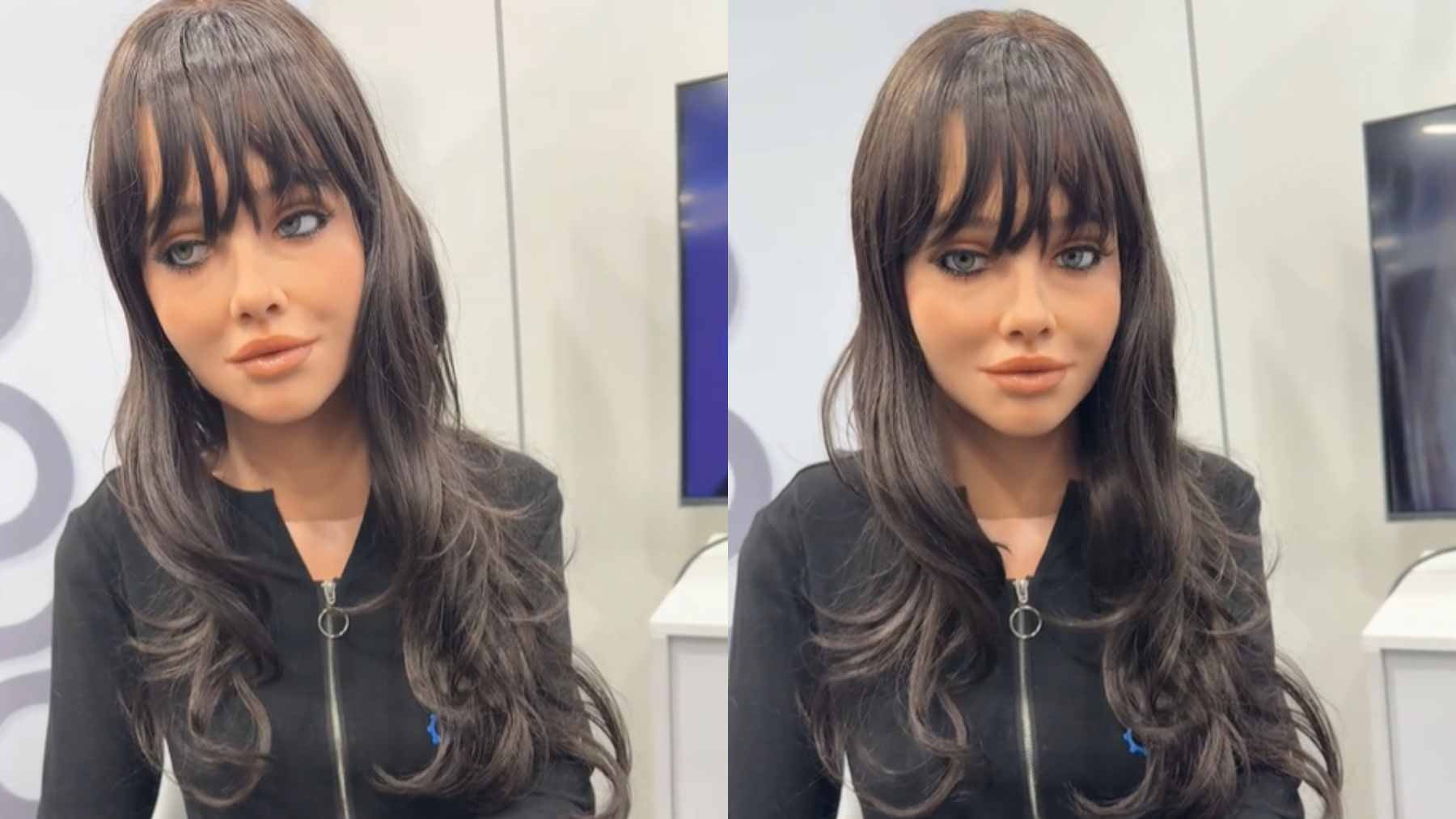
Artificial intelligence is no longer content to sit behind a screen. At Bitcoin 2026 in Las Vegas, Realbotix put Melody, an M-Series humanoid robot, at the center of a very real-world job (helping people find booths, answer basic questions, and avoid wandering around a huge venue like they lost the map).
That sounds like a customer-service story at first, but once AI gets a body, the environmental question changes, too.
Melody is not just software running in the cloud. It is motors, panels, synthetic skin, sensors, electricity, maintenance, and eventually, one more piece of advanced hardware that has to be repaired, reused, or responsibly recycled.
A new face for AI
Realbotix CEO Andrew Kiguel put it plainly: “AI is everywhere, but it lives behind a screen,” he said. The company’s pitch is that service jobs need a more lifelike presence, especially in crowded venues where a static kiosk can feel cold, confusing, or easy to ignore.
Melody belongs to the M-Series, a modular humanoid line that is stationary from the waist down but designed with full upper-body robotic capability. Realbotix says the M-Series has 39 degrees of freedom, can be configured in seated, standing, or desktop setups, and starts at $95,000.
In practical terms, Melody is not being sold as a walking household robot. She is closer to a high-end robotic receptionist, built for events, retail spaces, and service counters where attention matters almost as much as information.
Why the power cord matters
One detail should not be overlooked. Realbotix says M-Series robots can plug into standard electric sockets for extended runtime, allowing all-day deployment without relying on a battery. That may reduce some battery-related headaches, but it does not make the energy use disappear.
The electricity still shows up somewhere, often on the venue’s power bill. Anyone who has stood in a packed convention hall under bright lights knows that energy demand is not an abstract issue. There is lighting, cooling, screens, servers, and accumulating body heat that air conditioning has to fight all day.
The bigger AI picture is moving fast. The International Energy Agency estimates that data centers used about 415 terawatt-hours of electricity in 2024, around 1.5% of global electricity use, and projects that figure could reach about 945 terawatt-hours by 2030.
That does not mean Melody alone is a major energy burden, but it does place embodied AI inside a much larger power conversation.
The e-waste warning
Humanoid robots are not smartphones, but they belong to the same broader world of electronics, rare materials, motors, wiring, and parts that can become waste if products age badly. That matters because the global e-waste problem is already huge.
The Global E-waste Monitor 2024 reported that the world generated a record 136 billion lbs. of e-waste in 2022. Only 22.3% was documented as formally collected and recycled in an environmentally sound way, and the total could rise to 176 billion lbs. by 2030.
This is where Realbotix’s modular design becomes important, at least potentially. Reconfigurable faces and body panels could help extend a robot’s useful life if companies can repair, upgrade, and repurpose units instead of replacing them. But that only becomes a real environmental win when buyers get clear repair policies, spare-parts access, and end-of-life recycling plans.
Business comes first
At $95,000, Melody is not a casual gadget. She is an enterprise tool aimed at companies that want something more memorable than a touchscreen and more flexible than a scripted bot.
For businesses, the calculation is simple but not easy. A humanoid robot could reduce repetitive front-desk tasks, create buzz, and guide visitors in noisy, crowded spaces. On the other hand, it adds a complex machine to places that may already be packed with digital displays, kiosks, scanners, and connected devices.
That is the tension. The service industry wants smoother interactions, and the tech industry wants AI to feel more natural. The planet, meanwhile, needs fewer short-lived machines and a lot more honesty about energy use.
What to watch next
The most important questions are not about Melody’s smile or how natural her gestures look. Buyers should ask how much electricity the robot uses in a full day, what cloud systems support its conversations, how easily motors can be replaced, and where damaged components go when they are no longer useful.
That may sound less exciting than a lifelike robot greeting visitors in Las Vegas. Still, it is the part that will decide whether embodied AI becomes a durable service tool or another expensive stop on the road to more e-waste.
Melody’s appearance at Bitcoin 2026 shows where customer-service technology may be heading. The greener version of that future will not be the robot that looks most human, but the one that lasts longer, uses energy transparently, and does not end up as another forgotten machine in a storage room.
The official press release was published on Business Wire.