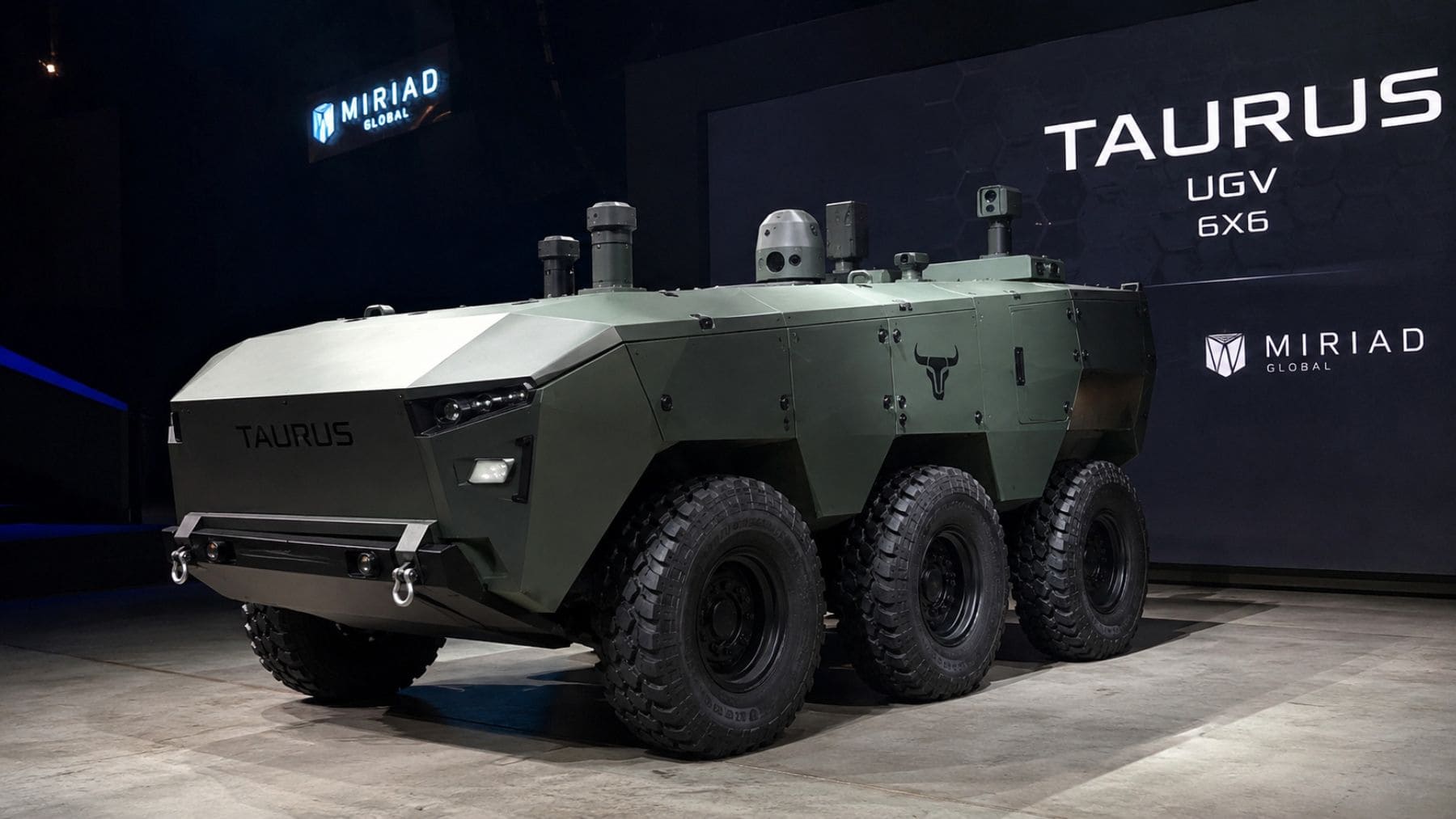
Spain has presented Taurus, an unmanned ground vehicle developed by Miriad Global and designed for missions where entering with a crew may be too risky. It is not a conventional tank. It is a six-by-six armored platform, with artificial intelligence and designed to recognize, monitor and support operations from the ground.
The presentation comes at a time when the government wants to strengthen Spain’s domestic defense industry and reduce technological dependencies. At the Miriad Global event, the secretary of state for defense, Amparo Valcarce, said companies such as Miriad make it possible to «develop sovereign technology, generate skilled jobs and reinforce our industrial autonomy,» while the company’s executive chairman, Antonio Navarro, linked the project to manufacturing and strategic knowledge inside Spain.
A 6×6 without a crew
Taurus is an unmanned ground vehicle, a machine capable of operating with no driver inside. Miriad Global presents it as a medium-class six-by-six system for demanding defense missions and also for critical civil-security operations.
The idea is simple to understand. Instead of sending a human patrol first into a dangerous area, a vehicle like Taurus can move ahead, observe and send information. It is a bit like sending an armored scout before crossing a street that does not look clear.
Its ballistic armor is intended to protect the platform from impacts and threats in the environment. Its modular design also allows sensors, equipment or tools to be changed depending on the mission, without having to build a different vehicle every time.
AI to move forward
The artificial intelligence inside Taurus should not be imagined as an independent mind, but as a set of programs that help the vehicle orient itself, recognize its surroundings and coordinate with other systems. According to Miriad, its architecture supports autonomous navigation, swarm coordination and operations that do not depend on satellite navigation signals.
That last point matters more than it may seem. In a military or emergency zone, a signal like GPS can fail, be jammed or simply not be available. That is why moving without that help can make the difference between getting stuck and completing the mission.
Swarm coordination means several robots can work together, like a small team. One can observe, another can carry equipment and another can watch a route. On paper, Taurus fits into that logic of robots that do not replace every human decision, but do take on dirty, repetitive or dangerous tasks.
A factory for prototypes
The presentation of Taurus coincided with the opening of a new Miriad Global prototyping plant in San Fernando de Henares. The company describes it as a center for creating early versions of autonomous systems and producing onboard subsystems, meaning the electronic and technological pieces that go inside these vehicles.
Miriad is not working on one isolated machine. The group organizes its activity into Miriad Engineering, focused on optronics, radio frequency and mission software, Miriad Systems, focused on the design and integration of robotic platforms, and Miriad Electronics, linked to critical electronics for Spanish defense programs.
The event was attended by institutional and military officials, including Lieutenant General Miguel Ivorra Ruíz, director of the DGEID, and Admiral Aniceto Rosique Nieto, director of the DGAM. Representatives from the CDTI, the Community of Madrid and the Government Delegation in Madrid also took part, a sign that the project is being read in industrial terms as well.
Why Defense is interested
Taurus appears in a very specific context. The Industrial and Technological Plan for Security and Defense foresees investment in artificial intelligence, cybersecurity, advanced communications, energy, materials, biotechnology and autonomous systems, with the CDTI as one of the pieces used to channel technological funding.
That plan is not just about buying equipment. It also seeks to strengthen the national technology base, create skilled jobs and energize the productive fabric. In practice, that means projects like Taurus are not viewed only as vehicles, but as factories, software, sensors, electronics and specialized jobs.
It also fits with the Deep Tech Spain 2026-2030 Strategy, approved by the Council of Ministers on May 19, 2026. The Ministry of Science says it will mobilize more than 8 billion euros by 2030 and that its strategic areas include artificial intelligence, robotics and autonomous systems.
What remains to be proven
Taurus should be read, for now, as an industrial and technological bet by Miriad Global, not as a solution that has already proven everything in real operations. It still has to show how it behaves in long tests, with dust, heat, interference, difficult terrain and missions where nothing goes as it does in a demonstration.
The key question is very direct. Can an unmanned armored vehicle reduce risks for soldiers without adding new control, maintenance or security problems? That is where much of the test will be.
If it matures, Taurus could be used for reconnaissance, surveillance, logistics or support in complex emergencies. But its real value will depend on something less flashy than AI and armor, reliability when the environment turns chaotic.
The official information on the Taurus project was published by Miriad Global.