
The thymus trains immune cells, then gradually fades into fat. Recent studies show a healthier-looking thymus links to lower risks of death, lung cancer, and cardiovascular disease, while some cancer patients respond better on immunotherapy.
Together, the studies examined more than 31,000 people. The results have pushed the thymus from forgotten anatomy into a fast-growing field of aging research, but they do not show that rebuilding the organ will extend anyone’s life. That is the big question now.
The immune system’s training school
The thymus sits above the heart and behind the breastbone. It acts like a training school for T cells, white blood cells that help fight infections, recognize abnormal cells, and keep the immune system from attacking the body’s own tissues.
Young T cells enter the gland unfinished. Inside, they learn what belongs in the body and what may be dangerous before moving into the bloodstream. After puberty, however, working thymic tissue gradually gives way to fatty tissue, and the supply of new T cells falls sharply.
The organ medicine once dismissed
For decades, many scientists treated the adult thymus as a leftover organ with little purpose. That view changed in 1961, when French-Australian immunologist Jacques Miller removed the thymus from newborn mice and found that they became severely short of immune cells called lymphocytes and highly vulnerable to infection.
A major human study reopened the case in 2023. Kameron Kooshesh and colleagues at Massachusetts General Hospital compared adults who had the gland removed during chest surgery with matched patients who kept it.
Five years later, 8.1% of the removal group had died, compared with 2.8% of controls, while cancer developed in 7.4% versus 3.7%.
“We discovered that the thymus is absolutely required for health,” senior author David Scadden said. Still, the study was observational, so it could not prove that removing the gland directly caused the extra deaths or cancers.
What the new scans revealed
In the first 2026 study, Simon Bernatz and an international team trained an artificial intelligence system to rate thymic health on routine chest scans. They tested it in 25,031 participants from the National Lung Screening Trial and 2,581 from the Framingham Heart Study.
Among people in the lung-screening group, those with high thymic health had about half the risk of dying from any cause compared with those in the low group.
They were also 36% less likely to develop lung cancer, and the reported reduction in cardiovascular death ranged from 63% to 92% across the two cohorts.
The companion study examined 3,476 patients receiving immune checkpoint inhibitors, drugs that help T cells attack cancer. Healthier-looking thymuses were linked to longer survival and slower disease progression, especially in non-small cell lung cancer.
The same general pattern appeared across melanoma, breast cancer, and kidney cancer, although the method is not yet a standard clinical test.
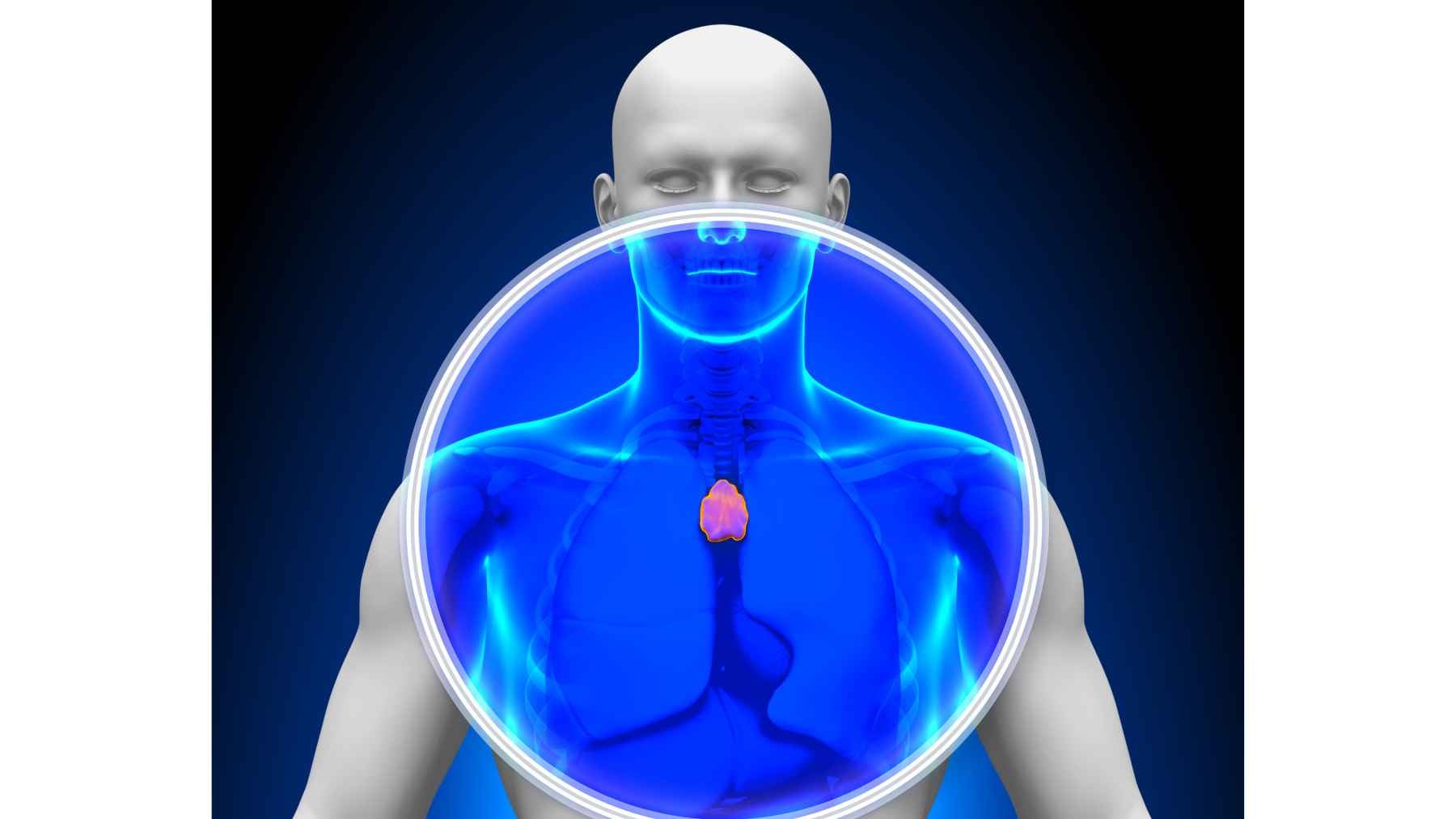
A medical illustration highlights the thymus, an immune organ that trains T cells and gradually shrinks with age.
The race to rebuild it
Could a fading thymus be restored? Gregory Fahy and Intervene Immune offered an early clue in a 2019 pilot trial involving nine healthy men ages 51 to 65.
After one year of growth hormone, metformin, and a hormone called DHEA, scans suggested thymic regrowth in seven participants, while epigenetic age markers moved about 2.5 years younger than the expected untreated trend.
That sounds dramatic, but the trial was tiny and had no control group. Epigenetic clocks estimate biological aging from chemical tags on DNA, and a younger score does not automatically mean a person will live longer or avoid disease. A larger follow-up study is registered, but the approach remains experimental.
Money is moving into the field. Zag Bio launched in October 2025 with $80 million to develop thymus-targeted treatments for autoimmune disease, while Swiss company TECregen raised about $12.6 million in January 2026 for engineered drugs designed to rejuvenate thymic cells.
Both remain development programs, not evidence that thymus treatments extend human life.
Promising signs and serious limits
Other interventions can change the gland. A two-year human trial found that an average 14% calorie reduction left participants with less thymic fat and more functional tissue, while androgen-deprivation treatment, a prostate cancer therapy that lowers male hormones, can temporarily increase new T-cell production. Neither approach is a general anti-aging prescription.
Growth hormone also carries real concerns, including high blood sugar, diabetes, swelling, and risks involving existing or previous tumors. That makes self-experimentation especially risky.
The safer scientific target may be a treatment that reaches the thymus without stimulating growth throughout the rest of the body.
Even successful regrowth would leave one hard problem. A larger gland is easy to see on a scan, but scientists must prove that it produces useful T cells and improves infections, vaccine responses, cancer control, or survival before calling it a longevity tool.
The main studies were published in Nature.