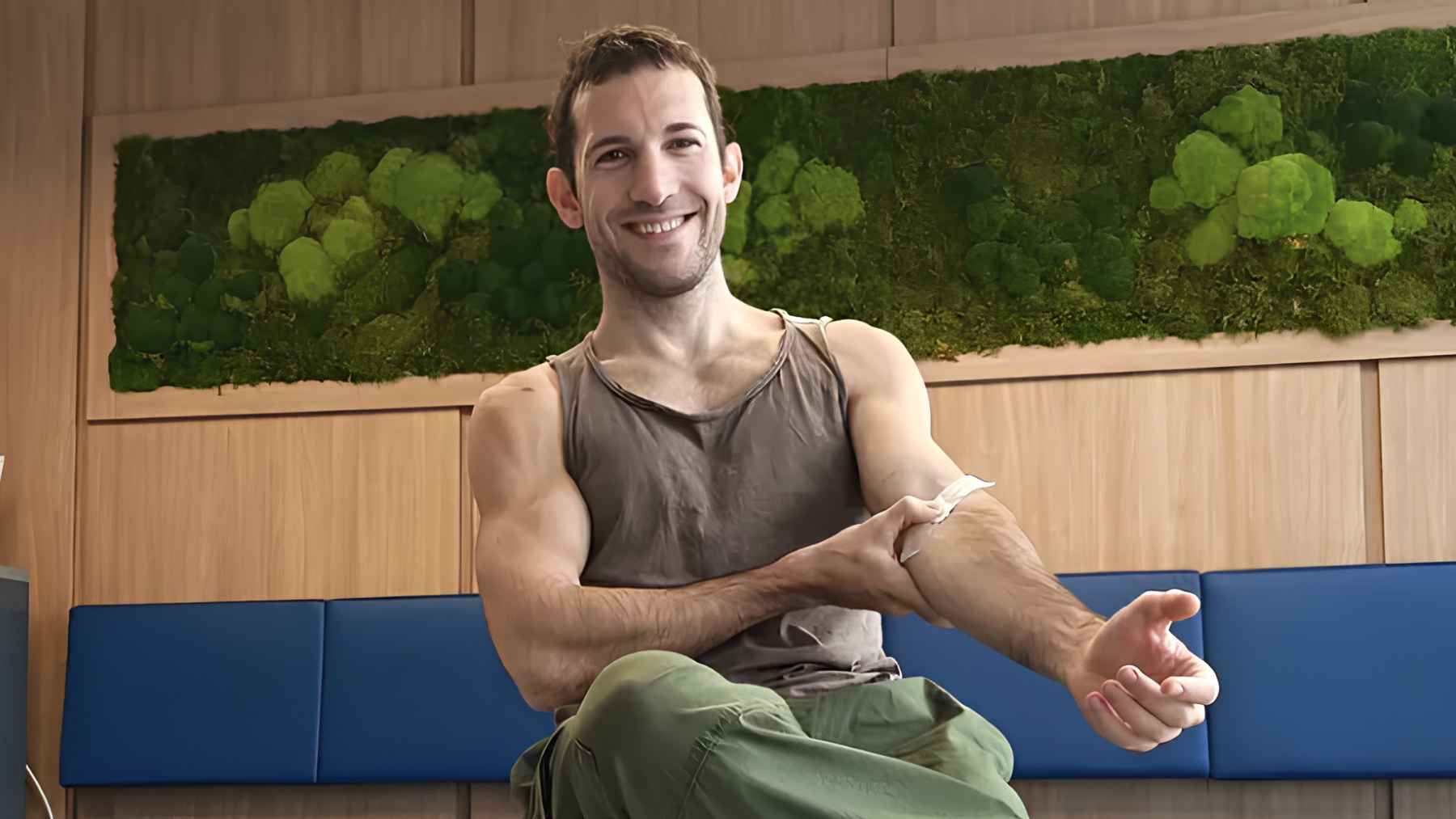
At 31, Hungarian filmmaker and art teacher Martin Helstáb sits seventh on an unusual global leaderboard that rewards people whose blood markers make them look biologically younger.
Hungarian reports said his age gap had reached 18.2 years, while the live official table listed a 16.6-year reduction on July 21, 2026. His rise followed a strict routine he began after an autoimmune joint diagnosis.
Does that mean he has secured 18 extra years of life? No. The result is generated by an aging clock, an algorithm that turns lab measurements into an age-like score, while his broader approach is often called biohacking because data guides the experiments.
It can flag favorable markers, but it cannot certify lifespan or prove that every organ has become younger.
How the ranking works
The Longevity World Cup is open to participants who submit qualifying lab results. Its professional track for 2026 uses the Bortz Age clock, while the amateur path uses PhenoAge.
Competitors are ranked by the gap between calendar age and calculated biological age, and same-day blood results are required.
The model behind Bortz Age came from research led by Jordan Bortz with colleagues at Imperial College London.
Using UK Biobank data from 306,116 people, the team built a mortality-risk model from circulating blood markers and reported an 11% relative improvement in predictive value over PhenoAge in its test group.
In simple terms, it compares a person’s lab pattern with patterns seen at different ages.

One claim, two different measures
Earlier coverage connected Helstáb’s reported 18.2-year age reduction with a pace of 0.62 biological years for every calendar year. Those figures sound interchangeable, but they are not. They answer two different questions about the body.
One number asks how much younger today’s biomarker profile appears than a person’s actual age. The other tries to estimate how quickly biology is changing over time.
You cannot turn one into the other with simple subtraction, so the 0.62 figure should be treated as a separate test result rather than proof created by the World Cup score.
Some aging clocks examine DNA methylation, small chemical tags that affect how genes are used, but scientists still lack a single gold-standard biological age.
A 2025 study of 18,859 adults found newer epigenetic clocks were more useful than older ones for predicting disease, yet the field still needs careful validation. Promising, yes, but not a life-expectancy certificate.
Illness changed his daily life
Helstáb said he was diagnosed with autoimmune polyarthritis at 24, after experiencing widespread joint pain and severe fatigue. “I wake up with energy and can live my days without pain,” he later told Blikk, describing his current condition.
That improvement is self-reported and should not be read as a clinical trial.
He made sauna sessions part of his routine and once used deposits from returnable bottles to help cover a portable sauna’s electric bill. After living in Malta, he returned to Budapest and said Hungary’s cold, dark winters make his symptoms harder to manage.
Heat may ease stiffness for some people, but that is not evidence that sauna reverses autoimmune disease.
The routine is strict but not luxurious
He says he has quit coffee, takes 22 vitamins or supplements, mostly stops eating after 7 p.m., and schedules 10 to 20 minutes of relaxation each day. Even with a stressful teaching workload, he says those quiet blocks help him fully switch off.
Sometimes the most advanced-looking biohack is simply protecting a small piece of the day.
His supplement stack is the clearest reason for caution. The U.S. National Institute on Aging notes that supplements can cause side effects and interact with medications, so copying a 22-product routine without medical guidance would be risky, especially for anyone with an autoimmune condition.
The useful lesson for everyone
Helstáb’s advice to ordinary people is to skip expensive gadgets at first. He recommends removing harmful habits and paying close attention to sleep, then improving food quality without turning every meal into a chemistry project. That is less dramatic than a leaderboard, but far more practical.
This overlaps with basic guidance from the U.S. Centers for Disease Control and Prevention, which emphasizes regular movement, balanced food, enough sleep, social connection, and stress care for healthy aging.
None of those habits guarantees a longer life, but they support health without requiring a private laboratory or a celebrity budget. At the end of the day, the aging clock is a dashboard, not a crystal ball.
The official ranking and competition rules have been published by the Longevity World Cup.