Juan López García did not grow up as a track star. He was a former auto mechanic from Toledo, Spain, who first tried running at 66 and could barely last a minute. Now 82, he has become a scientific case study after researchers found that some parts of his physiology resemble those of much younger trained adults.
The eye-catching line is that his metabolic age has been compared with someone in their 20s. But the more useful story is less flashy and more practical. His muscles appear unusually good at using oxygen and burning fat, two traits that help explain how he set a 31-mile world record for men over 80.
A late start
His road to endurance running began, not with a coach or a college team, but with retirement and family nudging him out the door. López told BBC Mundo that at first he told his daughter, “I can’t do this,” and she encouraged him to keep going for that single minute. “Little by little,” that minute became a habit.
That small beginning matters. For many readers, the barrier to exercise is not a 31-mile race, it is the first walk after dinner, the first gym visit, or the first morning when the couch looks more inviting than sneakers. Juan’s story pulls the science back into everyday life.
The record scientists studied
The Frontiers team examined an 81-year-old male runner who set the 50-kilometer record in May 2025 at the Spanish 50-km Master Championship in Málaga, Spain. For U.S. readers, that is about 31 miles. He finished in 4 hours, 47 minutes, and 39 seconds, which works out to roughly 6.5 mph, or about 9 minutes and 14 seconds per mile.
The study says he improved the previous record by 49 minutes and 2 seconds. Researchers also found that his lactate threshold came at the same pace as his record speed. In plain English, he could hold a hard pace without tipping quickly into exhaustion.
Why his muscles stand out
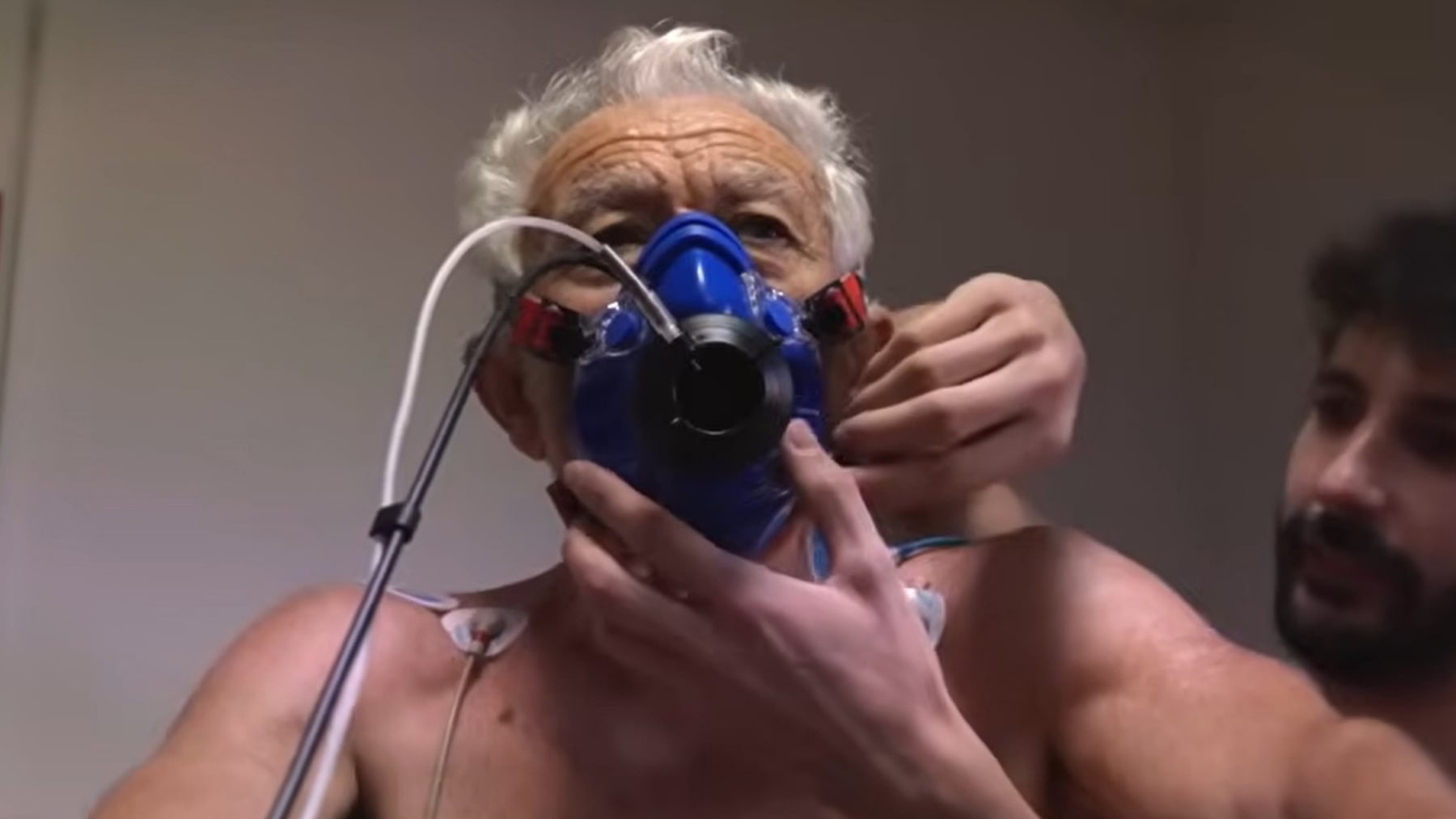
One of the biggest findings was his VO2 max, a measure of how much oxygen the body can use during intense exercise. His result was 52.8 in standard exercise-science units, which the authors described as the highest they know of in octogenarians. They also said it was equivalent to the 70th percentile for healthy men aged 20 to 30.
The body does not win endurance races only with lungs. Oxygen has to move from air to blood and then into working muscle, almost like a delivery system where every handoff matters. In López, researchers found exceptional adaptations near the final steps of that oxygen chain.
Fat as fuel
Another standout was his ability to oxidize fat. That means his body could rely more on fat for energy during long efforts, saving faster-burning sugars for tougher moments. For an ultradistance runner, that is not a small detail.
Julián Alcázar, one of the researchers, told BBC Mundo that López has an above-normal ability, comparable to a trained young person, to use oxygen and oxidize fats. It is the kind of engine most people associate with youth, except this one was built through movement, work, and late-life training.
A life that stayed in motion
Before he became a runner, López spent decades as an auto mechanic and eventually ran his own shop. That kind of active work may have helped give him a strong base before he ever began structured endurance training. At the end of the day, bodies tend to remember what we ask them to do often.
His training was not casual either. The study reported that he ran roughly 40 miles per week in general phases and up to 75 miles per week before target competitions, with six or seven sessions weekly. That is far beyond what most adults need, but it shows how consistency, not one heroic workout, shaped his physiology.
What older adults can take from it
Here is the important caveat. López is one person, and the Frontiers authors noted that their case study is a snapshot, not a full explanation of how he developed these traits. Genetics, luck, health history, lifelong movement, and training probably all matter.
That said, the practical lesson is not to copy an ultramarathon schedule. The CDC recommends that adults 65 and older aim for at least 150 minutes of moderate aerobic activity each week, along with muscle-strengthening and balance work. For many people, that can mean brisk walks, light weights, or simple balance drills instead of race medals.
Independence is the real headline
To López, exercise is not just about records. He said he dislikes the word “old” because he still feels capable, including helping his wife when she needs him. That line may be more powerful than any lab result.
The science matters because it points toward a larger idea. Maintaining exercise capacity in advanced age may help preserve VO2 max, a key marker linked with health and mortality risk. But at home, it often shows up in simpler ways, carrying groceries, getting up from a chair, or keeping balance in the hallway.
The lesson behind the lab numbers
López’s case challenges the idea that decline has to arrive all at once. It does not promise that everyone can run 31 miles at 82. Still, it suggests the body may have more room to adapt than many people assume.
Start small, repeat often, build patiently. That may not sound as dramatic as a world record, but for healthy aging, it may be the message most worth keeping.
The study was published on Frontiers in Physiology.