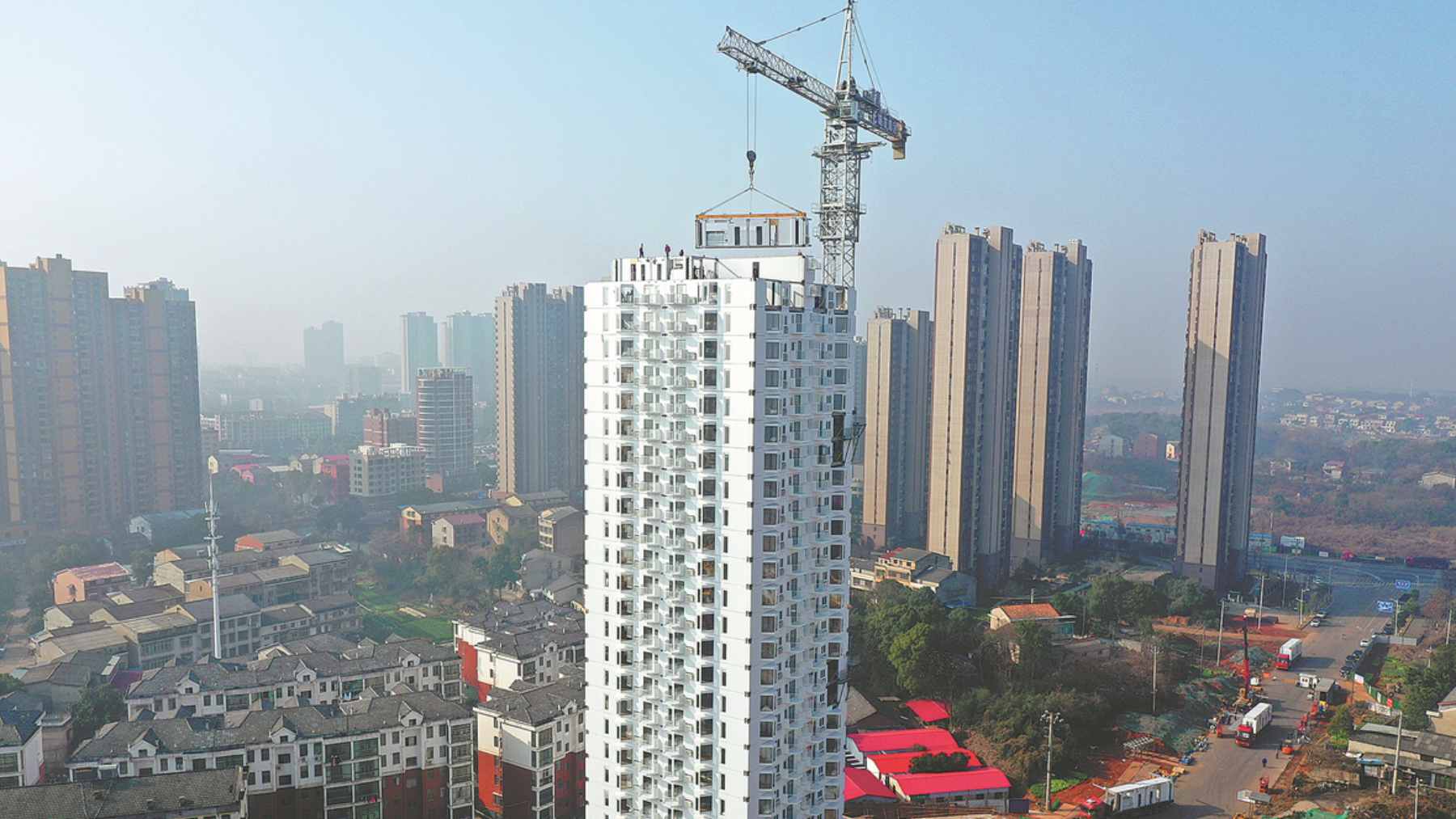
A 26-story residential building in China has gone from modules on trucks to a finished tower in just five days, turning a construction site into something closer to an assembly line.
The Jingdu Holon Building in Hunan province uses factory-made, stainless-steel apartments that arrive with wiring, ducts, and key systems already in place. The bigger story is not only speed, it is what this model could mean for housing, energy use, and the future of construction.
A tower built like blocks
Broad Group Holon built the 14,000-m² structure in Xiangyin county from January 7 to January 11, according to China Daily. The building is designed to house workers hired through a local talent program, and residents will not pay rent for the first two years.
Each floor includes eight apartments of 68 m² and four elevators. In practical terms, that’s 208 homes rising in less time than many people spend waiting for a kitchen repair.
How the Holon system works
The secret is the Holon method, a modular system developed by Broad Group. Each apartment is made in a factory as a stainless-steel unit measuring 12 meters long, 3 meters high, and 2.4 meters wide.
Once the units reach the site, cranes stack them into place like building blocks. After that, workers connect the water, electricity, air conditioning, and ventilation systems–simple to describe, very hard to do well.
Speed with an environmental angle
The construction industry is under pressure to build faster while wasting less. That’s why modular construction is getting so much attention, with UL Solutions noting that the global market is expected to grow from $95 billion in 2025 to more than $150 billion by 2032.
Factory production can also reduce waste because materials are cut, reused, and managed under controlled conditions. That does not make every modular building automatically green, but it does change the messy rhythm of a traditional site.
Stainless steel instead of concrete
Broad’s most unusual bet is stainless steel. The company says the material helps the structure resist earthquakes better than concrete because it can absorb stress without cracking in the same way.
The company also claims the building could last more than 1,000 years–a bold statement, and time will have to judge it. Still, durability matters in environmental terms because the cleanest building is often the one that does not need to be replaced.
Comfort inside the module
The apartments are not just empty metal boxes. Broad says the finished building includes water, electricity, air conditioning, and its own energy recovery ventilation system.
China Daily also reported that insulated exterior walls reduce noise and preserve heat, while four-paned windows help block solar heat on hot days. The company says this can cut air-conditioning costs by as much as 90%, which is the kind of number people notice when the electric bill arrives.
A building that can move
One of the strangest details is that the whole structure can be dismantled and rebuilt somewhere else, according to the company. That turns a building from a fixed object into a product that can, at least in theory, change addresses.
For cities dealing with floods, infrastructure projects, or fast-changing housing needs, that idea is powerful. Why demolish everything when parts of it could be moved and reused?
What comes next
Broad has done this before. In 2021, the company erected an 11-story apartment building in Changsha in 28 hours and 45 minutes, another sign that this was not a one-off stunt.
The question now is whether this model can travel beyond China at scale. Building codes, local labor rules, financing, and public trust all matter. But five days for 26 stories is hard to ignore.
The official statement was published on BROAD USA.