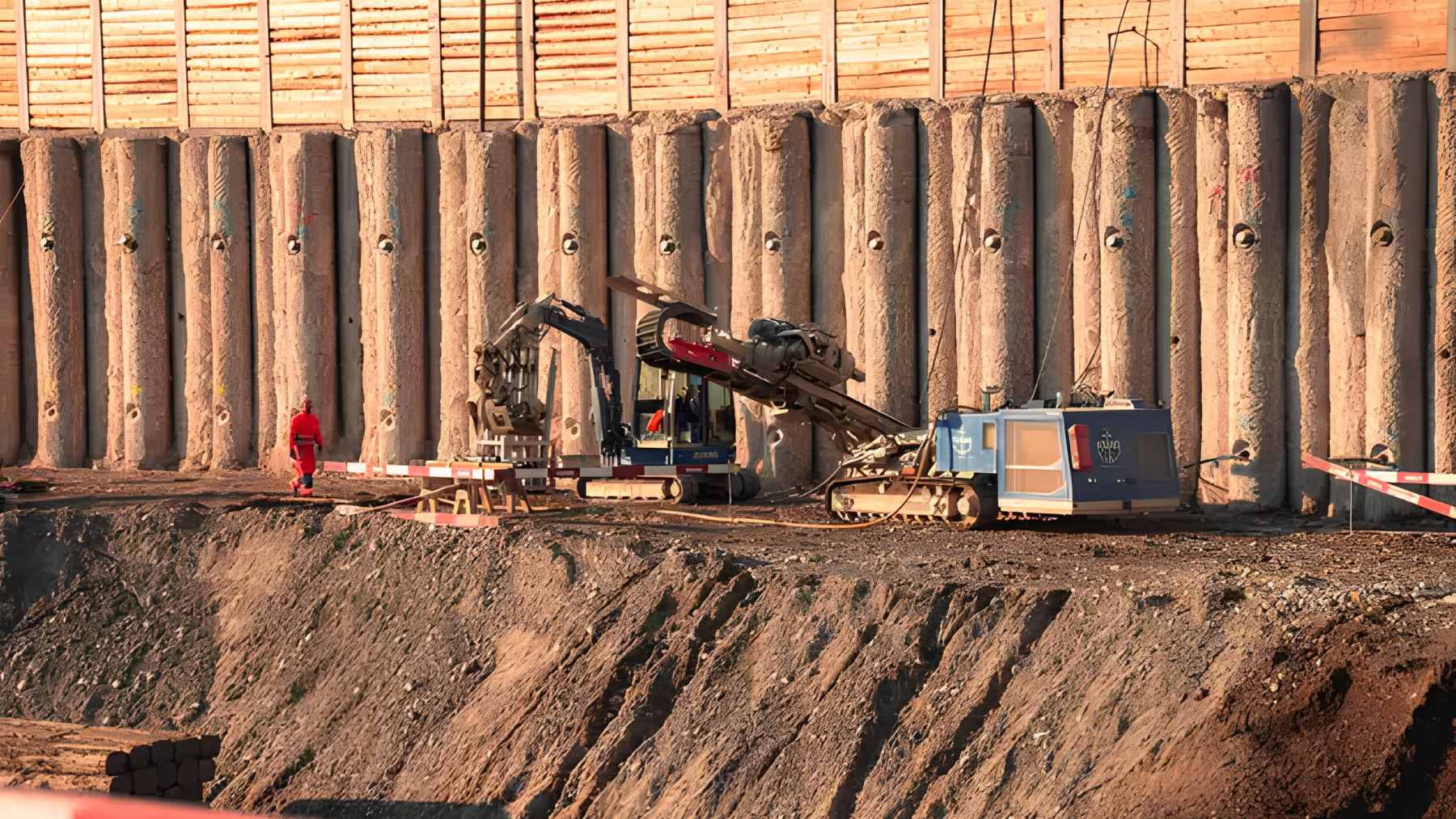
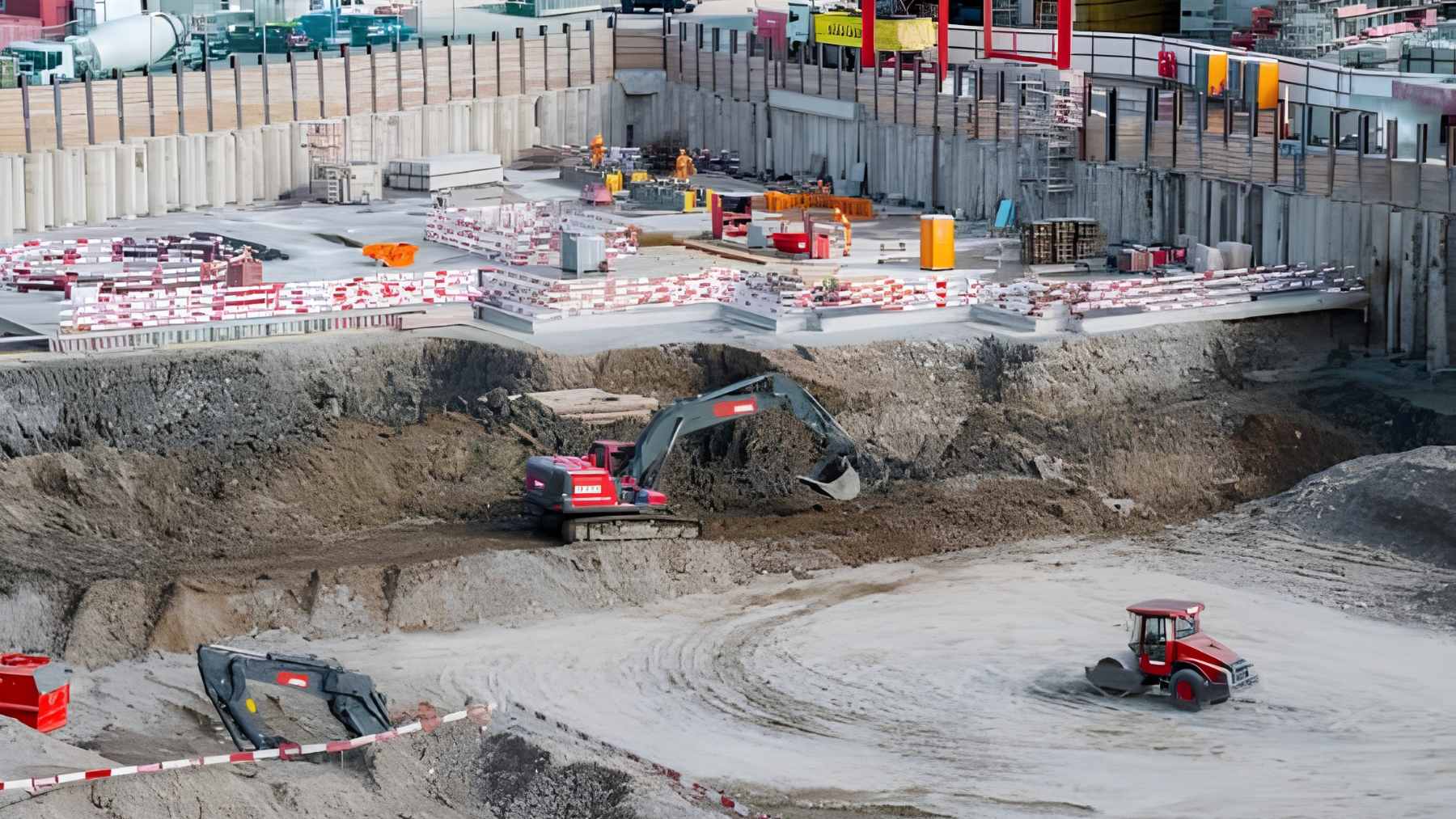
Switzerland is turning an 89-ft.-deep excavation in Laufenburg into the foundation of a huge underground flow-battery system, one designed to store clean electricity and send it back to the grid almost instantly.
FlexBase says the final installation will exceed 2.1 GWh of capacity and more than 1.2 GW of output, putting it in the same power class as the Leibstadt nuclear plant.
The project is not just another shiny piece of energy hardware. It is a test of whether Europe can make solar panels, wind turbines, electric vehicles, heat pumps, AI data centers, and ordinary household power demand fit into the same grid without wasting clean electricity when it is abundant. That’s where this giant battery comes in.
A battery under Laufenburg
The system is being built at the Technology Center Laufenburg in Switzerland, near the German border. According to FlexBase, the broader campus will cover about 430,000 ft.² and combine battery storage, an AI data center, offices, laboratories, and energy infrastructure.
Why put so much of it underground? Redox flow batteries are not compact like the lithium-ion packs in phones, laptops, or electric cars. They need large tanks, pumps, pipes, and conversion systems, which makes space a real part of the design.
Why the grid needs it
Renewable energy has a timing problem. A sunny afternoon or windy night can produce more electricity than the grid needs, while a cold evening or a brutally hot summer day can push demand sharply higher.
FlexBase says the Laufenburg battery is meant to store surplus renewable electricity and release it when needed, helping stabilize voltage and frequency. In practical terms, the battery could act like a shock absorber for a power grid that is becoming harder to predict.
Swissgrid gives the green light
A major step came in January 2026, when Swissgrid approved the first expansion phase of the grid connection for the Technology Center Laufenburg. That phase has a capacity of 800 MW, a figure that shows this is not a small pilot project tucked away for laboratory testing.
FlexBase says the final system’s storage capacity will be enough to supply about 210,000 households for 24 hours.
That number makes the project easier to picture–it is not just energy on a spreadsheet, but electricity that could keep homes, workplaces, and essential services running when clean generation dips.
How flow batteries work
A redox flow battery works differently from the lithium-ion systems most people know. Instead of storing most of the energy inside solid electrodes, it stores energy in liquid electrolytes held in tanks and pumped through electrochemical cells.
During charging, electricity is converted into chemical energy in the liquid. During discharge, the process runs the other way and electricity flows back out–a simple idea with huge machinery.
Why the technology matters
This design can be useful for stationary storage because capacity and power can be scaled in different ways. More tank volume can generally mean more stored energy, while conversion equipment has more to do with how fast that energy can be delivered.
FlexBase highlights another feature that matters for a large underground site. Its redox flow system uses an aqueous electrolyte with high water content, which the company describes as non-flammable, non-explosive, durable, and recyclable.
Invinity steps in
The latest official milestone came on May 21, 2026, when FlexBase announced that Invinity Energy Systems had been selected as the strategic partner for the flow-battery facility. Invinity said the project will include a vanadium flow battery of up to 1.5 GWh in the initial scope, with FlexBase looking to expand it to 2.1 GWh in later phases.
Marcel Aumer, FlexBase’s group CEO, chairman, and founder, said Invinity’s technology fit the project because of its “non-flammability,” “cycle stability,” and “flexibility in application.” That matters because safety is not a side issue when a battery is planned at this scale.
AI changes the equation
The Laufenburg plan also includes an AI data center, which gives the battery a second role beyond storing renewable power. Data centers need steady, reliable electricity, and AI workloads can be demanding in ways that local grids are still learning to handle.
FlexBase says the AI data center will use water cooling, waste heat recovery, and support from the redox flow battery system. At the end of the day, the idea is to make the site both a power consumer and a grid-support tool, not just another heavy load plugged into the network.
Heat that does not go to waste
There is also a more local environmental angle. Data centers produce heat, and FlexBase says waste heat from the AI data center can be fed into a district heating network for Laufenburg and the surrounding area.
That detail may sound less dramatic than a massive underground battery, but it could matter in everyday life. If captured properly, server heat can help warm buildings instead of simply being dumped into the air.
The business side
The price tag is big. Swissinfo reported that the privately financed project is expected to cost about $1.2 billion to $6.2 billion and could create around 300 jobs.
There is still timing uncertainty, which is normal for infrastructure of this size. FlexBase has pointed to a phased schedule, while Swissinfo reported that the company plans to put the giant battery into operation in 2029.
What happens next
For now, the bigger message is clear. Europe’s energy transition is no longer only about building more wind farms and solar arrays.
The next challenge is making clean electricity available when people actually need it. In Laufenburg, that future is taking shape inside a giant underground battery, with AI, grid stability, and local heating all tied into the same project.
The official press release was published on FlexBase.