The U.S. Army has taken “Hammer of the Gods,” a low-signature electronic warfare emitter, to sea for the first time during Project Convergence Capstone 6 in Southern California.
Rather than destroying missiles with an interceptor, the system is designed to disrupt the positioning, navigation, and timing data that help long-range artillery, guided missiles, cruise munitions, and uncrewed systems find their targets.
The Army says the maritime experiment showed the counter-PNT capability could be deployed, controlled, and recovered in real-world operations while extending reach through a resilient mesh network.
The official record describes a first at-sea trial in Southern California, not the “overseas” deployment reported by some secondary coverage, and it offers no independent performance data.
A weapon aimed at coordinates
Modern precision warfare depends on more than explosives and engines. PNT data tells weapons and military networks where they are, where they are going, and when systems must act together, which is why Lt. Col. Darrin Hall called it “the foundation of modern military operations.”
Hammer of the Gods is intended to attack that digital dependency with electromagnetic effects. The Army says counter-PNT operations can undermine pinpoint targeting for long-range artillery, guided missiles, and cruise munitions, sharply reducing precision when reliable data disappears.
The platform is also described as easy to deploy and low in electromagnetic signature. That description suggests the Army wants it close enough to influence a contested area without making the emitter an obvious target, although the public release does not explain how that signature is reduced.
Why the maritime debut matters
Land-based versions have appeared in exercises for roughly two years, but the mid-July 2026 event marked the maritime variant’s first test at sea. Moving the concept into a naval setting gave the services a chance to prove the system could be inserted, operated, and recovered as part of real maritime activity rather than a land demonstration.
The test also brought several organizations together as one team. The Army, Navy, and Space Force participated with U.S. Space Forces Pacific, Naval Base San Diego, and the Army Space and Missile Defense Command, linking space, cyber, communications, and conventional operations around the same experiment.
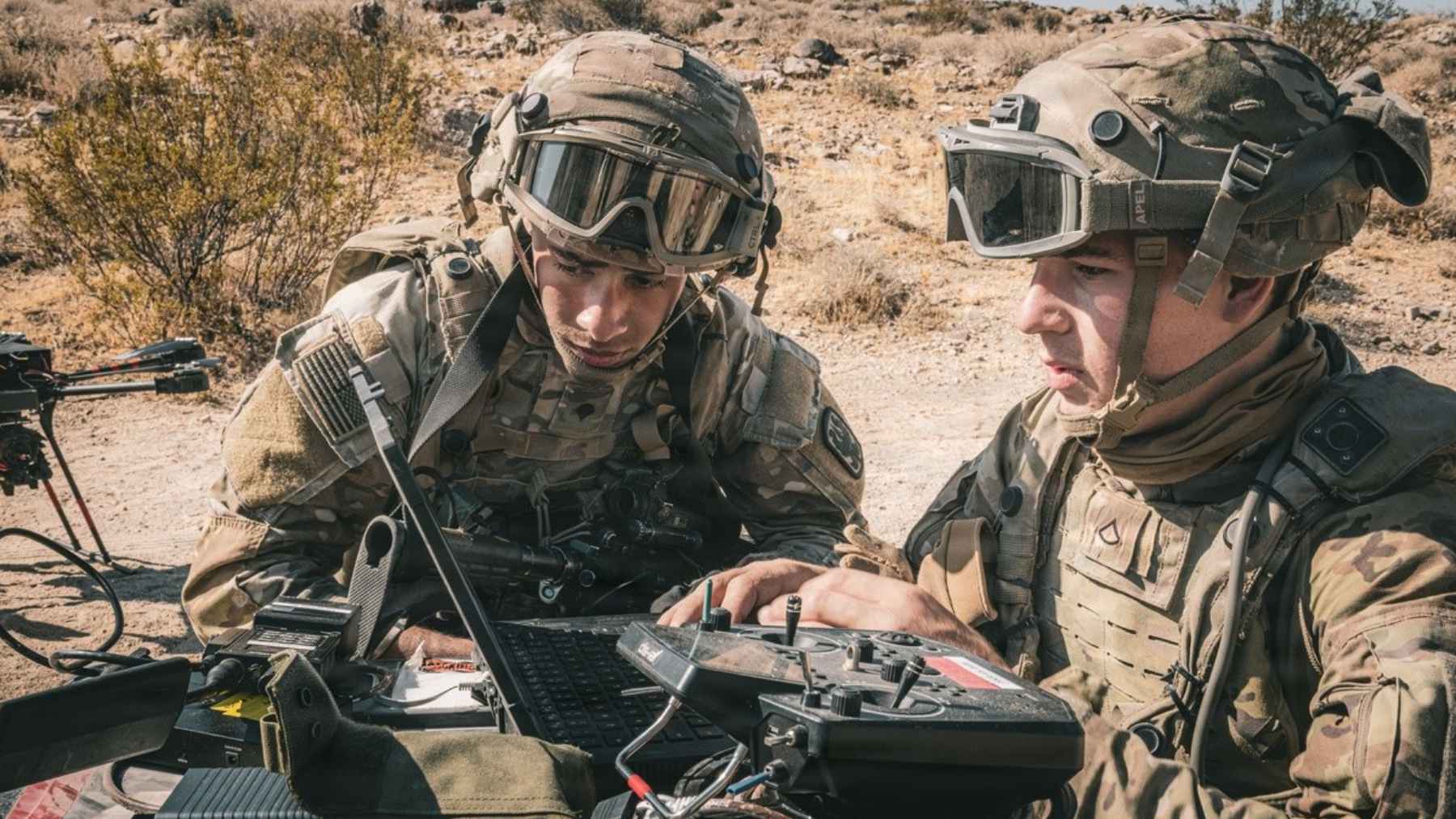
Hall said the trial demonstrated deployable counter-PNT effects and “resilient mesh networking,” but the official release did not disclose the emitter’s range, power output, frequencies, target set, or performance against specific weapons.
Deny the signal, keep the network
Electronic warfare creates an awkward problem. A force may want to disrupt an opponent’s navigation while still protecting its own ability to communicate, synchronize fires, and move through the same congested spectrum.
Hammer of the Gods is notable because the Army presents it as both a counter-PNT emitter and a command-and-control enabler. Its mesh network is intended to keep friendly devices connected in degraded conditions, supporting the familiar requirement to “shoot, move and communicate” even when satellite services or radio links are under pressure.
This fits a wider two-sided strategy. The Army is also fielding MAPS GEN II, an assured PNT system that uses M-code, sensor fusion, and anti-jamming and anti-spoofing features to help vehicles operate when GPS is degraded or denied.
Part of a much larger experiment
Hammer of the Gods was only one piece of PC-C6, the Army’s largest Project Convergence event to date. The 10-day exercise at Fort Irwin brought approximately 10,000 participants together to examine more than 90 technologies, concepts, and formations, with personnel from the United Kingdom, Australia, Canada, and New Zealand joining U.S. forces.
The central focus was Next Generation Command and Control, known as NGC2, which combines data, software, artificial intelligence, and multiple communications paths to speed decisions across a formation. By the end of PC-C6, Army leaders said the architecture was ready to begin scaling beyond the prototype phase, starting with I Corps and related units.
That context changes how the maritime trial should be read. Hammer of the Gods was not tested as a lone gadget but as one electronic warfare tool inside a broader network built to sense threats, share information, and coordinate effects across services.
What remains unproven
The Army’s announcement establishes an integration milestone, not a complete battlefield scorecard. It offers no public figures for effective radius, precision of the interference, duration, resistance to enemy countermeasures, or whether live precision munitions were defeated during the event.
That distinction matters because GPS is only one part of the navigation problem. The Government Accountability Office has warned that military PNT faces jamming, spoofing, cyber threats, and anti-satellite risks, while upgrades such as M-code and anti-jam antennas still leave vulnerabilities.
Because the Army released no target-by-target data, performance against weapons with different navigation architectures remains unknown. The same is true for the system’s ability to maintain friendly connectivity while producing electronic effects in a more demanding operational setting.
The quiet battle behind precision
The old image of missile defense is a missile chasing another missile. Hammer of the Gods points to a quieter contest in which the decisive move may be denying reliable coordinates before a weapon reaches its target.
If the approach works as intended, it could force an opponent to accept lower accuracy, spend more on hardened guidance, or change tactics while U.S. forces preserve their own network. Until the Army releases more testing details, however, the safest conclusion is narrower.
The maritime variant has crossed from land demonstrations into joint at-sea experimentation.
The official statement appears on the U.S. Army.