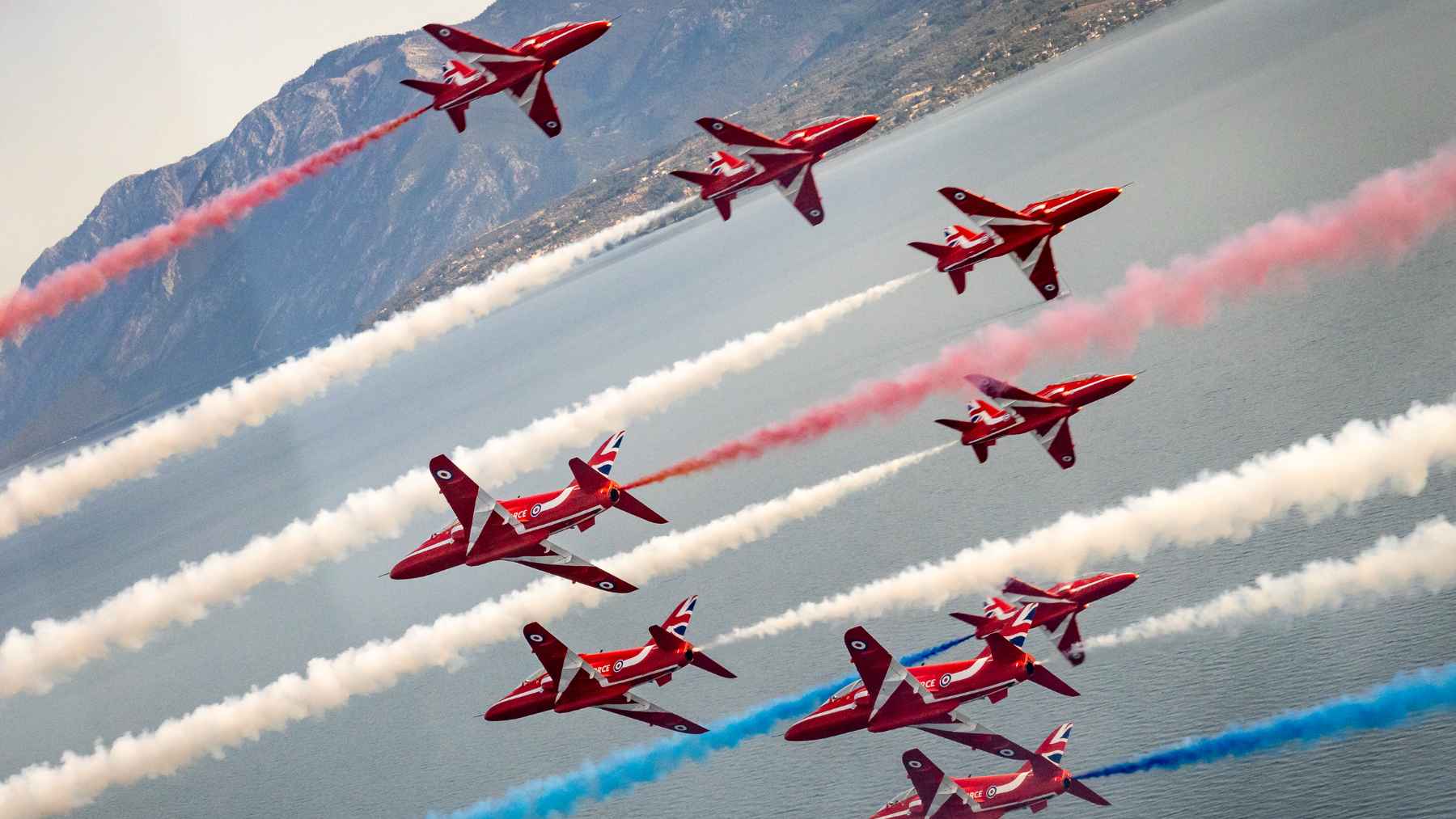
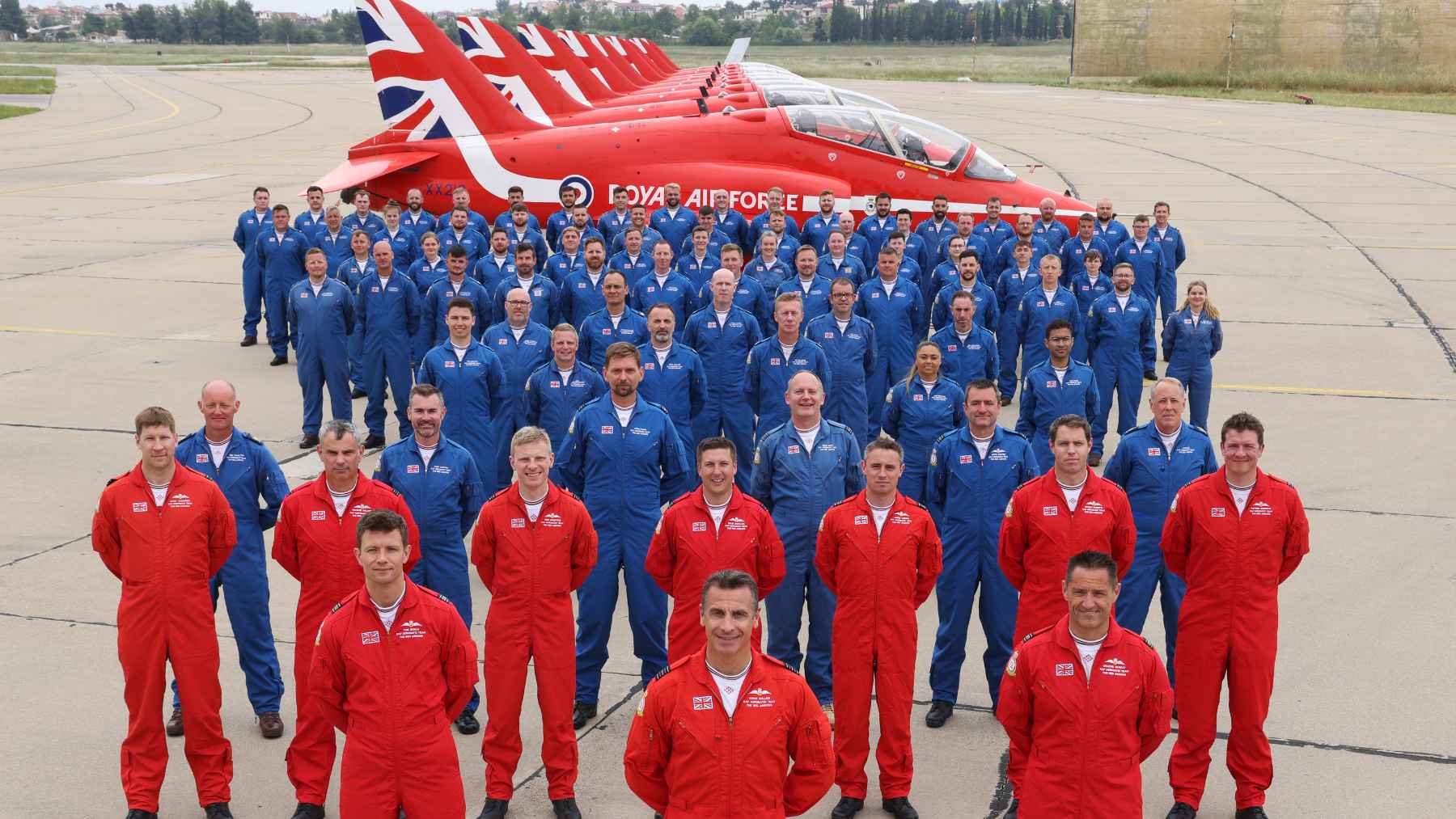
The Red Arrows remain at Canadian Forces Base Goose Bay after prolonged poor weather blocked their staged return to Britain from Operation Eagle Hawk.
The Royal Air Force now expects the transatlantic journey to restart late in the week beginning Aug. 10, but the delay has forced the team to withdraw from Airbourne in Eastbourne, the Royal Edinburgh Military Tattoo, and Lyme Regis Lifeboat Week.
At first glance, this may sound like a routine weather hold. It is not. The Red Arrows’ single-engine Hawk T1 jets cannot refuel in the air, so crossing the North Atlantic depends on several fuel stops, a workable weather window, limited diversion airfields, and support aircraft being correctly positioned.
Why the Hawks cannot simply fly home
The Hawk T1 was built as a training and aerobatic jet, not as a long-range transport aircraft. RAF specifications give it a maximum range of 1,000 nautical miles, or about 1,151 miles, but safe planning must still account for fuel reserves, winds, payload, routing, and alternate airfields.
On a map, the journey from Canada to Britain can look like one long flight. In practice, the Red Arrows must move home in stages through Canada, Greenland, and Iceland. The RAF said one attempted sortie had already turned back to Goose Bay because the conditions no longer met the team’s operating limits.
The Hawks do not travel alone. Search-and-rescue coverage and RAF aircraft carrying technical equipment are part of the same moving chain, so a delay at one point can affect the entire Atlantic trail.
Weather without the climate leap
The RAF has identified prolonged poor weather in northeastern Canada and the Atlantic’s complex weather patterns as the reason for the postponement. Its public updates do not say whether the decisive hazard was wind, visibility, low cloud, icing, or a combination, so choosing one would be speculation.
It would also be a mistake to present this single disruption as proof that climate change caused the delay. One weather event cannot establish a climate trend. What the episode does show is how environmental conditions can expose the limits of aircraft, routes, and support plans even when planners build extra time into the schedule.
Three major appearances lost
The Aug. 8 update confirmed that the Red Arrows will not perform at Eastbourne, the Royal Edinburgh Military Tattoo, or Lyme Regis Lifeboat Week. All three events remain scheduled, and the RAF has arranged or retained other appearances to reduce the gap. Wing Commander Sasha Nash said, “We are very sorry the Red Arrows cannot participate.”
Eastbourne is still due to feature the Typhoon Display Team and the Battle of Britain Memorial Flight. A C-17 Globemaster and two Typhoons are set to fly over the Edinburgh event on Aug. 15, while the Battle of Britain Memorial Flight is scheduled to make Lyme Regis flypasts on Aug. 21 and 22.
Those replacements matter, but they do not erase the disruption. The Red Arrows are often a headline draw at large public events, although the official RAF update does not quantify any economic loss from their absence.
Goose Bay becomes a workshop
The team has used the enforced stay rather than simply wait beside the runway. Scheduled post-tour engineering that had been planned for Britain was carried out at Goose Bay, while some personnel took mandated mid-season leave so they would be rested for the return journey.
That is practical contingency planning. It should help the team rejoin its summer program more quickly once the aircraft reach Britain, although maintenance completed in Canada cannot create a safe weather window over the Atlantic.
The RAF had already included a buffer based on experience from crossings in 2019 and 2024. Still, a buffer is a cushion, not a guarantee. This time, the weather lasted long enough to consume that margin and reach the public display calendar.
A successful tour with a difficult exit
Operation Eagle Hawk began in June as a month-long United States tour marking 250 years of American independence. The program included events in Maryland, New York, Maine, Michigan, and Wisconsin, plus a major international flypast over New York on July 4.
The deployment was designed as more than an airshow tour. The RAF presented it as defense diplomacy and included work with young people around science, technology, engineering, and math. The Red Arrows carried a British military, industrial, and educational message from city to city.
That successful public role makes the delayed return more visible. The compact Hawk can cross an ocean, but only through carefully coordinated hops. The logistics are part of the performance, even when spectators never see them.
The Hawk’s age is part of the wider story
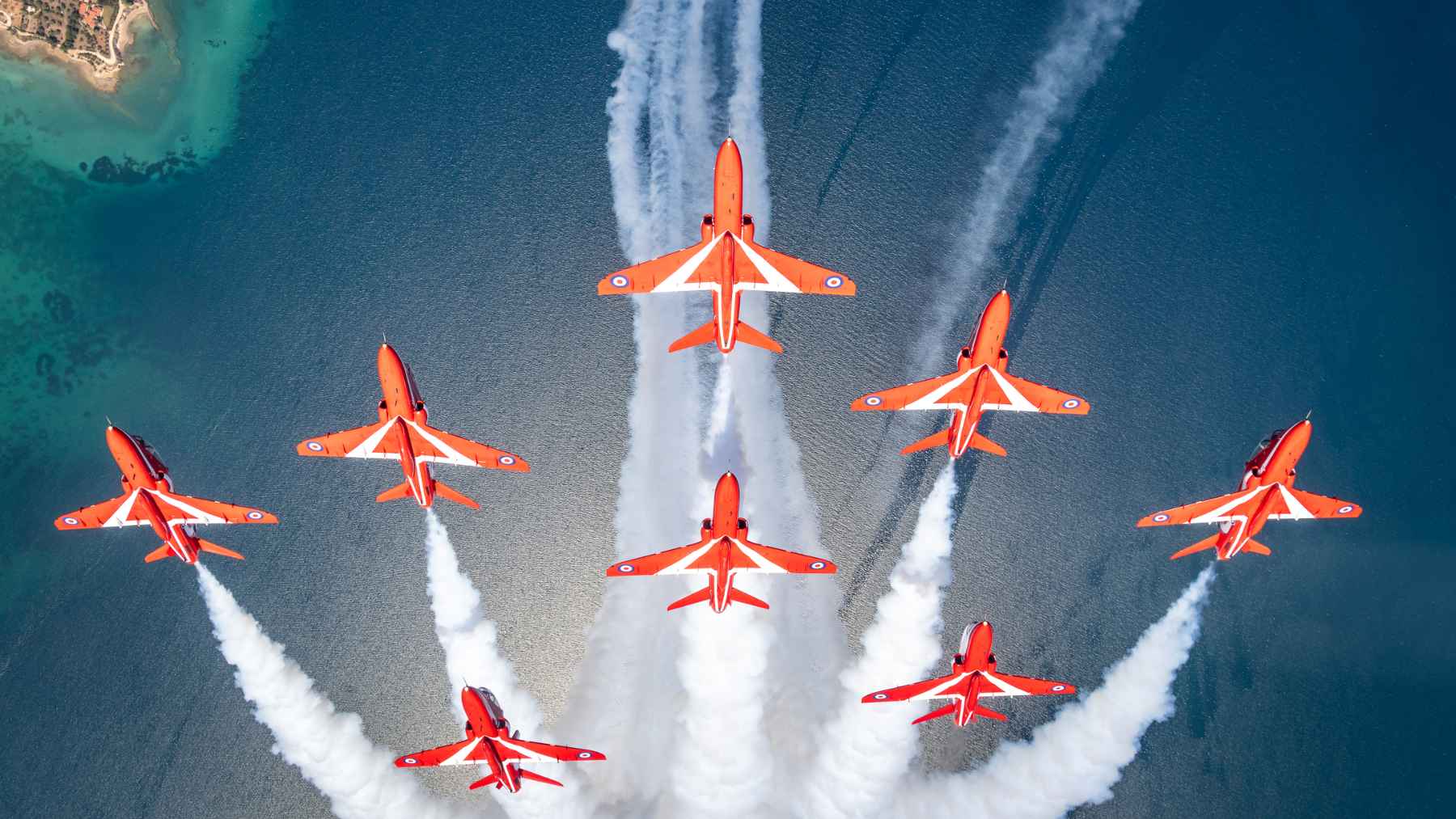
The Hawk entered RAF service in 1976 and has been flown by the Red Arrows since the 1980 season. The RAF expects the T1 to remain with the team through the end of the 2029 display season, while the British government’s 2026 Defence Investment Plan says new jets will replace the aging Hawk within a modernized training system.
That does not mean the Canada delay was caused by an old or faulty aircraft. The RAF has cited weather, not a mechanical failure, and scheduled engineering continued during the stop. Blaming age alone would go beyond the evidence.
Still, the episode highlights questions that will matter when a successor is selected. Range, support requirements, resilience after weather delays, and ease of overseas deployment all shape how effectively a display team can operate abroad. The government has not named the replacement aircraft or promised air-to-air refueling capability.
What happens next
The current plan is to resume the multi-leg crossing late in the week beginning Aug. 10, based on more favorable conditions. That is an operational expectation, not a guaranteed arrival date. Every leg will still depend on weather, diversion options, aircraft serviceability, and the wider support package.
For spectators, the safest approach is to check the RAF and individual event pages before traveling. Wing Commander Sasha Nash said safety is “the only factor that will determine the timing of the team’s return from Canada.”
The official statement was published on the Royal Air Force website.