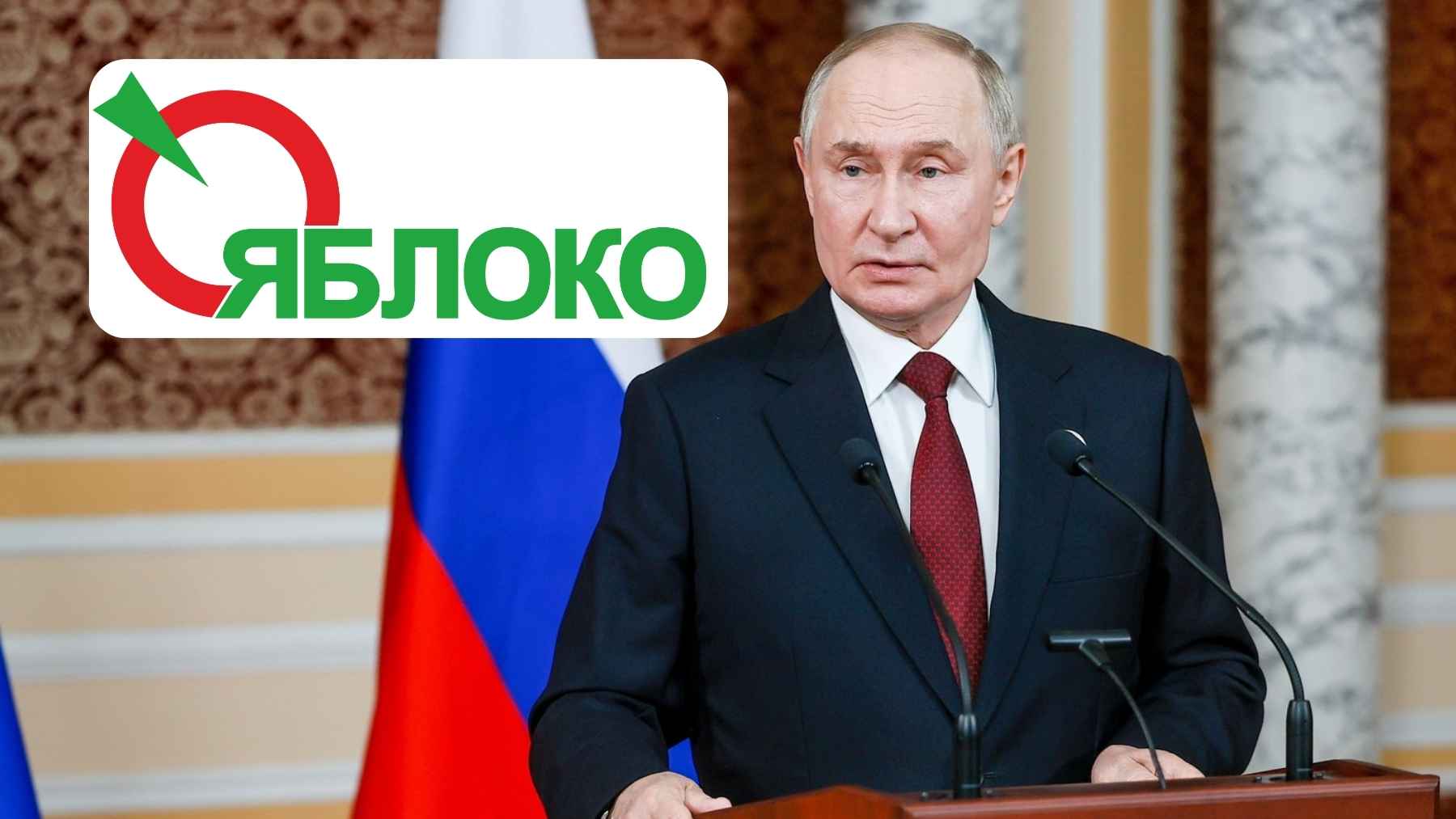
Russia’s dwindling space for legal political opposition is facing another test ahead of the September parliamentary elections. The liberal Yabloko party, which openly calls for a ceasefire, diplomacy and an end to political repression, is confronting mounting legal and administrative pressure as the country prepares to elect a new State Duma on Sept. 20.
The bigger fight involves more than Yabloko. Yabloko presents itself as the only registered Russian party contesting the election on an explicitly antiwar platform, while several of its candidates and senior figures have already been barred, prosecuted or jailed.
For voters who oppose the war in Ukraine, that leaves fewer legal ways to make their position visible at the ballot box.
Yabloko campaigns on peace
Yabloko’s election message is unusually short. Its official 2026 platform calls for “peace and freedom,” a ceasefire agreement, diplomacy, an end to political repression and what it describes as a Russia where people can live without fear.
The party nominated 275 candidates on its federal list and another 137 in single-member districts at its June congress. Four additional district candidates were later nominated under provisions allowing parties to add candidates already included on the federal list.
That campaign stands apart from the parties already represented in parliament. Yabloko itself argues that all five current parliamentary parties support the authorities’ political course and the continuation of the fighting, leaving it as the only registered party offering voters an explicitly antiwar choice.
That is Yabloko’s description of the political landscape, rather than an independent legal designation.
Court battles are piling up
The pressure is not theoretical. In Karelia, the regional branch of the nationalist Rodina party filed a lawsuit seeking to overturn the registration of Yabloko’s candidate list for the regional legislature. The Supreme Court of the Republic of Karelia accepted that case for consideration in July.
Yabloko has also faced trouble in St. Petersburg, where the city electoral commission refused to register its list for the Legislative Assembly election. Separately, courts have upheld decisions that prevent several prominent Yabloko politicians from taking part in the 2026 campaign.
That pattern matters. A challenge against one regional list could look like an ordinary election dispute. Add candidate bans, prosecutions and repeated court cases across several regions, though, and the party’s ability to campaign becomes considerably narrower.
Navalny posts have carried a price
Yabloko chairman Nikolai Rybakov is among those barred from standing for election. A St. Petersburg court fined him 1,500 rubles and stripped him of his eligibility to run for one year over a social media post expressing condolences after the death of opposition leader Alexei Navalny. Russian courts found that the post displayed symbols classified as extremist.
Rybakov appealed, but Russia’s Supreme Court upheld the lower court decisions in late July. Yabloko argues that the authorities are using extremism rules as a political instrument to remove opposition figures from the election. That is the party’s allegation, while the courts have treated the cases as violations of Russian administrative law.
Other party figures have encountered similar problems. Alexander Shishlov, a senior Yabloko politician in St. Petersburg, lost an appeal against a ruling that also prevents him from participating in the 2026 election.
Repression extends beyond elections
The legal pressure around Yabloko comes against a much broader crackdown on political dissent in Russia.
In June, a Moscow court sentenced Yabloko deputy chairman Maxim Kruglov to seven years in a penal colony over two social media posts. Yabloko said the posts expressed regret over the loss of human life and characterized the prosecution as politically motivated.
Russia has also continued expanding its system for blacklisting organizations connected with the opposition. On Aug. 7, authorities designated the New York-based Human Rights Foundation, chaired by Navalny’s widow Yulia Navalnaya, as an “undesirable organization.”
Under Russian law, cooperation with organizations carrying that designation can expose Russian citizens to prosecution.
For opposition activists, that creates an awkward reality. Support from well-known Russians abroad can help draw attention to a campaign, but links with people or organizations targeted by Moscow can also create new legal risks inside the country.
A shrinking legal route for dissent
Navalnaya has emerged as one of the most recognizable figures in Russia’s exiled opposition since her husband died in a Russian penal colony in February 2024. She has said she intends to continue his political work and has publicly opposed President Vladimir Putin’s rule and the war in Ukraine.
Alexei Navalny himself had historical ties to Yabloko before becoming Russia’s best-known anti-Kremlin campaigner. His later “Smart Voting” strategy encouraged Russians to support whichever candidate had the strongest chance of defeating the Kremlin-backed contender in a given race.
Yabloko, however, is trying to operate inside Russia rather than as an exile movement. That distinction helps explain why outside endorsements can be politically useful and legally dangerous at the same time.
Why the September election matters
The State Duma election is scheduled for Sept. 20, 2026. Yabloko describes the vote as a rare remaining opportunity for Russians who want an end to the fighting and political repression to express that position through legal electoral channels.
Whether that opportunity survives intact is another question. Candidate exclusions, court challenges and administrative cases are already reshaping who can appear on ballots well before voting begins.
For ordinary Russians, the stakes are fairly simple. An election can only measure competing political views if voters are actually allowed to choose between them. As the September vote approaches, the battle over Yabloko is becoming a test of just how much political choice remains.
The official election program and statement on Yabloko’s participation in the September 2026 State Duma election were published on the party’s official website.