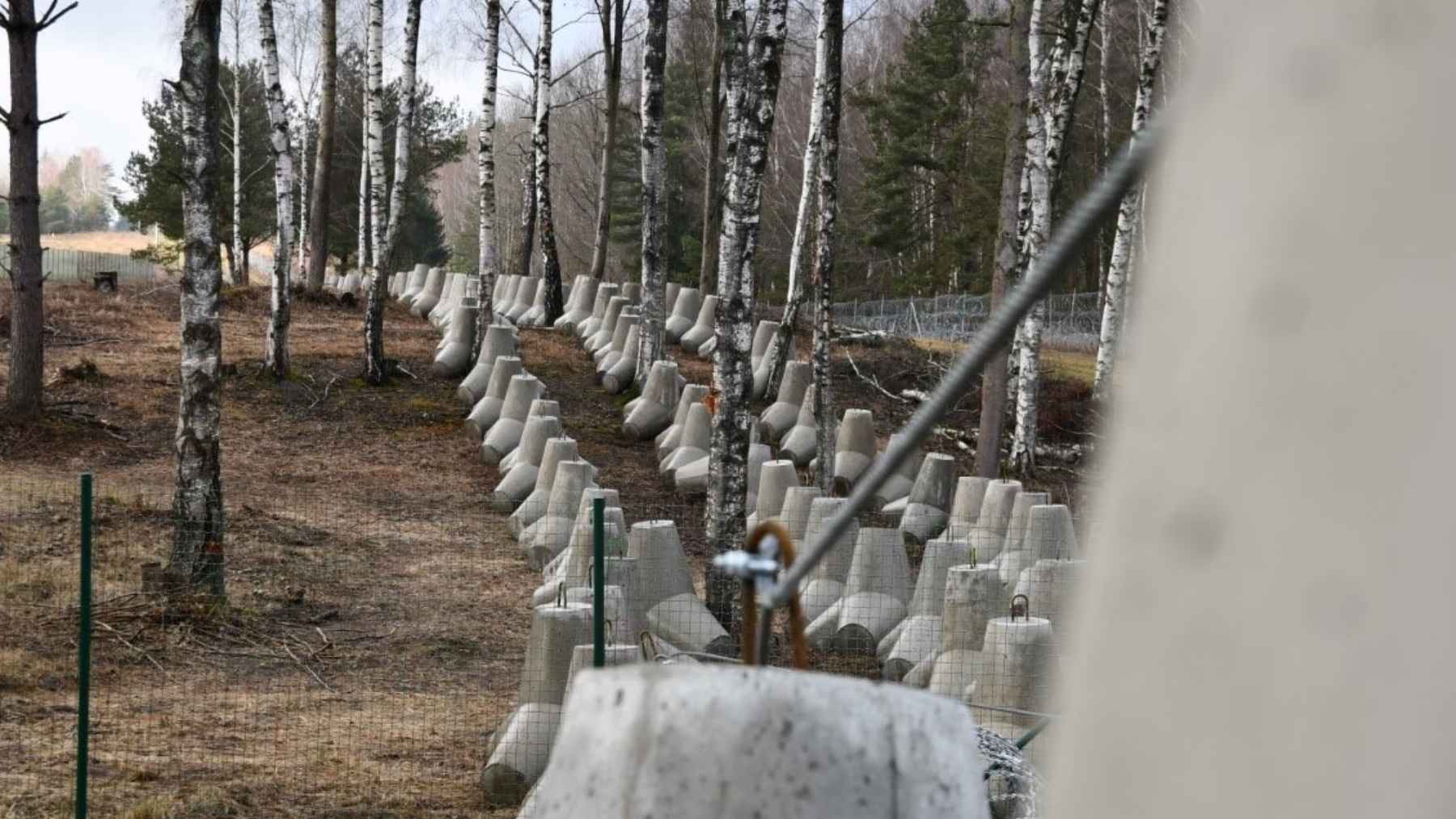
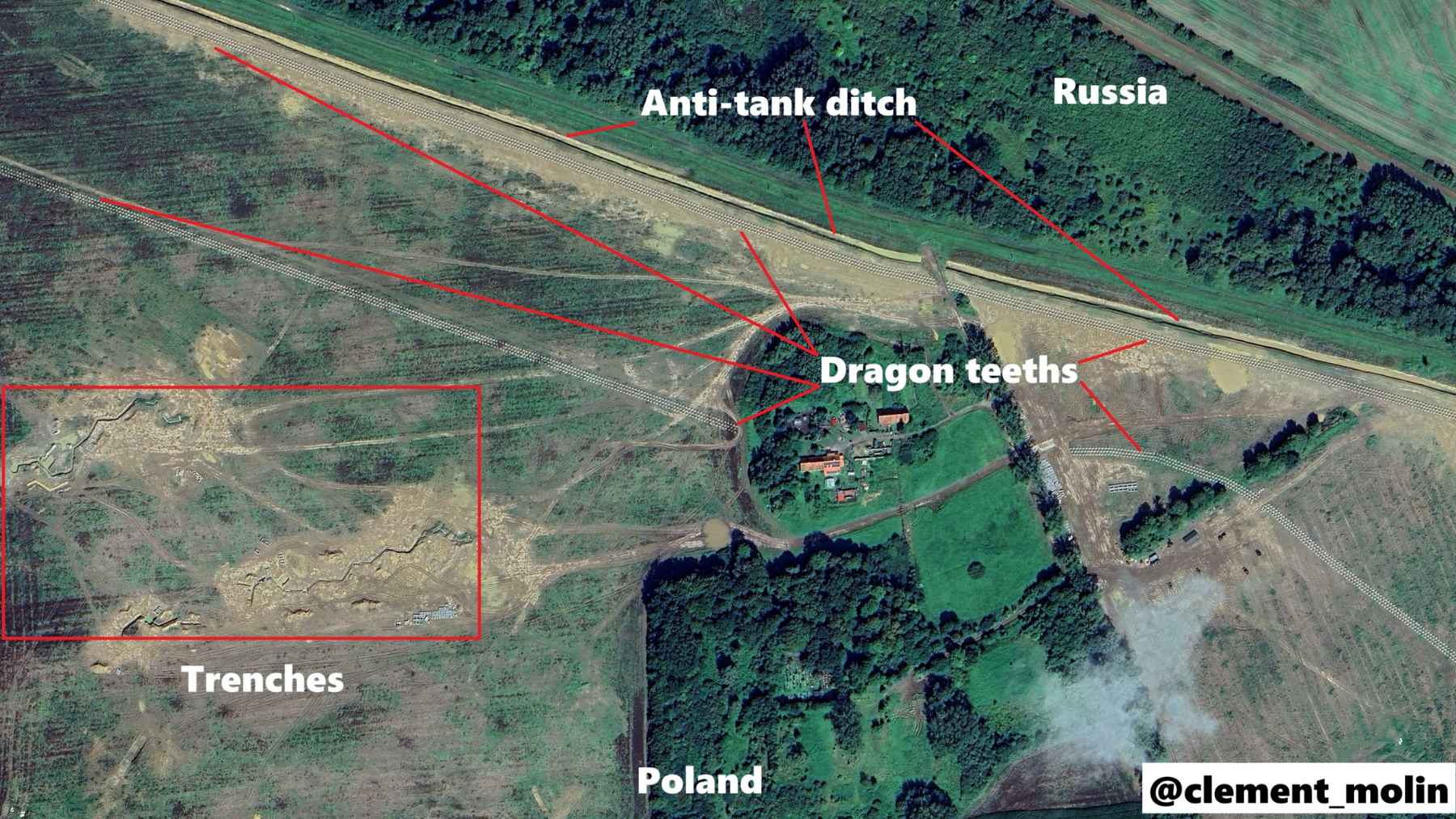
From orbit, Poland’s flagship border-defense project looks surprisingly small. A review of public satellite imagery by French open-source analyst Clément Molin identified visible defenses in only four short zones along Poland’s roughly 130-mile frontier with Russia’s Kaliningrad exclave.
That is a striking contrast with the wider East Shield program, which is meant to cover nearly 435 miles beside Russia and Belarus.
The finding is serious, but it does not prove the shield barely exists. Its official design combines fixed works, stored obstacles, sensors, and natural terrain rather than one uninterrupted wall. The harder question is whether that dispersed system can be assembled fast enough under wartime pressure.
What satellites found
Molin’s imagery review showed visible defenses in four areas, with the longest stretch measuring about 1.2 miles. He described broken anti-tank ditches, one or two rows of concrete “dragon’s teeth,” gaps at forest lines, and major roads that appeared to lack prepared blocking positions. None of the visible sections formed a continuous barrier.
A separate Polish security account focused on trenches near Rutka, about 984 feet from the border fence. Its concern was straightforward. Positions that close to the frontier could be watched by drones and struck early, while barriers farther inland might force an attacking formation to spread out and reveal its direction.
A shield, not a wall
Warsaw announced East Shield in 2024 as a roughly $2.7 billion program running through 2028. Official plans call for different levels of fortification across about 249 to 311 miles, while forests, wetlands, slopes, and other terrain would help cover the remaining distance. This is a layered plan, not a concrete ribbon from one end of the border to the other.
The system also reaches well beyond concrete blocks. Poland’s Defense Ministry says it includes detection and warning networks, anti-drone infrastructure, forward operating facilities, logistics hubs, protected positions, and improvements that help Polish and allied troops move while slowing an opponent.
That distinction matters. A row of obstacles can delay armored vehicles, but it cannot detect a drone, keep communications running, shelter civilians, or bring reinforcements forward. East Shield is closer to a defensive ecosystem than a border wall, which is why a satellite count of trenches captures only one part of the project.
The real issue is deployment speed
Poland’s own figures still show that permanent construction remains limited. By the end of 2025, the military said it had secured about 37 miles of border, but only around 6 miles consisted of new linear works. The remainder represented engineering equipment stored at 13 depots for rapid use.
The buildup has accelerated. By Aug. 5, 2026, the General Staff said 16 storage sites were receiving about 1,000 concrete anti-tank obstacles a day, with 300,000 units expected by mid-October. Officials said the accumulated barriers could secure roughly 62 miles of border, with about 124 miles targeted by year-end.
Here is the catch. Storing the barriers keeps roads, farms, and businesses functioning in peacetime, and officials say it “allows the economy and residents to function normally,” but it also makes transport, road access, trained engineering units, and warning time critical to the plan.
The same tradeoff shapes the camouflage debate, with one former intelligence analyst calling the visible sites a security lapse and a retired general arguing that visibility strengthens deterrence.
Nature is part of the barrier
The breaks at forest lines may look like unfinished work, but natural terrain is built into the regional strategy.
Poland plans to reinforce terrain that already slows vehicles, while Estonia says its strongpoints and obstacles are dispersed according to military plans, environmental analysis, local conditions, and agreements with landowners. In other words, a blank patch on a satellite image may sometimes be terrain doing part of the job.
Latvia is taking that idea a step further. Its Defense Ministry is supporting the restoration of abandoned peat-extraction areas into bogs, marshes, waterlogged ground, and forest along the eastern frontier. The project is intended to repair damaged ecosystems while creating terrain that is harder for heavy vehicles to cross.
There is a tradeoff. Ditches, bunkers, roads, storage areas, and cleared zones can place pressure on habitats and private land, even when planners use existing natural barriers.
The most durable version of this defense line will depend on careful siting, agreements with landowners, and environmental monitoring rather than treating every forest or wetland as space on a military map.
The Baltic picture has moved on
Molin’s review described Lithuania as the least fortified Baltic state and said direct construction had not begun in Estonia. Official updates now show a more complicated picture.
Lithuania reports 27 engineering-equipment parks along its borders with Russia and Belarus, while Estonia has installed its first bunkers, begun anti-tank ditch construction, and plans up to 600 concrete bunkers by the end of 2027.
Latvia also says anti-mobility materials are already being deployed and that 25 equipment parks are planned in its eastern border region. None of this creates a continuous fortress, and much of the equipment remains stored rather than permanently emplaced. Still, the absence of long visible lines should not be confused with the absence of preparation.
The strategic pressure is greatest around the roughly 40-mile Suwałki Gap, NATO’s only land connection between Poland and the Baltic states. Concrete obstacles will not defend that corridor by themselves. They must work with troops, artillery, air defense, drones, sensors, logistics, and allied reinforcement plans.
What matters before 2028
Satellite images have exposed a genuine gap between Poland’s headline promise and the amount of permanent fortification now visible. They have not proved that East Shield is empty.
The decisive test will be whether Poland and its neighbors can turn dispersed stores, natural terrain, sensors, and short fortified sectors into a coherent defense before an adversary can disrupt that deployment.
Poland still has until 2028 to close the distance between stored potential and fielded readiness.
The latest official East Shield update was published on the Polish Armed Forces website.