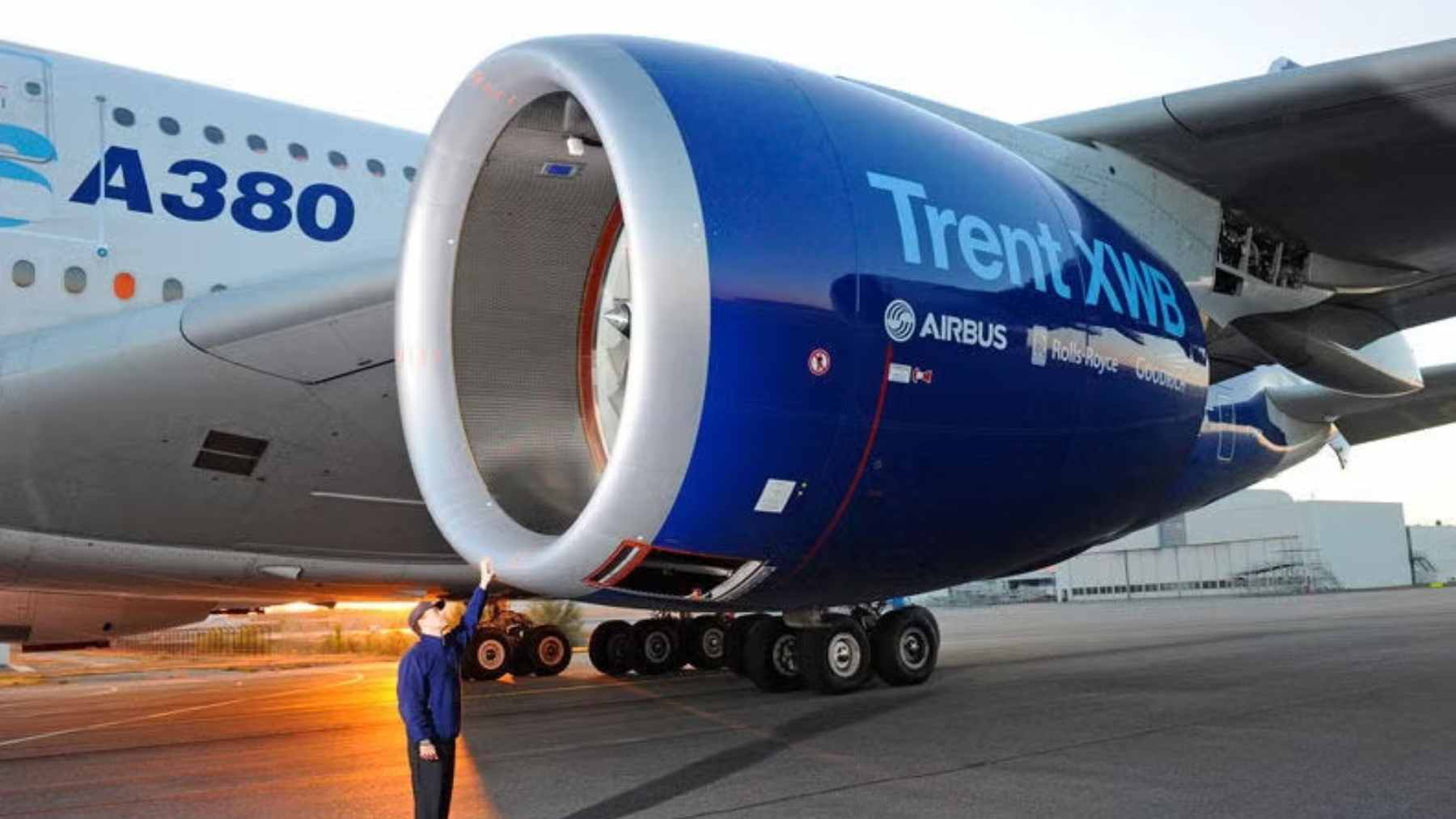
Rolls-Royce did not simply bolt a huge engine onto the Airbus A380 and call it a day. The Trent 900 was part of the superjumbo’s DNA from the beginning, a massive powerplant built for the world’s largest passenger aircraft and powerful enough to shape decisions around wings, braking, noise, and efficiency.
Now, that same engineering story has a second chapter. As aviation tries to cut emissions without grounding the global travel network, Rolls-Royce is using lessons from the Trent family to push UltraFan, a next-generation engine program aimed at burning less fuel, reducing noise, and working with sustainable aviation fuel.
This matters because aviation accounted for 2.5% of global energy-related carbon dioxide emissions in 2023, according to the International Energy Agency.
A giant built for the A380
The Airbus A380 remains a one-of-a-kind aircraft. Airbus describes it as the largest passenger plane ever built, about 239 ft. long with a wingspan of nearly 262 ft., and the only full-length double-deck commercial aircraft. It can carry more than 850 passengers in an all-economy layout.
That size demanded serious thrust. The A380 can be powered by four Rolls-Royce Trent 900 engines or four Engine Alliance GP7000 engines, according to Airbus. In practical terms, the aircraft was a flying city block, and every gallon of fuel mattered.
Rolls-Royce says the Trent 900 delivers the “lowest lifetime fuel burn” for the A380 and has received fuel-burn improvements of up to 1.6% since entry into service. That may sound small, but across long-haul fleets, tiny efficiency gains can add up quickly in fuel costs and emissions.
The redesign was more nuanced
Some versions of the story make it sound as if Airbus had to dramatically redesign the A380 after Rolls-Royce produced an engine that was too powerful, but the better reading is more nuanced. The aircraft and engine were developed in parallel, with Airbus already planning for a very large thrust class.
Still, the Trent 900’s size and the A380’s weight shaped the airplane around it. The wings, pylons, cooling systems, hydraulic integration, and braking strategy all had to fit an aircraft with four huge engines and a maximum takeoff weight of roughly 1.27 million lbs.
One notable design decision came with thrust reversers. Airbus ultimately used reverse thrust on the two inboard engines rather than all four, relying heavily on carbon brakes and wing spoilers while still adding extra help for wet or contaminated runways.
Power meets climate pressure
This is where the story moves from aviation trivia to environmental technology. Modern jet engines are not just about getting heavier planes into the sky. They are also about squeezing more distance out of each pound of fuel.
The IEA says aviation emissions reached over 1 billion tons of carbon dioxide in 2023, more than 90% of pre-pandemic levels. It also says the sector needs low-carbon fuels, better engine and airframe design, improved operations, and some demand restraint to align with a net-zero pathway.
That is a tall order. Planes last for decades, airlines run on thin margins, and passengers still expect affordable tickets. So the engine bay has become one of the most important battlegrounds in cleaner flight.
UltraFan changes the scale
Rolls-Royce’s UltraFan program is the company’s answer to that challenge. The UltraFan 80 demonstrator uses a 140-inch fan system, which Rolls-Royce describes as the largest in the world, and the company is aiming for a 25% fuel-efficiency improvement over first-generation Trent engines.
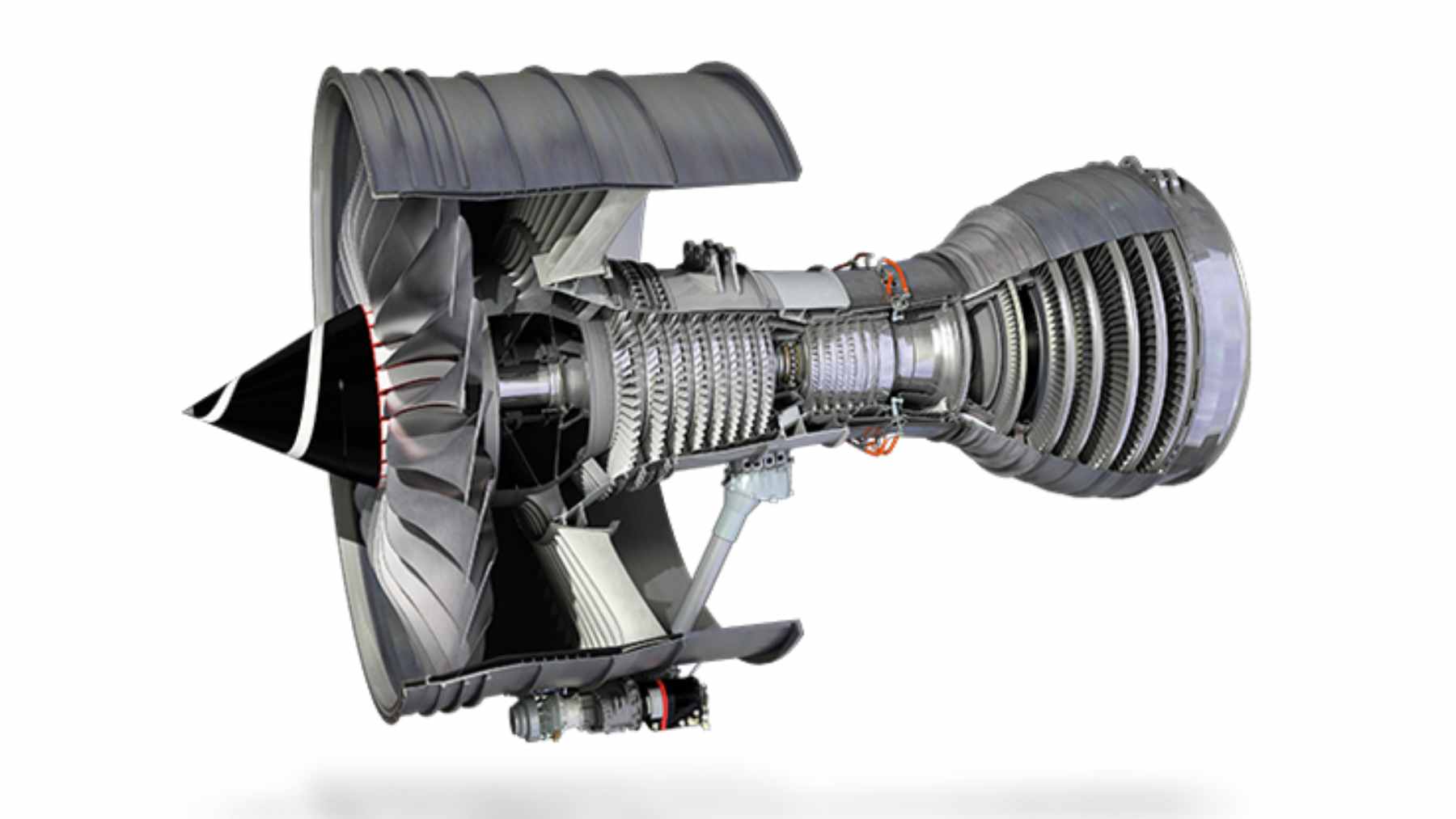
The engine has already hit major test milestones. Rolls-Royce says the UltraFan demonstrator reached full power at 85,000 lbs. of thrust in November 2023 after testing that used 100% sustainable aviation fuel and generated 35 terabytes of data. More testing for a second UltraFan 80 build is planned later in 2026.
At the end of the day, the idea is simple even if the machinery is not. A bigger, slower-turning fan can move more air more efficiently, while new materials, gear systems, and combustor technology try to cut fuel burn without giving up the reliability airlines demand.
The narrowbody prize
The next target may be even bigger from a business standpoint. Rolls-Royce is working on UltraFan 30, a demonstrator aimed at future narrowbody aircraft, the kind of planes most people board for everyday domestic and regional trips.
In March 2026, Rolls-Royce said it had secured about $74.5 million in European Union Clean Aviation funding to lead UNIFIED, a research project supporting UltraFan 30 development and planned ground testing in 2028. The broader Clean Aviation funding round represents about $1.1 billion in total research effort across selected projects.
That matters because narrowbody jets dominate airline fleets. Cleaner long-haul aircraft help, of course, but the daily rhythm of aviation is also shaped by short and medium-range routes, from early-morning business flights to family trips during school breaks.
SAF is not a magic fix
Sustainable aviation fuel is often presented as the clean answer for aviation. It is important, but it is not a silver bullet.
IATA estimates SAF could contribute up to 65% of the emissions reductions needed for aviation to reach net-zero carbon dioxide emissions by 2050. It also says current waste-oil-based SAF can reduce lifecycle emissions by around 80% compared with conventional jet fuel, depending on how it is made.
The trouble is supply. The European Union Aviation Safety Agency, or EASA, reported that SAF production represented only 0.53% of global jet fuel use in 2024, and that it can cost three to 10 times more than conventional fuel. That is why engines that burn less fuel still matter, even in a future with more SAF.
What passengers should watch
For travelers, this will not show up as a dramatic change at the gate tomorrow morning. The plane will still look like a plane, the boarding line will still move too slowly, and the overhead bins will still fill up fast.
Behind the scenes, however, engine technology can influence ticket costs, airline route planning, airport noise, and carbon footprints. Rolls-Royce’s Trent 900 helped make the A380 possible, and UltraFan is trying to make the next generation of aircraft less fuel-hungry.
The big question is whether the industry can move fast enough. Cleaner engines, more SAF, smarter operations, and better aircraft design all need to arrive together. No single invention will carry the whole load.
The press release was published on Rolls-Royce.