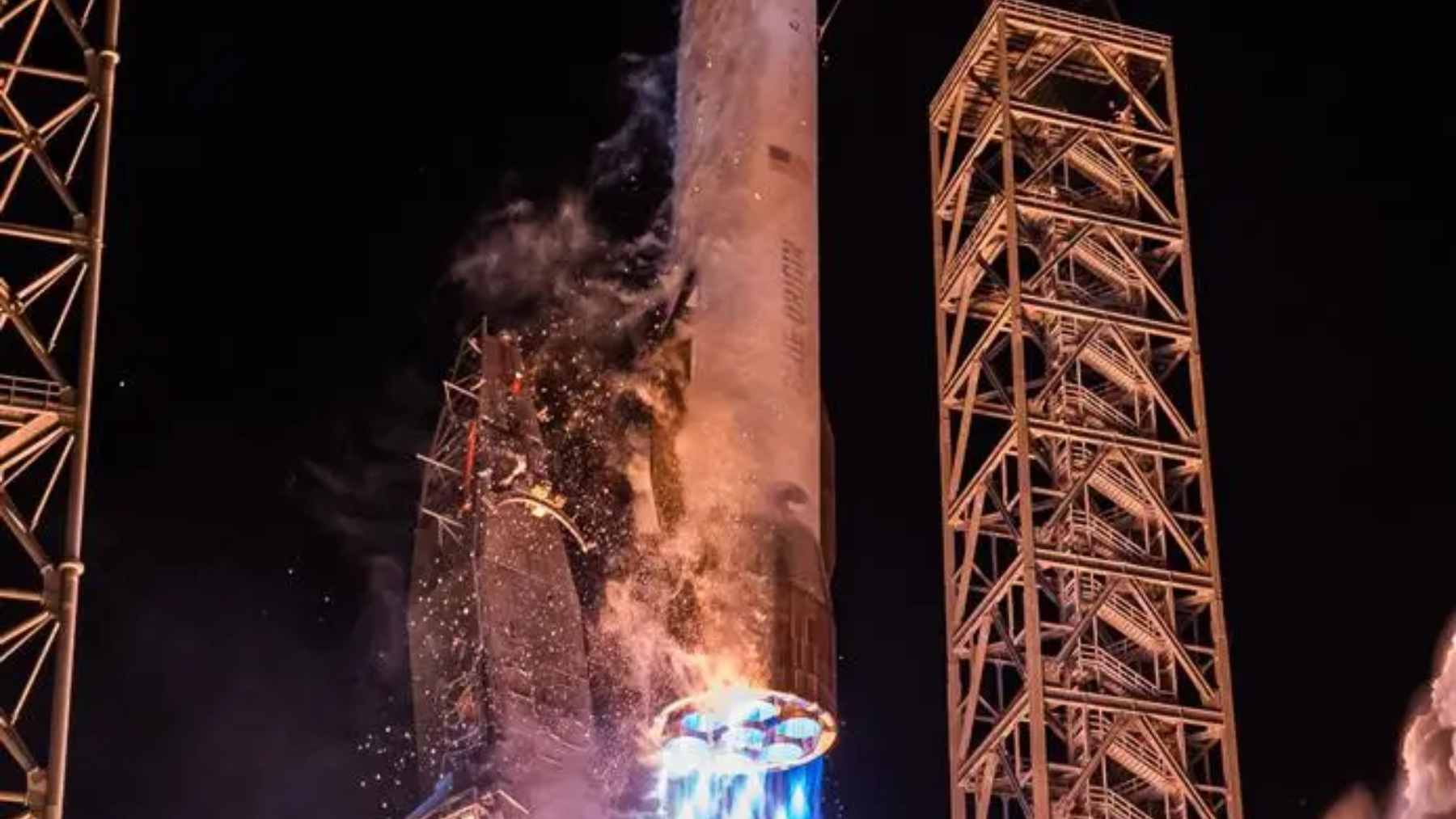
A Blue Origin New Glenn rocket exploded on the launch pad at Cape Canaveral Space Force Station during a hot-fire test, sending a huge fireball into the Florida night and shaking nearby homes.
The company said all personnel were accounted for, but the blast instantly turned a private spaceflight setback into a wider question about safety, debris, and the environmental footprint of the new space race.
This was not a launch. It was a ground test, the kind engineers use to fire rocket engines while the vehicle remains held down.
Still, when a rocket standing more than 320 ft. tall fails beside beaches, neighborhoods, and sensitive coastal areas, the story is not only about Jeff Bezos trying to catch Elon Musk. It is also about what happens on the ground after the sky lights up.
What happened on the pad
The explosion occurred around 9 p.m. local time on May 28 as Blue Origin prepared New Glenn for its next mission. Reuters reported that video from NASASpaceflight showed the rocket igniting on the pad before erupting into a fireball, with flames and smoke rising into the air.
Blue Origin described the event as an “anomaly” during the hot-fire test and said it would provide updates as more information became available. As of yet, the company has not yet publicly identified the technical failure that turned a routine engine test into a major accident.
The cause remains unknown
Jeff Bezos said it was “too early to know the root cause” and added that Blue Origin would rebuild whatever needed rebuilding. That is a careful statement, and for now it matters because early guesses after rocket failures are often wrong.
The Federal Aviation Administration said it was aware of the incident but noted that the test was outside the scope of FAA-licensed activities and did not affect regional air traffic. So the immediate public safety picture was less severe than the images suggested, but the technical investigation is still the big unanswered piece.
Debris became the first environmental concern
Blue Origin later warned that debris from the hot-fire anomaly could wash ashore in the following days or weeks. The company told the public not to touch or approach any possible wreckage and asked people to report its location.
That warning is important for anyone who lives near the Space Coast or walks those beaches after work or on the weekend. A rocket failure can quickly become a local cleanup issue, and the safest advice is simple: see something strange, leave it alone.
The fuel story is complicated
New Glenn is powered by seven reusable BE-4 engines that use liquid oxygen and liquefied natural gas, and Blue Origin says LNG burns cleaner than most traditional kerosene-burning rocket engines. That is part of the company’s pitch for a more reusable and less wasteful launch system.
But cleaner fuel does not make a launch site impact-free. A prior FAA environmental review for Blue Origin’s Cape Canaveral launch site examined engine testing, liquid-fueled heavy-lift launches, and air quality impacts, finding that the planned operations would not significantly affect the human environment under the reviewed conditions.
A pad explosion is different from a normal launch plan, and that is why the cleanup and investigation matter.
Why Amazon and NASA are watching
New Glenn had been preparing for a mission expected to carry 48 Amazon Leo satellites into low Earth orbit, part of Amazon’s broadband constellation effort. Reuters reported that the satellites were not integrated on the rocket at the time of the incident, which likely avoided an even more complicated debris and payload loss situation.
NASA also has a stake in what comes next. Just two days before the accident, the agency awarded Blue Origin $188 million, with a larger option period, to help deliver rovers to the Moon’s South Pole region as part of its broader lunar plans.
The defense angle
There is also a military and national security layer to this story. On May 28, the U.S. Space Force awarded Blue Origin a National Security Space Launch task order for a National Reconnaissance Office mission planned for late 2027 or early 2028 from Cape Canaveral.
After the anomaly, Space Systems Command said the Space Force and NRO remained committed partners with Blue Origin and would work with the company to identify the root cause and corrective actions. In other words, New Glenn is not just a commercial rocket–it sits inside America’s future launch plans for business, science, and defense.
Rebuilding the spaceport
Blue Origin CEO Dave Limp later said the propellant farm, oxygen, liquid hydrogen, and LNG tanks were in good shape. He also said the water tower was fine, the support tower could be repaired in place, and the company expected to fly again before the end of the year.
That is the optimistic read. The cautious read is that launch pads are complex machines, not just concrete slabs, and confidence will depend on what engineers find once the wreckage is cleared and every damaged system is inspected.
A bigger lesson for reusable rockets
New Glenn’s first stage is designed for at least 25 flights, and reuse is supposed to cut waste, cost, and manufacturing pressure over time. That is the promise of modern spaceflight, and it is a powerful one when it works.
But reuse only helps the environment to a large extent when the hardware is reliable, the ground systems are resilient, and failures are handled transparently. This explosion is a reminder that the “cleaner space race” is still a race involving enormous energy, complex fuels, coastal infrastructure, and real-world cleanup.
What to keep in mind
The most important fact is that no injuries were reported. The next most important fact is that the cause remains under investigation, and until that answer arrives, the explosion should be treated as both a technical failure and a public safety event.
For Blue Origin, the road back runs through engineering, regulators, NASA, the Space Force, Amazon, and the beaches around Cape Canaveral. That is a lot of ground to cover before New Glenn flies again.
The official statement was published on Blue Origin.