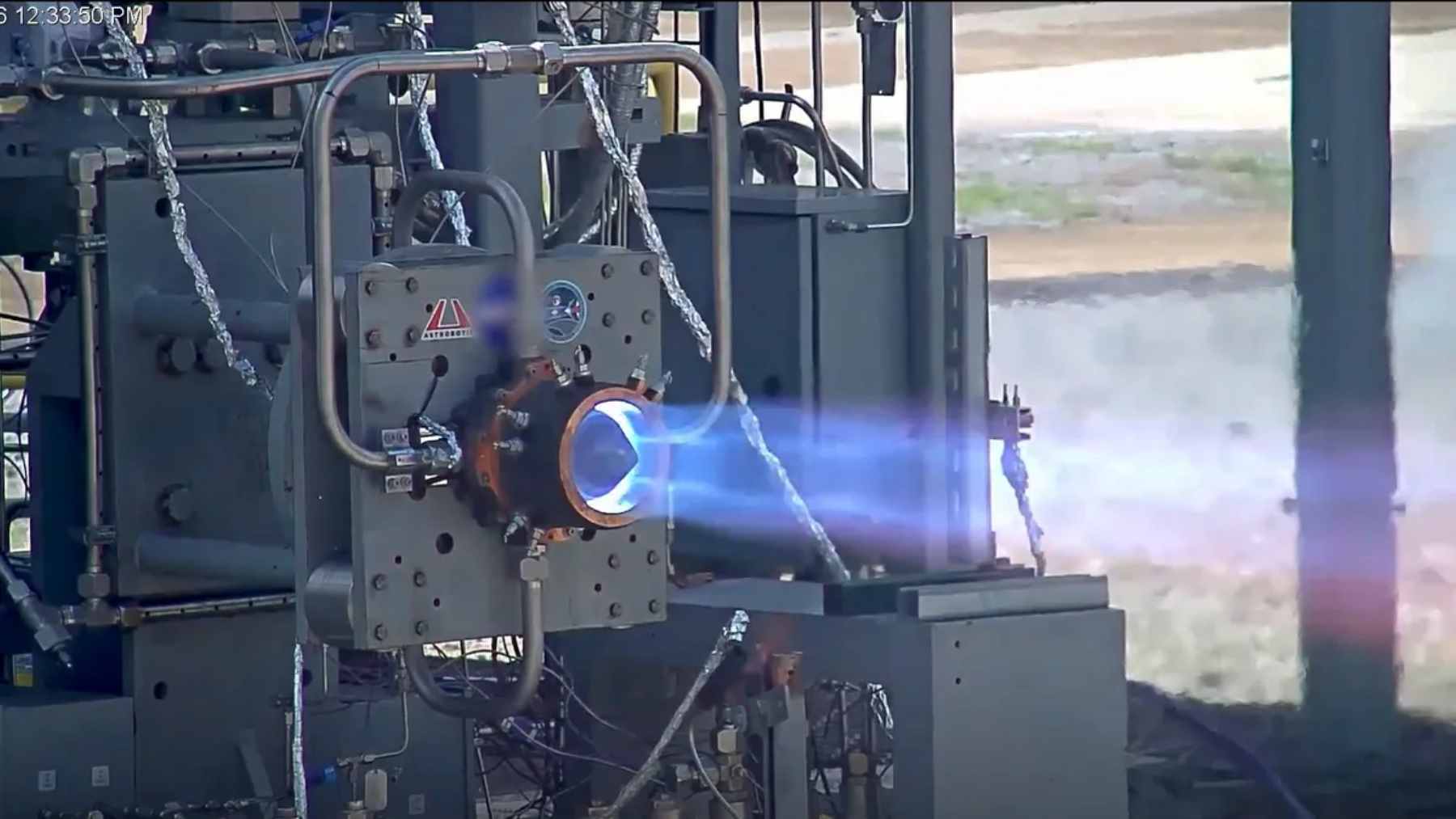
Astrobotic says it just ran its Chakram rotating detonation rocket engine continuously for 300 seconds at NASA’s Marshall Space Flight Center, a duration the company believes is a record for this technology.
Two prototypes logged more than 470 seconds total across eight hot fires, each producing over 4,000 lbs. of thrust, and Astrobotic reported no discernible damage to the hardware.
It is easy to treat that as a space nerd headline. But rocket exhaust does not stay near the ground, and researchers are increasingly warning that emissions injected high in the atmosphere can affect ozone and climate in outsized ways.
So the practical takeaway is more nuanced–a more efficient engine could help, but only if the industry also gets serious about measuring and limiting the full footprint of spaceflight.
The record and the tech behind it
In its April 23, 2026 press release, Astrobotic said most of the campaign reached thermal steady state, meaning the engine ran in a stable way long enough for temperatures to level out. That matters because RDREs have a reputation for being hard to tame once you move past short proof of concept bursts.
So what is different here? Instead of a steady flame in a chamber, an RDRE uses supersonic detonation waves that race around a ring-shaped channel, which can create higher pressure and better efficiency. Astrobotic says that pressure-gain-style combustion can boost specific impulse by as much as 15% while also improving thrust to weight and shrinking the engine package.
Why rocket exhaust is an environmental issue
Rocket pollution is not just carbon dioxide, and that is where things get tricky. A 2025 modeling study in npj Climate and Atmospheric Science lists key emissions as including black carbon particulates, alumina, water vapor, nitrogen oxides, and reactive chlorine species, depending on the propellant type.
Those ingredients can alter stratospheric chemistry in ways that are still being quantified.
The altitude is the problem. An Aerospace Corporation analysis notes that black carbon from kerosene-fueled engines can accumulate in the upper stratosphere while alumina from solid rocket motors tends to sit lower, and that small particles injected into the stratosphere can persist for up to about four years.
In other words, launch day ends, but the chemistry experiment keeps running overhead.
Efficiency helps, but launch volume can erase the gains
If an engine does the same job with less propellant, emissions per mission should drop in theory. That is why RDRE efficiency gains get people excited–it is like shaving waste out of a system, the way better insulation can chip away at a monthly electric bill.
But what happens if cheaper, lighter propulsion simply leads to more launches? The same 2025 ozone study points out how fast launch activity has grown, citing 102 orbital launches worldwide in 2019 and 258 in 2024, and it warns that ongoing growth could delay ozone recovery.
Under scenarios ranging from 884 to 2,040 launches per year, the authors projected a reduction in near-global, total-column ozone in 2030 of about 0.17% to 0.29%, with larger seasonal losses over Antarctica.
And launches are only part of the pipeline. In 2026, researchers reported the first near-real-time detection of a pollution plume from a reentering Falcon 9 upper stage by tracking lithium as a tracer, a reminder that reentry products can matter, too, as satellite fleets expand.
Business is chasing payload, flexibility, and manufacturing speed
Astrobotic is clear about where it wants this to go. The company says it plans to incorporate Chakram into future vehicles including Griffin-class lunar landers, Xodiac and Xogdor reusable rockets, and an orbital transfer vehicle for cislunar operations.
More performance per pound can translate into more payload, or more margin, which is often what makes a mission pencil out.
There is also a manufacturing story tucked inside the propulsion story.
Astrobotic says Chakram development was supported by two NASA SBIR contracts and a Space Act Agreement with NASA Marshall, and it highlights work on injector design and a proprietary metal additive manufacturing approach called PermiAM that aims to improve thermal management and combustion stability.
The next engineering targets sound less flashy, but they are the gates to real operations. Astrobotic says upcoming iterations will focus on regenerative cooling, throttling, and mass reduction, the kinds of features you need if the engine is going to fly, restart, and survive a demanding mission profile.
Defense interest adds momentum and pressure for oversight
RDREs are not just a commercial bet, they are a strategic one. The Air Force Research Laboratory says RDREs can improve performance for space launch vehicles, spacecraft, and missile propulsion, and it ties the work to supporting both the U.S. Air Force and the U.S. Space Force.
DARPA’s Gambit program also explicitly framed rotating detonation engines as a path to standoff strike of time-critical targets, arguing that the engines can be more compact and less complex than some conventional options.
Dual-use demand can accelerate adoption, which is another reason environmental monitoring and emissions transparency cannot be treated as an afterthought.
The press release was published on Astrobotic.