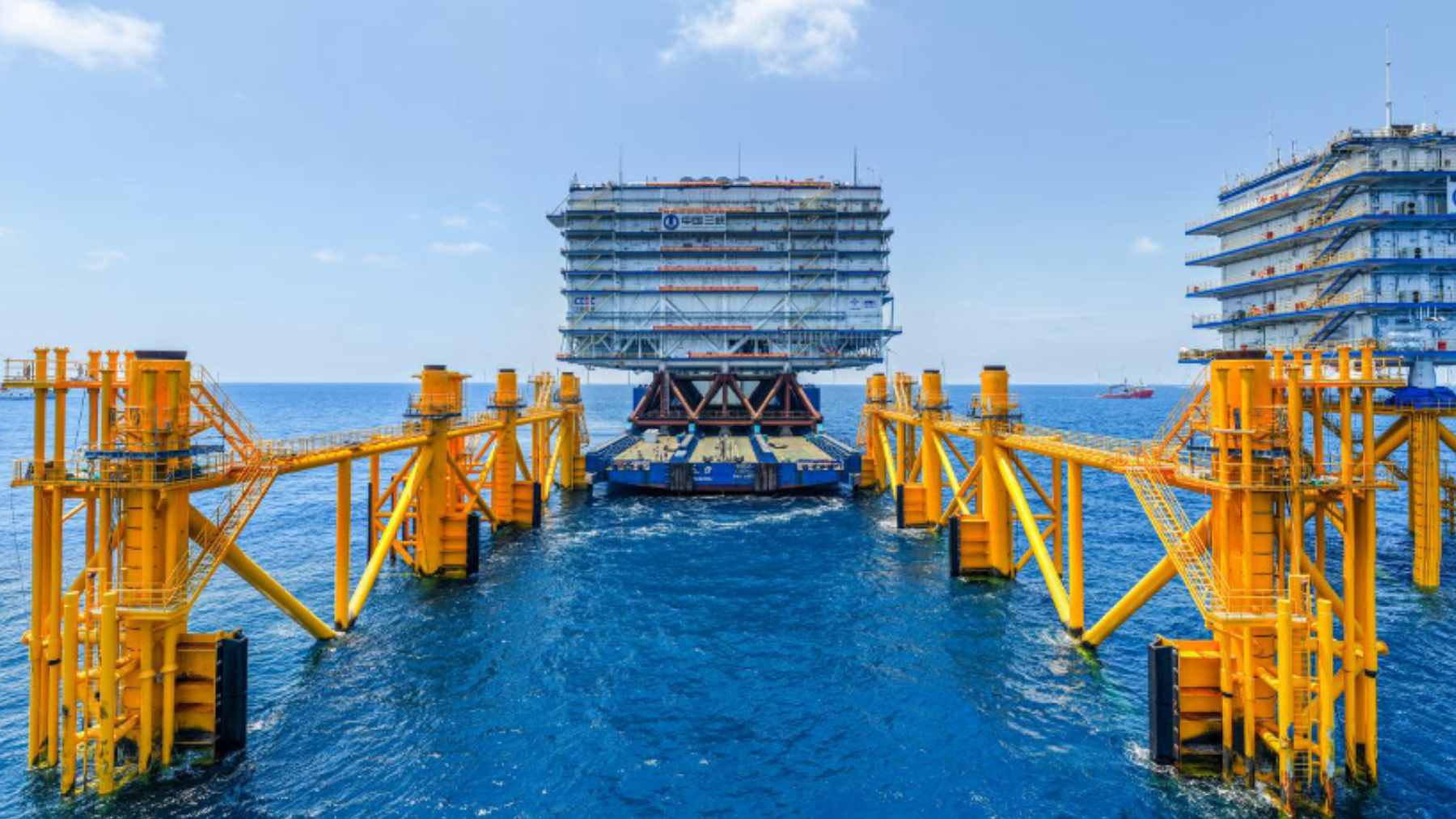
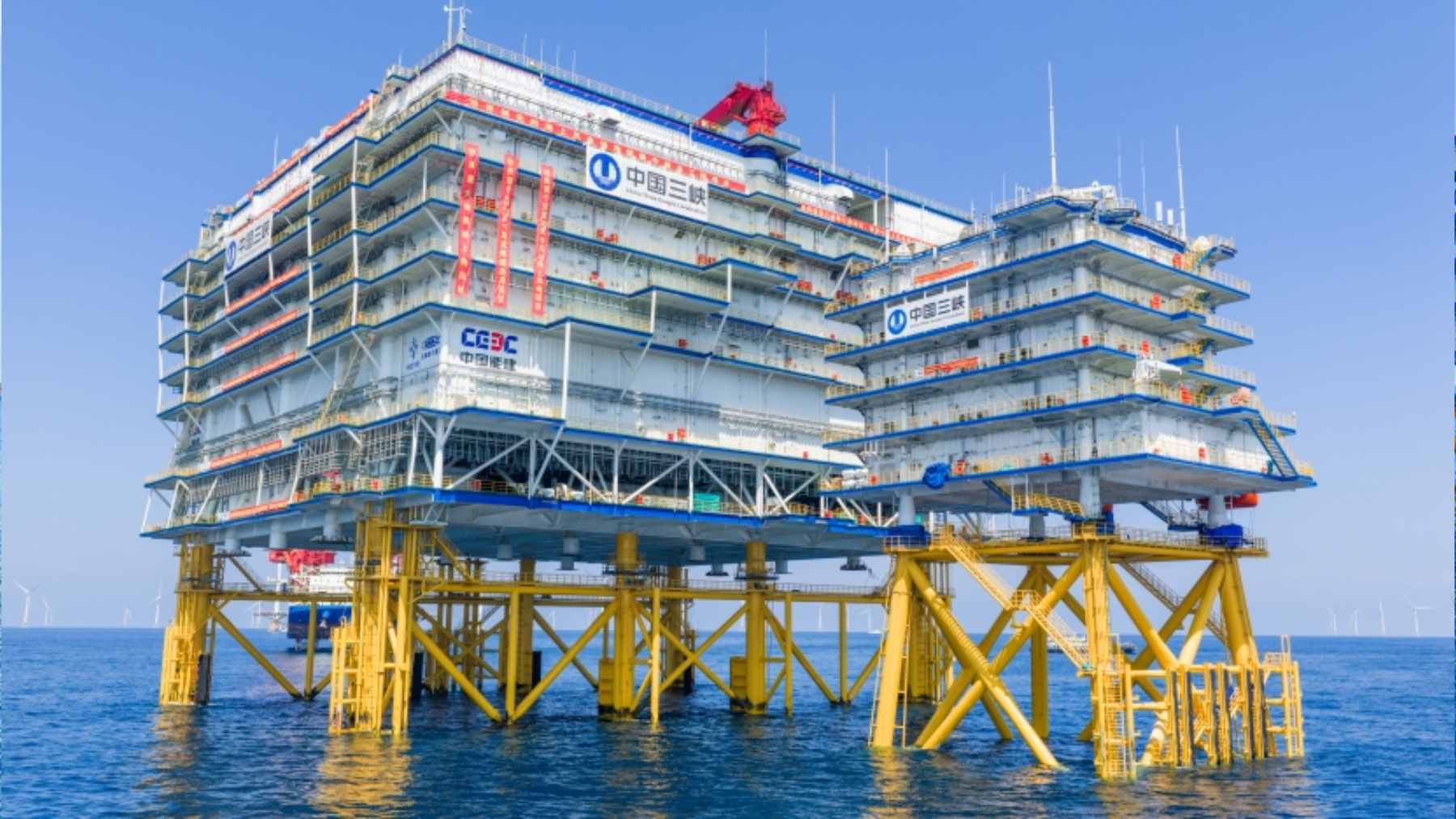
Moving clean electricity from the ocean to a city is not as simple as planting turbines in windy water. China’s Rudong offshore wind project shows why. Its huge converter station in the Yellow Sea was designed to gather 1,100 MW of offshore wind power and send it back to land through a roughly 62-mile submarine cable.
The platform does not generate electricity itself, but it may be the most important part of the whole system. By turning offshore wind power into high-voltage direct current, it helps reduce losses over long distances and makes far-from-shore wind farms more practical.
The hidden machine
The Three Gorges Rudong converter station was described as the world’s largest and Asia’s first offshore converter station when it was installed in 2021. It weighed about 24,250 tons and stood about as high as a 15-story building. That is not exactly the kind of equipment you just lift into place.
Its job was simple to explain but hard to do. The station collects power from the Rudong H6, H8 and H10 wind farms, converts it into direct current, and sends it to shore with fewer losses than a long alternating-current link would normally face.
Why direct current matters
When offshore wind farms move farther from the coast, the grid problem gets bigger. Alternating current can lose more energy over long submarine cable routes, especially when large amounts of electricity must travel many miles before reaching land.
That is where flexible high-voltage direct current technology comes in. Think of it as swapping a leaky bucket for a tighter pipe. The electricity still has a long trip, but more of it arrives where people actually need it.
A giant engineering bet
The station’s size forced engineers to avoid a standard crane lift. China Three Gorges said the platform was so heavy that even the world’s largest lifting vessels at the time could not handle the job, so crews used ballast systems and natural tides to position it.
That may sound like a detail for engineers only, but it isn’t. At the end of the day, better installation methods can decide whether offshore wind becomes a niche project or a repeatable industrial model.
The climate math
There is a small caveat in the household figures. China Classification Society said the full project could meet the annual electricity needs of about 1.36 million households, while China Three Gorges Renewables put annual generation at 2.4 billion kWh, equal to about 990,000 households. Different household-use assumptions can change the final number.
By CTG’s own estimate, the Rudong project can also save about 815,700 tons of standard coal and cut about 2 million tons of carbon dioxide emissions each year compared with a coal-fired plant of similar scale. That is the bigger point–clean power only counts when it can reach the grid.
China is already scaling it
Rudong was not the end of the story. On June 4, 2026, China Three Gorges said its newer “Heart of Sea Wind” offshore converter station had been installed in Guangdong waters, a larger platform built for the Three Gorges Yangjiang Qingzhou V and VII offshore wind farms.
That newer station weighs about 27,600 tons and is 144 ft. tall. CTG said it will deliver about 6 billion kWh of clean electricity each year after full operation and reduce carbon dioxide emissions by nearly 5.5 million tons.
What to keep in mind
The lesson is easy to miss. Offshore wind is not just about bigger turbines. It is also about cables, converters, software, corrosion protection, maintenance crews and grid planning.
The long and the short is that the sea can produce enormous amounts of power, but only if the hidden infrastructure keeps up. Rudong helped prove the concept. The next wave is about making that concept cheaper, smarter and easier to repeat.
The official statement was published on China Three Gorges Corporation.