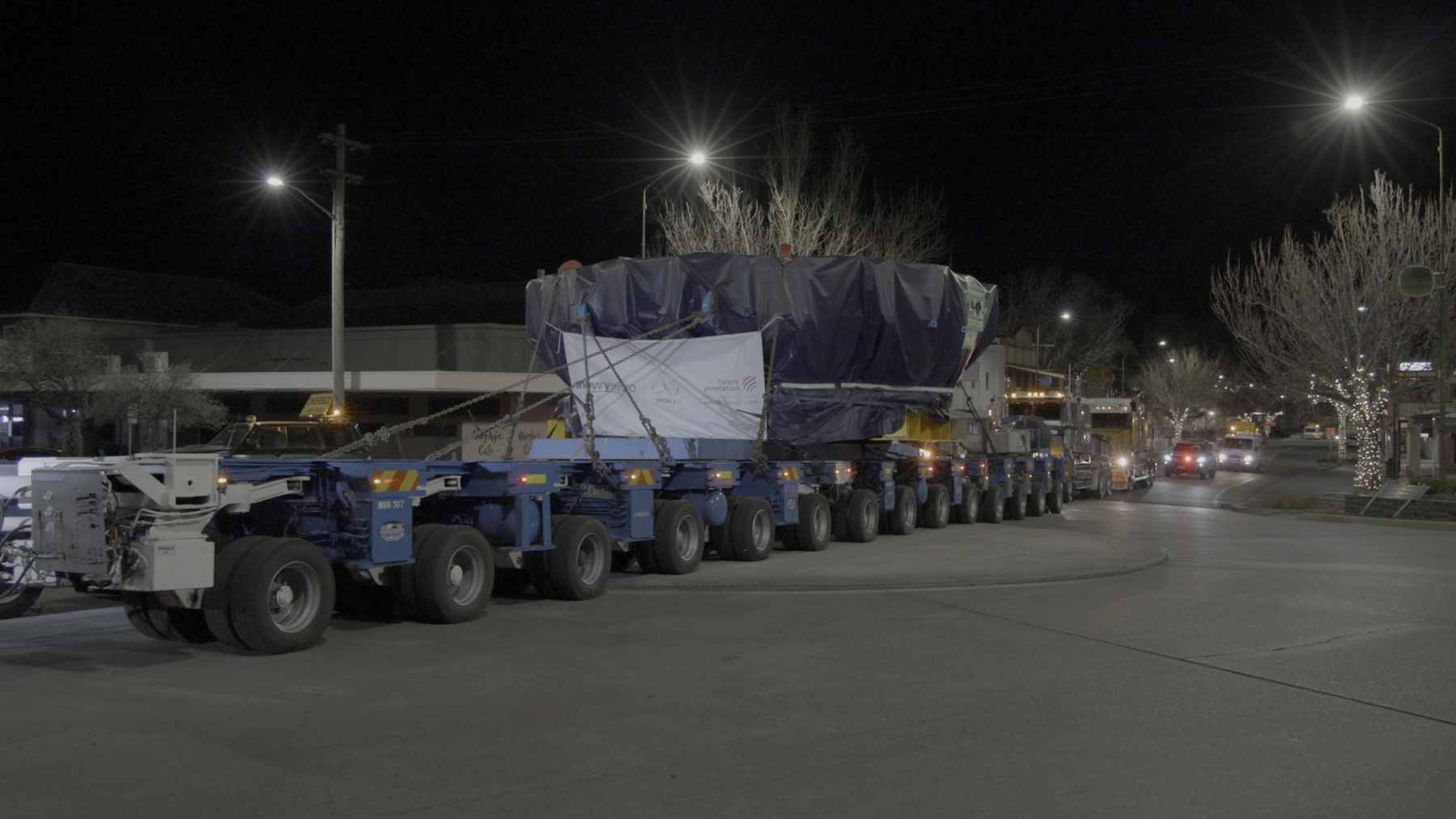
A piece of clean energy infrastructure does not always look like a solar panel, a wind turbine, or a sleek battery pack. Sometimes it looks like a 302,000-lb. steel cutterhead crawling through a mountain town at night on 152 wheels.
That is what happened in Cooma, New South Wales, when Snowy Hydro moved the center piece of tunnel boring machine Monica’s cutterhead to the Marica worksite north of Kiandra. The delivery was one step in Snowy 2.0, a 2,200-megawatt pumped hydro project designed to store clean energy and send it back to the grid when it is needed most.
A massive move through Cooma
Snowy Hydro said the center cutterhead piece traveled through Cooma on a Wednesday night in early October 2025, heading toward the remote Marica site. The transport stretched about 240 ft., rolled up Sharp Street, and then moved toward the Snowy Mountains Highway for the last leg of the trip.
For anyone watching from the sidewalk, it must have looked less like a delivery and more like a moving construction site.
The part measured about 23 ft. wide and weighed more than 151 tons, which explains why it needed a 152-wheel vehicle underneath it. Big infrastructure rarely passes the shopfront window, but this time, it did.
Why the cutterhead matters
A tunnel boring machine is basically a mobile underground factory. Its cutterhead is the rotating face that breaks rock and soil at the front, while the rest of the machine carries the tunnel operation behind it.
That is why this piece mattered. When Monica was commissioned in February 2026, Snowy Hydro said Snowy 2.0 was more than 70% complete and that the machine would excavate part of the 10.6-mile headrace tunnel through the geologically difficult Long Plain Fault Zone.
The headrace tunnel is not just another hole in the ground. In practical terms, it is part of the water pathway that will connect the reservoirs with the underground power station, allowing the project to store and release energy on a scale normal batteries cannot easily match.
Broken into five pieces
The cutterhead was too large to move as one object, so Snowy Hydro said it had to be split into five pieces. Even then, the center section alone needed months of planning and a carefully managed route through public roads.
This was also not a one-off delivery. More than 140 oversize loads had already been delivered from Port Kembla to the Marica site in the weeks around the move, each carrying parts needed to assemble Monica.
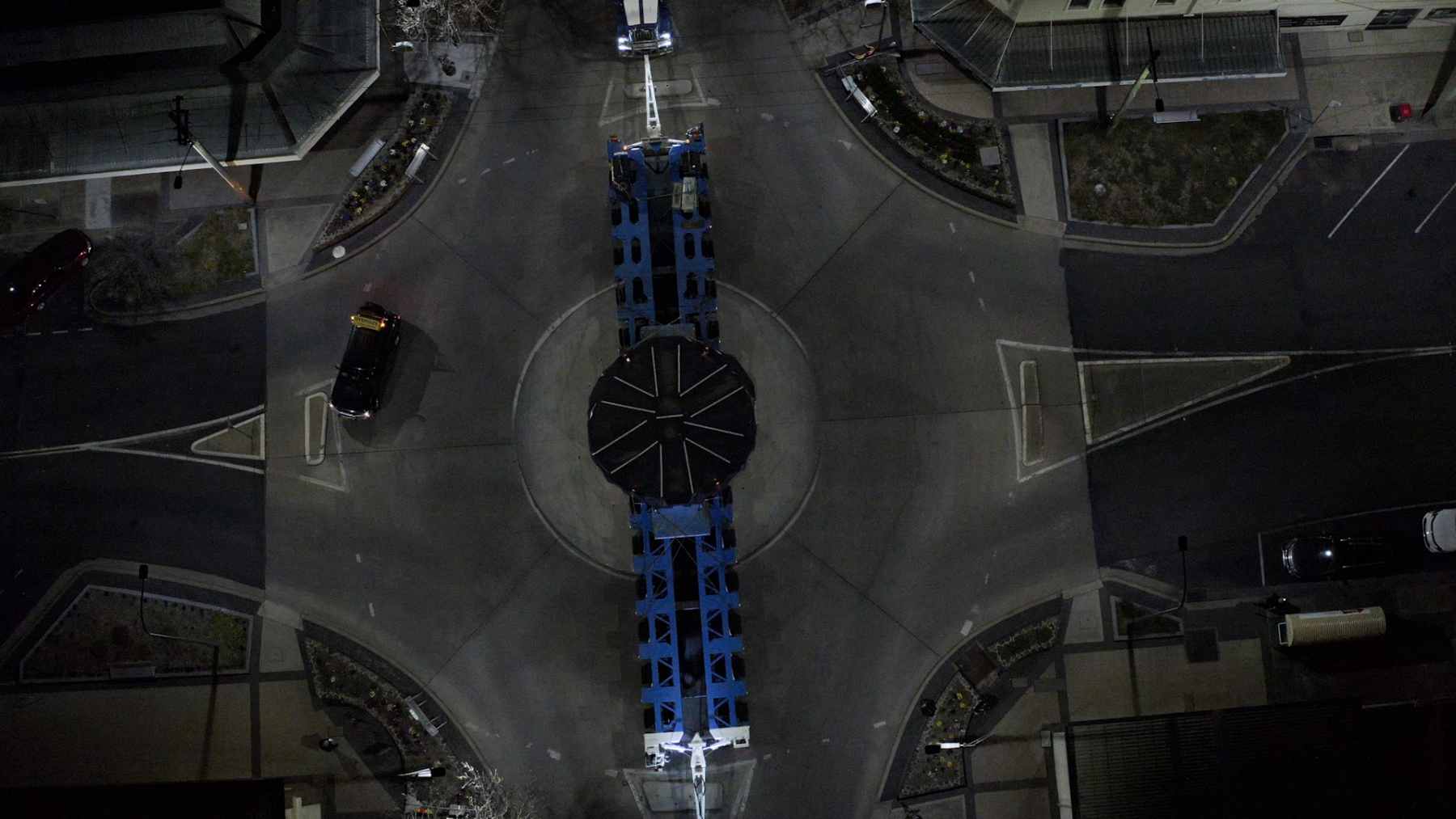
Dave Evans, Snowy Hydro’s chief delivery officer for Snowy 2.0, called the huge tunnel boring machine pieces an “amazing sight.” He also credited the transport team for completing a “complex operation safely.”
A giant battery under the mountains
Snowy 2.0 is often described as a giant battery, and that is a simple way to understand it. The project will link the Tantangara and Talbingo reservoirs through 16.8 miles of tunnels and a new power station roughly 2,600 ft. underground at Lobs Hole.
When electricity demand is high, water can be released downhill to generate power. When there is extra wind and solar energy available, the system can pump the water back uphill so it can be used again. That’s the whole trick.
By Snowy Hydro’s own estimates, the project will provide 2,200 megawatts of capacity and about 350 gigawatt hours of storage. The company says that is enough energy to power 3 million homes for a week, which is a number large enough to make even a 302,000-lb. cutterhead seem like only one piece of the puzzle.
The geology problem
Monica was not added to the project for show. Snowy Hydro has said the fourth tunnel boring machine is part of the effort to reduce risk through challenging geology in the Long Plain Fault Zone.
The broader context is less tidy. In October 2025, Snowy Hydro directed its principal contractor, Future Generation Joint Venture, to carry out a line-by-line cost reassessment, expected to take up to nine months, while the official completion target remained December 2028.
ABC News reported in June 2026 that Snowy 2.0 was years behind its early schedule and billions over budget, while also noting that Snowy Hydro still expected power generation to start in late 2027 with full completion in December 2028.
A machine with a local name
Monica’s name comes from Monica Brimmer, a Tumut High School student who won a First Nations art and storytelling competition connected to Snowy 2.0. Her artwork reflected flowing water, connected dams, mountains, energy, an underground power station, and connection to Country.
That detail gives the huge machine a more human edge. Megaprojects can sound like spreadsheets until a student’s name is painted on the equipment, and until families line the street to watch the steel pass by after dark.
It also fits the Snowy Mountains story. This region has been shaped by energy infrastructure before, and Snowy 2.0 is trying to write the next chapter while Australia adds more renewable power to the grid.
What readers should keep in mind
The 152-wheel convoy through Cooma was not just a strange traffic event. It was a reminder that clean energy storage is physical, heavy, and difficult to build.
Before the water moves through the mountain, someone has to move the machinery to the mountain. Before the grid gets more long-duration storage, crews have to assemble, test, and operate machines in places most people will never see.
For households, the promise is easy to understand. When summer heat pushes air conditioners hard, or when the wind drops after sunset, storage can help keep electricity available. The harder question is whether a project of this size can manage cost, geology, and schedule pressure all the way to the finish line.
The official statement was published on Snowy Hydro.