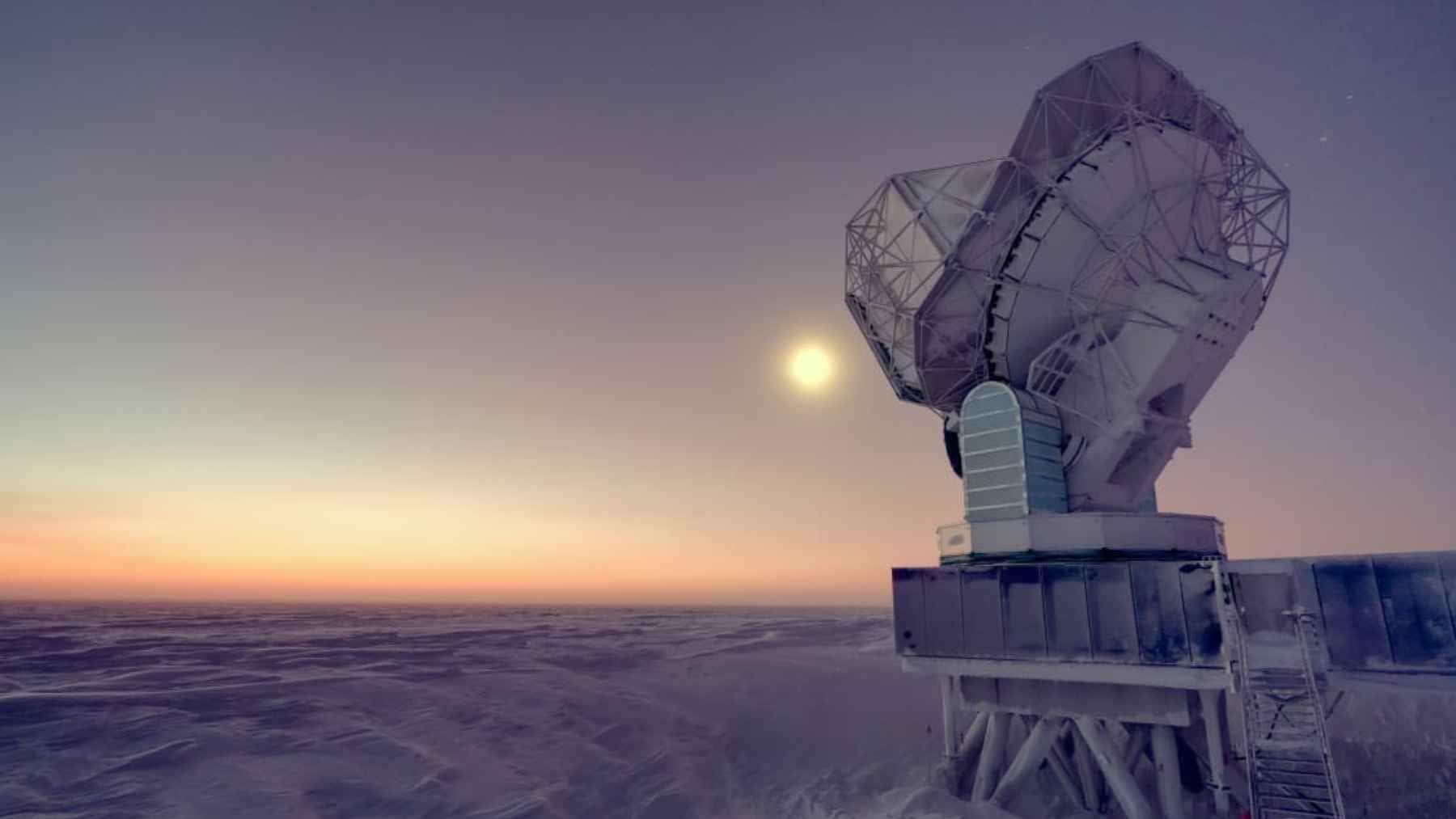
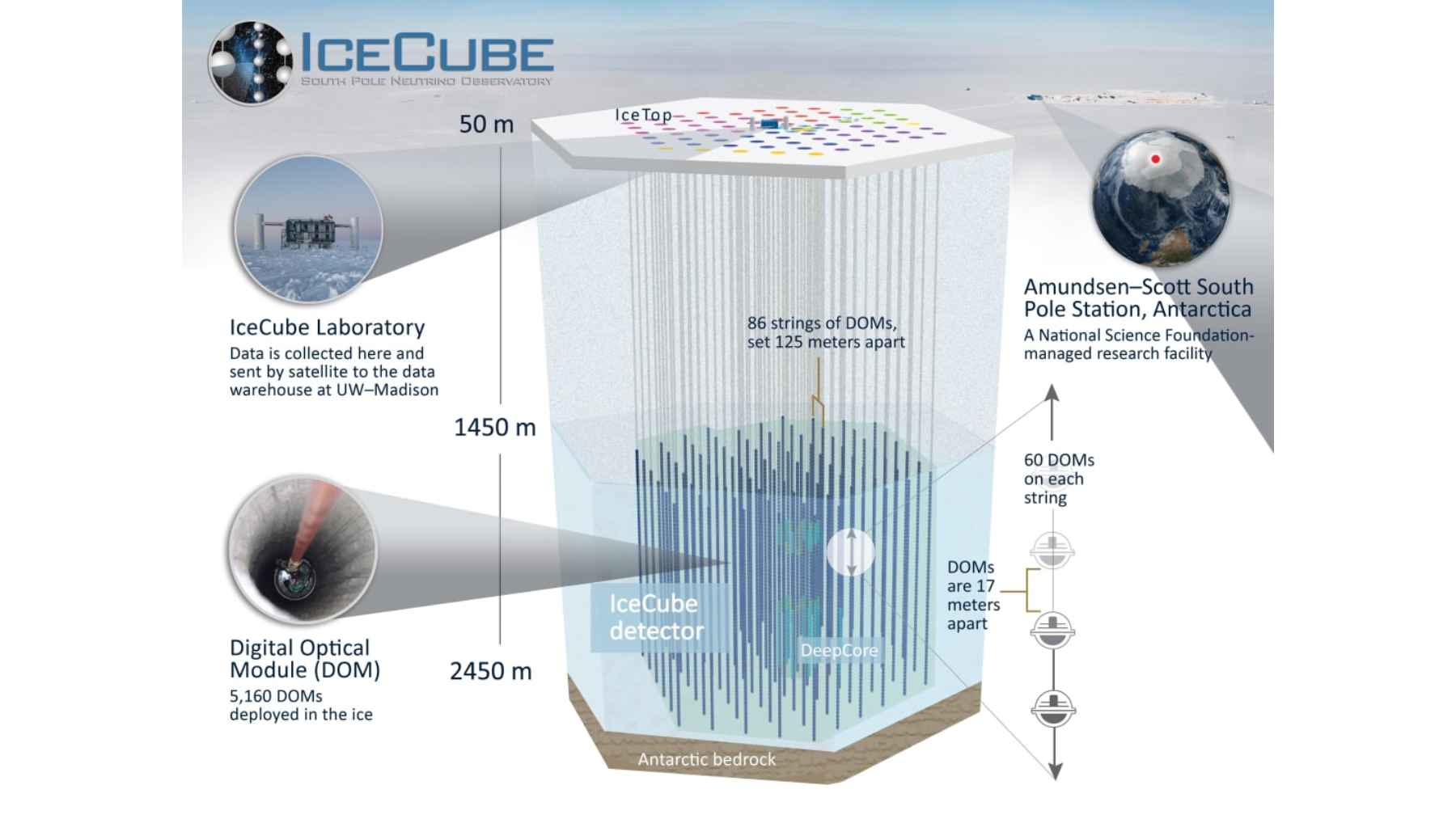
Scientists built one of the world’s strangest telescopes without a mirror, lens, or conventional camera. The original IceCube array uses 5,160 light sensors frozen between about 4,760 and 8,040 feet beneath the South Pole, spread through roughly 0.24 cubic miles of Antarctic ice.
Here is the twist. For much of its work, IceCube looks upward from below by using Earth itself to block unwanted particles, allowing ghostlike neutrinos from the northern sky to reveal violent cosmic events that ordinary telescopes can miss.
A telescope made from ice
Each glass sphere contains a sensitive photomultiplier tube and electronics. The modules hang from 86 vertical cables, typically spaced about 410 feet apart, while the 60 sensors on each cable are spaced roughly 56 feet apart.
That sounds sparse, because it is. IceCube works only because the polar ice does three jobs at once: providing matter for rare neutrino collisions, carrying the resulting light, and holding the sensors in a stable three-dimensional grid.
At the center, DeepCore packs sensors more closely to detect lower-energy neutrinos. It gives the observatory a second scale, like placing a finer net inside a much larger one.
Blue light from an invisible particle
Neutrinos have no electric charge and interact through the weak nuclear force, so almost all pass through matter untouched. IceCube estimates that about 100 trillion cross your body every second, which is why a human-sized detector would rarely see one.
When a neutrino finally strikes a proton or neutron in ice, it can create a charged secondary particle such as an electron, muon, or tau. That particle may move faster than light travels through ice, though never faster than light in a vacuum, producing a blue cone of Cherenkov radiation.
Timing is everything. Long, tracklike flashes often indicate muons and can be traced with relatively good angular precision, while compact cascades usually reveal energy more clearly but make direction harder to reconstruct. At extreme energy, a tau neutrino may produce two separated bursts.
Earth becomes the filter
Cosmic rays striking the atmosphere above Antarctica send huge numbers of downward-moving muons into the detector. Burying IceCube deep under the ice removes much of that clutter, but the most decisive shield is the planet under our feet.
A muon cannot travel through all of Earth. When software reconstructs a long track moving upward through IceCube, the event was probably started by a neutrino that entered from the Northern Hemisphere, crossed thousands of miles of rock and ice, then interacted near the detector.
Atmospheric neutrinos can do the same, so researchers still separate the signal statistically using energy, direction, and clustering.
That is the clever part. Instead of turning a telescope toward a northern star, IceCube waits for a particle from that direction to cross the planet and arrive from below.
Earth also blocks the signal
Earth is a shield, not a perfectly transparent window. In 2017, IceCube measured fewer high-energy neutrinos along the thickest paths through the planet, confirming that absorption rises as neutrino energy increases and matches Standard Model expectations.
At the highest energies, looking through Earth can remove part of the desired signal along with atmospheric muons. For the southern sky, scientists instead favor events that begin inside the instrumented ice, use outer sensors as a veto, or combine in-ice data with the surface array IceTop.
A 2025 southern-sky analysis showed how hard that job remains. After nine years of data and two complementary background filters, just two events survived the selection, and neither matched a known astrophysical source.
What IceCube has already seen
These faint flashes have already changed astronomy. In 2013, IceCube reported the first solid evidence for a population of high-energy neutrinos from beyond the solar system, prompting principal investigator Francis Halzen to call it “the dawn of a new age of astronomy.”
Then a 2017 alert led telescopes around the world to the blazar TXS 0506+056, linking a high-energy neutrino to a known cosmic accelerator. In 2022, years of accumulated events provided evidence of neutrino emission from NGC 1068, an active galaxy whose central region is hidden by gas and dust in many kinds of light.
In 2023, the detector produced the first high-energy neutrino image of the Milky Way. It was not a conventional photograph but a statistical map built mainly from cascade events, showing our galaxy through particles of matter rather than electromagnetic radiation.
Ancient ice needs constant correction
The ice is clear, but it is not optically uniform. Dust and volcanic material change how light scatters and is absorbed at different depths, so calibration LEDs and detailed ice models are essential for estimating a neutrino’s direction and energy.
A small modeling error can move a reconstructed event across the sky. The Antarctic environment stops being passive scenery and becomes part of the measurement itself.
A frozen detector keeps evolving
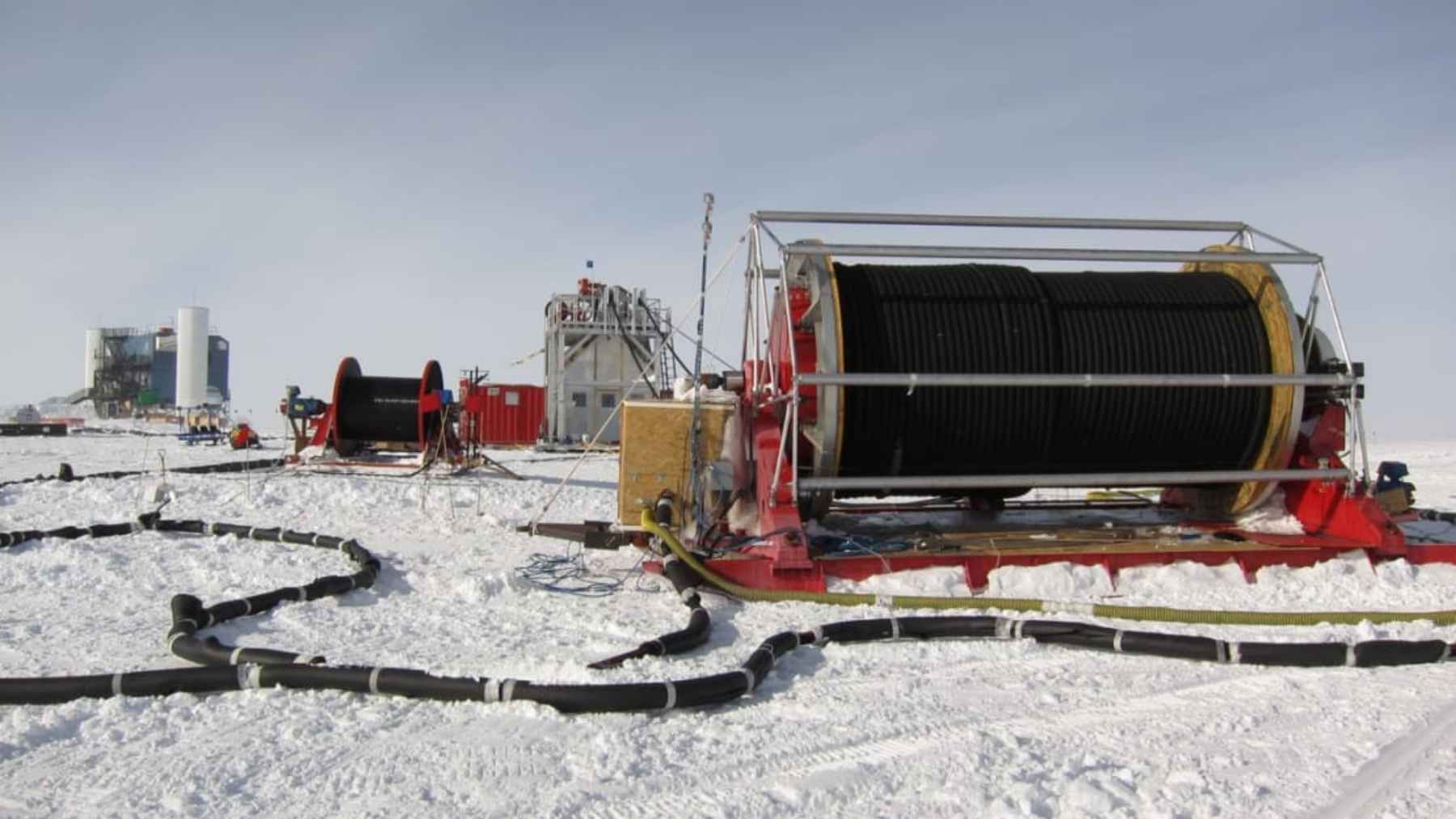
The original sensors cannot be pulled out when one fails because the boreholes refroze around the cables. Yet the observatory is not stuck in 2010. In February 2026, IceCube completed its first major expansion, adding five closely spaced strings with more than 600 enhanced sensors and calibration devices.
The new hardware is designed to sharpen measurements of neutrino oscillations, improve ice calibration, and revisit 15 years of archived data. A March 2026 analysis also reported 3.0 sigma evidence for a collective neutrino signal from X-ray-bright Seyfert galaxies in the southern sky, showing why better event selection matters.
Now, software is learning to read individual light pulses at the nanosecond scale.
The official research update was published on the IceCube Neutrino Observatory website.