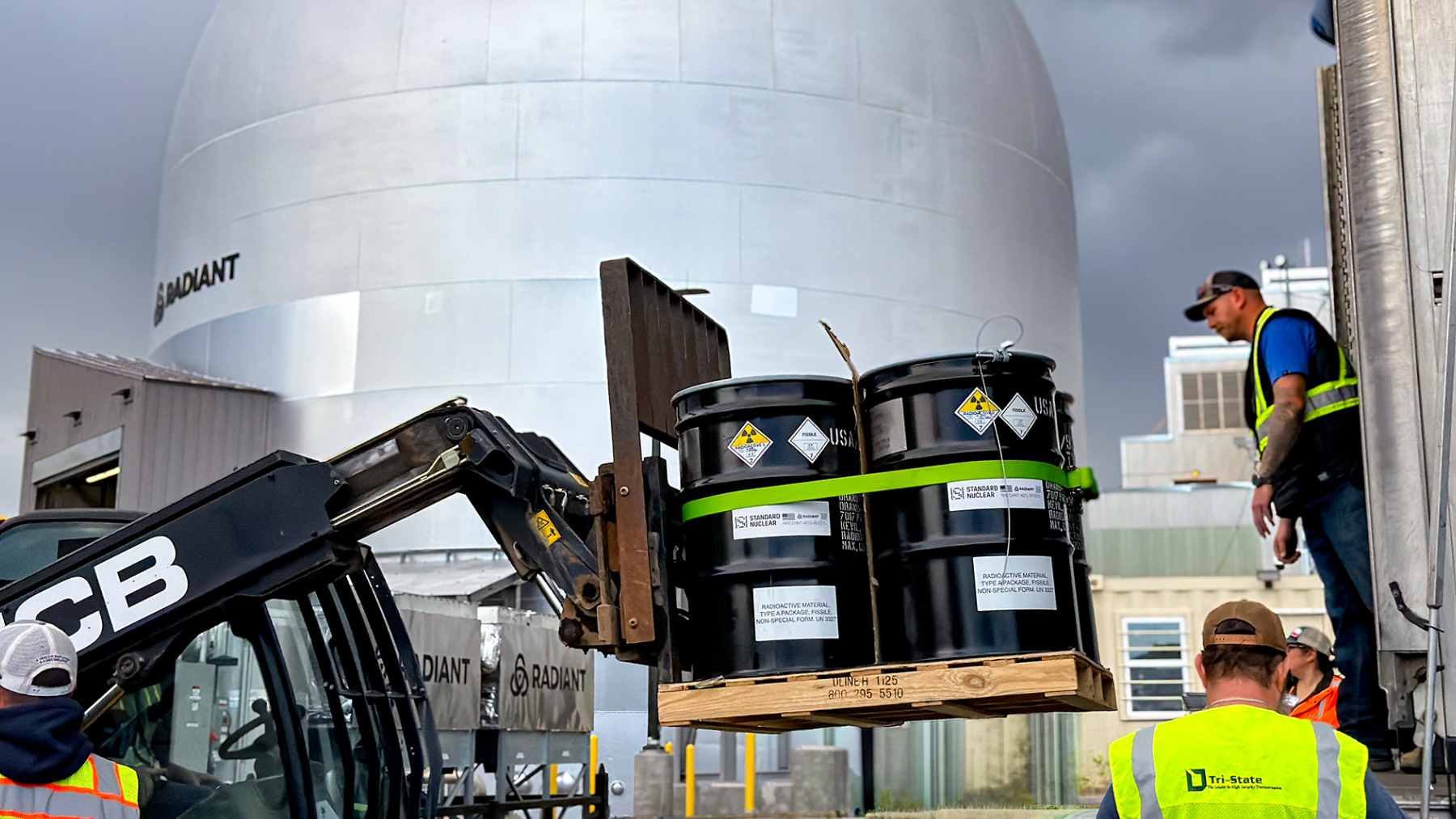
What would it take to replace a diesel generator at a remote base with a reactor that can arrive by truck? Radiant is preparing to test that idea at Idaho National Laboratory after receiving the first batch of custom-made TRISO fuel for its Kaleidos microreactor.
The company plans to move from zero-power criticality to full heat and full power, then operate for at least 150 hours without operator intervention. That is a little more than six straight days, and the results could help determine whether the roughly one-megawatt electric system is ready for factory production and customer deliveries targeted for 2028.
Fuel arrives at DOME
The fuel was not made at the Idaho lab. Standard Nuclear fabricated it in Oak Ridge, Tennessee, to Radiant’s specifications earlier this year, then delivered it to the Demonstration of Microreactor Experiments facility, better known as DOME.
DOME opened in April as a federal test bed for privately developed advanced reactors. Radiant is currently the first developer in line there, giving the company a controlled place to gather the kind of performance data that computer models alone cannot provide.
The six-day endurance test
The program has five main steps. Kaleidos will first approach criticality at very low power, then pass a one-megawatt thermal checkpoint before moving to full power, full heat, and the final 150-hour run.
Criticality sounds dramatic, but it simply means the reactor has reached a self-sustaining chain reaction. The bigger commercial question comes later. Can the system hold steady while its controls handle routine operation without constant human adjustment?
Radiant says the test will use the same fuel form and specifications planned for commercial reactors. That matters because a demonstration built around substitute components may prove the concept, but it does less to prove that the product customers will receive can perform the same way.
Why TRISO matters
TRISO fuel is made from tiny uranium-bearing kernels wrapped in layers of carbon and ceramic material. The U.S. Department of Energy says those coatings make the particles highly resistant to irradiation, corrosion, oxidation, and extreme heat while helping retain radioactive fission products inside the fuel.
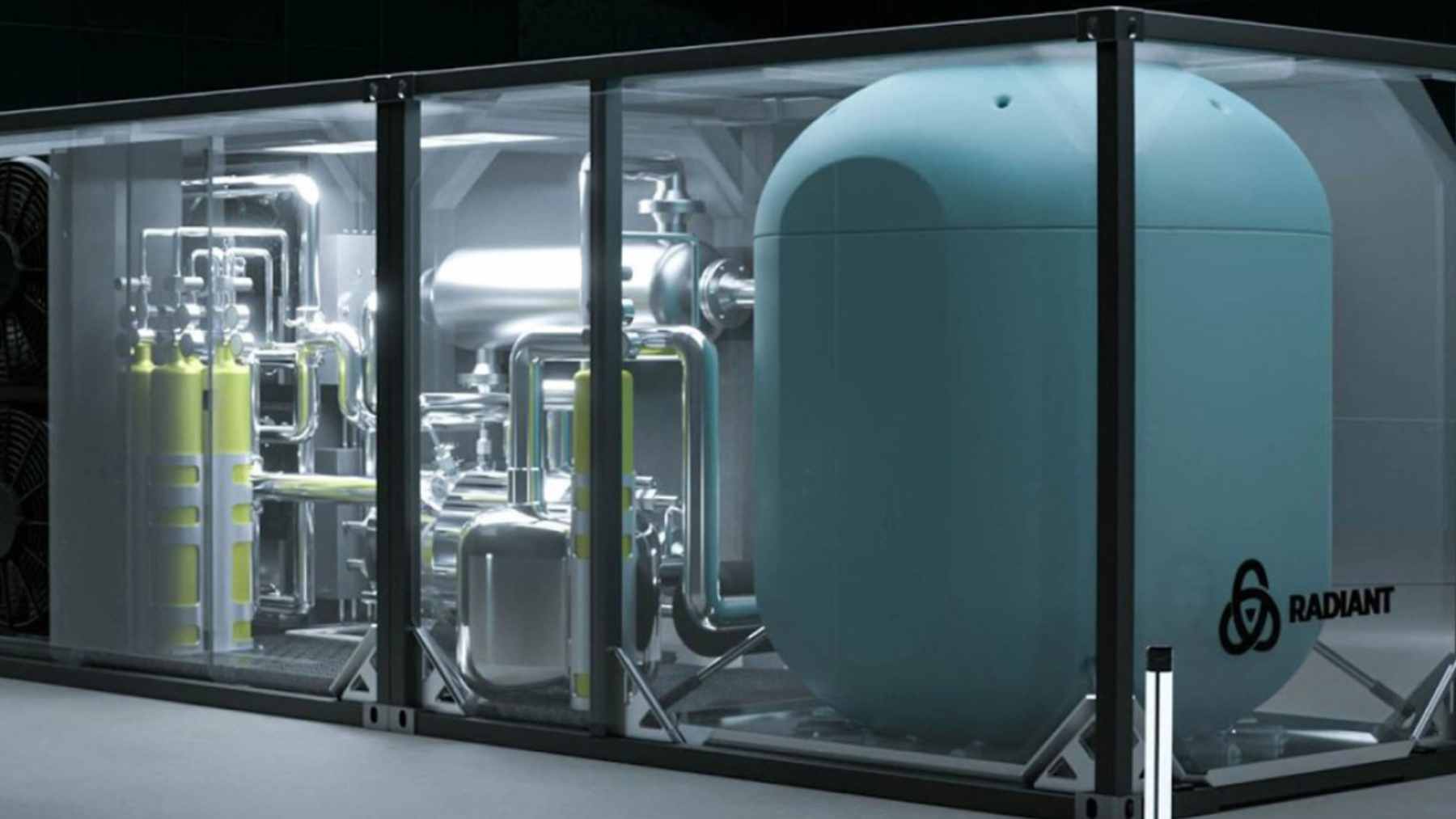
Kaleidos is a high-temperature gas-cooled reactor that uses helium coolant and graphite blocks. The design is rated at about three megawatts of thermal output and roughly one megawatt of electricity, so the test’s one-megawatt thermal stage should not be confused with the unit’s final electrical rating.
Radiant says one unit could supply electricity comparable to the needs of about 1,000 homes, although real-world demand varies widely. It also says the reactor can provide 1.9 megawatts of usable heat for building systems or water desalination.
Aiming to overtake diesel
The commercial pitch is not to compete with a giant nuclear plant. It is to replace diesel generators at remote villages, hospitals, data centers, disaster sites, and military installations where dependable power can matter more than access to a large grid.
Radiant says Kaleidos uses air cooling and requires no water at the operating site. In practical terms, that could reduce diesel exhaust and recurring fuel deliveries while also making the unit useful in dry regions, but it does not remove questions about fuel handling, transportation, security, and eventual refueling.
That environmental trade-off is why regulation remains central. The NRC says its review of Radiant’s proposed Tennessee fueling facility will include both a detailed safety evaluation and an environmental assessment.
Defense interest is already real
The Department of the Air Force has paired Radiant with Buckley Space Force Base in Colorado as one of three potential microreactor projects under its Advanced Nuclear Power for Installations initiative. The service wants at least one advanced reactor operating at a Department of the Air Force installation by 2030 or sooner.
“The future of air and space dominance is powered by resilient energy,” Air Force official Michael Borders said. Still, the word “potential” matters because the Buckley project must move through siting and environmental analysis before it becomes an operating plant.
For defense planners, the attraction is easy to see. A compact source that runs day and night could reduce dependence on vulnerable grid connections and diesel supply chains, but only if reliability, security, cost, and licensing work outside the test hall too.
The factory is the business test
Radiant’s next hurdle is not limited to reactor physics. The NRC accepted the company’s application for a Part 70 special nuclear materials license for its R-50 facility in Oak Ridge and set a goal of completing the review within eight months, about 55 percent faster than the standard schedule.
Approval would allow the fueling building to handle nuclear material and load Kaleidos units before shipment. That factory-first model could make production more repeatable, much like assembling complex equipment on one line instead of rebuilding it at every customer site.
But there is an important distinction. The Part 70 review covers special nuclear material at the manufacturing facility, not final approval of the Kaleidos reactor itself, and the NRC says Radiant plans to submit a separate reactor application later.
What happens next
Radiant received federal approval for key preliminary safety documentation in February, and the fuel is now at the DOME site. The coming campaign should produce records on the core, coolant, fuel behavior, and overall system performance that can guide later engineering and licensing work.
“We are de-risking a commercial product that will be manufactured and delivered within 18 months,” Radiant nuclear chief Rita Baranwal said. That is the company’s schedule, not a regulatory guarantee, and a successful 150-hour run would still be one gate on a longer road to commercial deployment.
For now, the fuel delivery turns Kaleidos from a polished concept into a machine that must prove itself under heat, power, and time.
The official press release was published on Radiant Nuclear.