For many stroke patients, the biggest emergency is clear. A clot blocks blood flow to the brain, and doctors have to open that path as fast as possible. But a new clinical trial from Barcelona suggests that reopening the main artery may not always be the finish line.
The CHOICE-2 trial found that giving a clot-dissolving drug directly into the brain artery after mechanical thrombectomy improved recovery in people with severe ischemic stroke.
Indications were that more patients were able to return to life with no disability or only mild symptoms after three months.
Why this matters
A severe ischemic stroke happens when a blood clot blocks an artery in the brain. Without blood and oxygen, brain cells can be damaged quickly, which is why every minute matters in the emergency room.
Mechanical thrombectomy is one of the most important tools doctors have for these cases. A specialist uses a thin device to reach the blocked artery and pull out the clot, a bit like clearing a jammed pipe before the damage spreads.
That procedure can be lifesaving, but it does not always restore full independence. Stroke was the third leading cause of death and disability globally in 2021, according to the World Health Organization, so even modest improvements can matter for patients, families, and health systems.
The hidden blockage
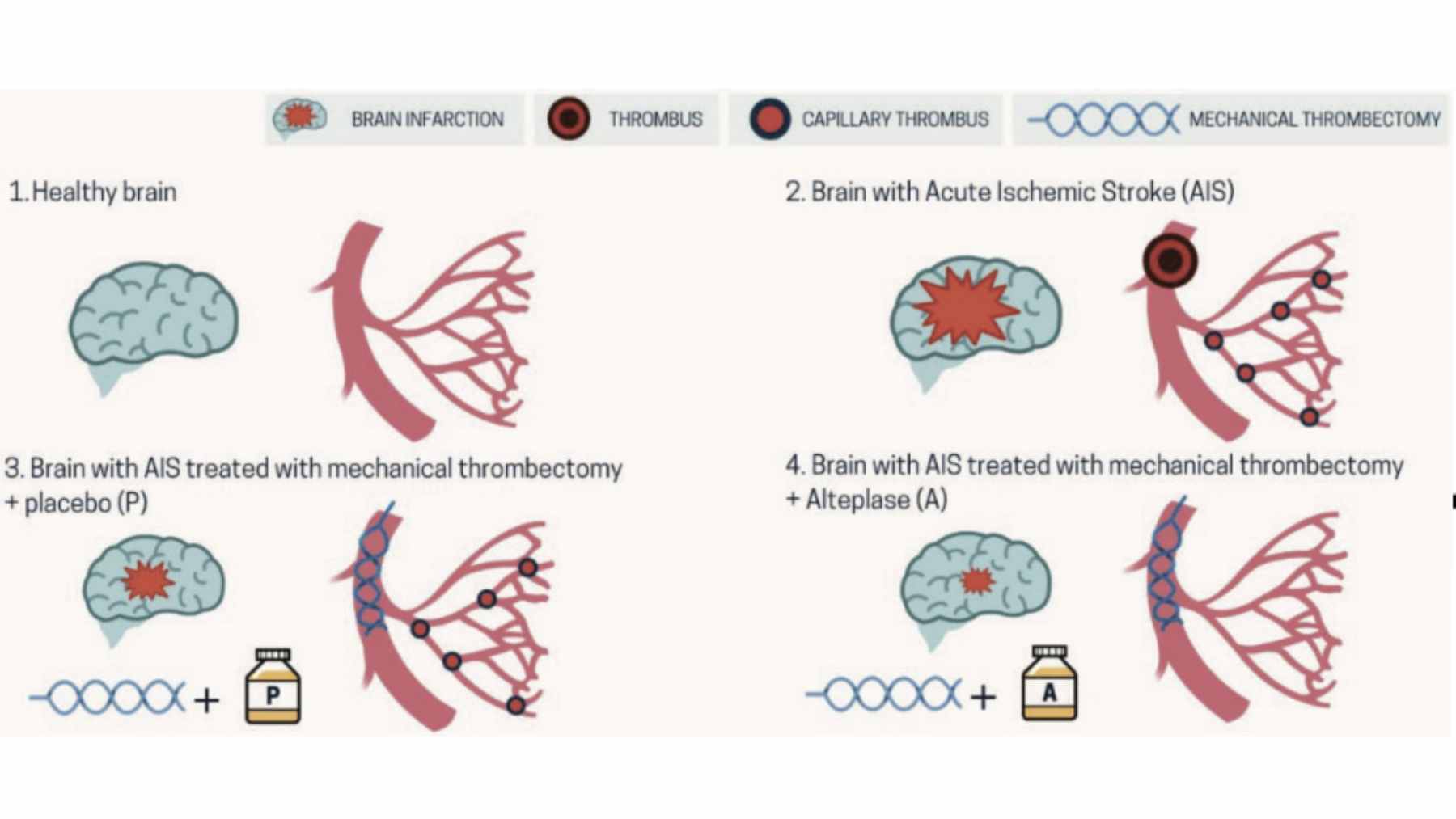
So why do some patients still struggle after the main clot is removed? The answer may lie in the brain’s microcirculation, meaning the tiny blood vessels that feed small areas of brain tissue.
Arturo Renú, the first author of the new work, described it this way: “it is like reopening a highway while some side streets remain blocked.” That image gets to the heart of the problem.
The main road may be open, but blood still has to reach the neighborhoods. If small vessels remain clogged or sluggish, parts of the brain may continue to suffer, even after a technically successful thrombectomy.
What the trial tested
The CHOICE-2 study was coordinated by Hospital Clínic Barcelona and the August Pi i Sunyer Biomedical Research Institute, known as IDIBAPS. Neurologist Ángel Chamorro led the work with Renú, and the trial involved 440 adults treated at 14 specialized hospitals in Spain.
All patients had severe ischemic stroke and were successfully treated with mechanical thrombectomy. Afterward, they were randomly assigned to receive standard care alone or standard care plus intra-arterial alteplase, a drug designed to help dissolve remaining clots.
The timing is the key twist. Alteplase has often been used before clot removal, but this trial tested whether giving it after the procedure could help clear the smaller vessels that thrombectomy cannot easily reach.
Better outcomes at 90 days
The results were clear enough to draw attention. After 90 days, 57.5% of patients who received the added drug had an excellent functional outcome, compared with 42.5% in the thrombectomy-only group.
That does not mean the treatment is a magic fix. It means the combined approach gave a larger share of patients the chance to live with no disability or only minimal symptoms after a serious stroke.
Brain imaging also pointed in the same direction. Patients who received the added treatment had fewer areas with poor blood flow, suggesting that the drug may have helped restore circulation where the smallest vessels were still struggling.
Built on earlier work
This trial did not come out of nowhere. The same research line began with the earlier CHOICE trial, published in 2022, which suggested that intra-arterial alteplase after thrombectomy could improve neurological outcomes.
That first study was smaller and had limitations, so experts needed stronger evidence before changing practice. CHOICE-2 was designed to test the idea in a larger group and across more hospitals.
The new results largely support the earlier signal. The 2022 CHOICE trial reported better 90-day outcomes with alteplase compared with placebo, but it also warned that the finding should be considered preliminary until replicated.
What happens next
The findings may influence future stroke treatment guidelines, but doctors will still need to decide carefully which patients are most likely to benefit. In medicine, more treatment is not automatically one-size-fits-all.
The JAMA paper also reported that death at 90 days was higher in the group that received alteplase, while serious brain bleeding was not significantly increased.
That mixed safety picture is one reason researchers say more study is needed before the approach becomes routine everywhere.
For now, the message is both hopeful and cautious. Clearing the big clot can save brain tissue, but protecting recovery may also depend on what happens in the smallest vessels, the places doctors cannot see as easily.
The main study has been published in JAMA.