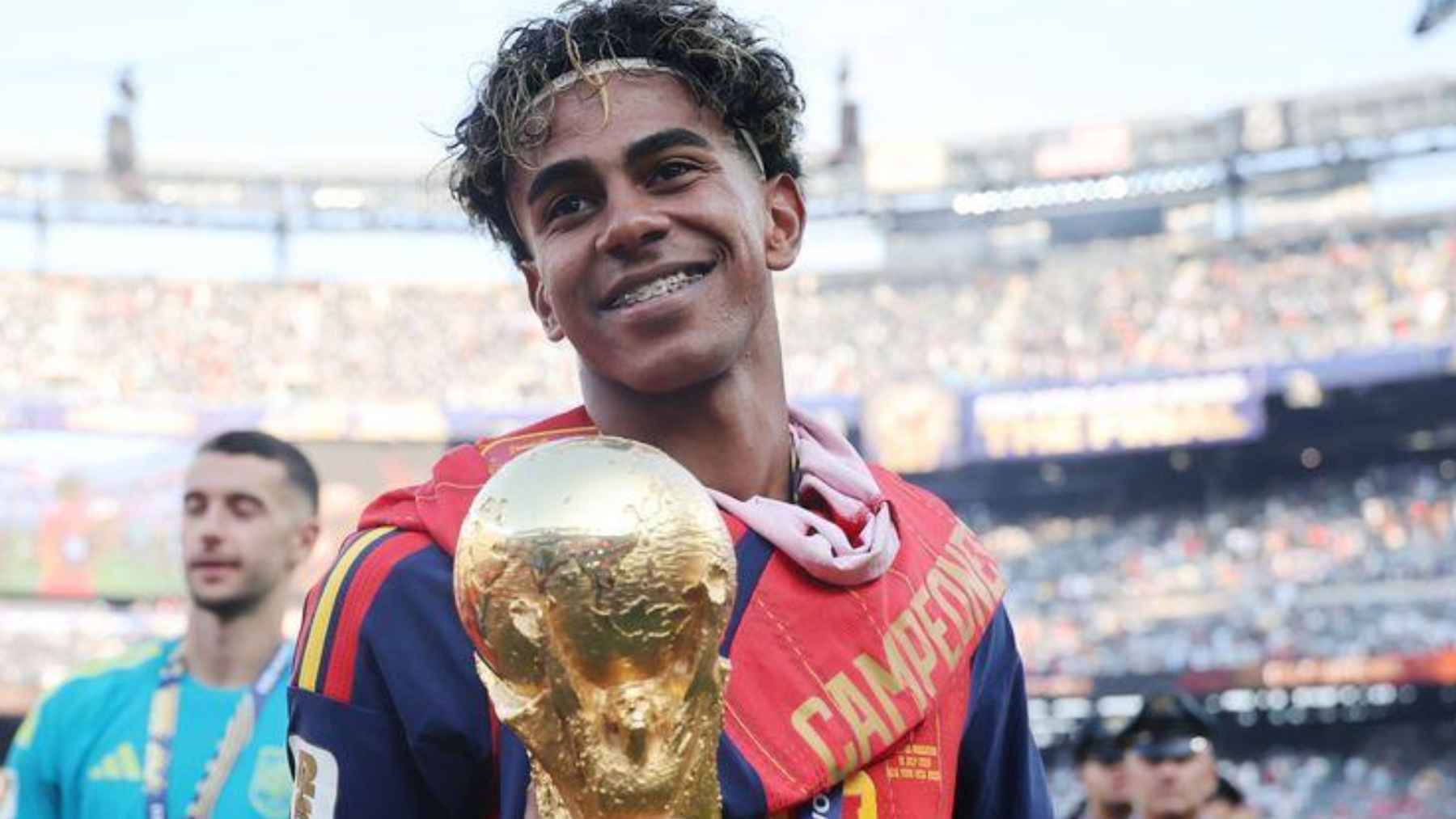
At 19, Lamine Yamal has already grabbed soccer’s golden ring after Spain beat Argentina 1-0 in extra time on July 19, 2026. FIFA lists him as one of the youngest players ever on a World Cup championship team. The trophy is historic, but what happens when winning becomes the core of a young athlete’s identity?
Spanish psychologist Lara Ferreiro, running a practice in New York City, says early triumph can come with an emotional price when a player begins to feel responsible for a family’s hopes (or expectations), pride, or social standing.
In a recent interview, she examined the comments of Yamal’s father, Mounir Nasraoui, to illustrate what she calls a “mandate for success.” Her remarks describe a potential risk, not a clinical diagnosis of either man.
When winning becomes a duty
The psychologist uses “mandate for success” to describe an unspoken expectation that can form when affection, praise, or family pride seem to be dependent on results. “The father of Lamine Yamal may unconsciously create a mandate for success,” she said, warning that a young player may come to believe his worth depends on not failing.
This pressure does not need to be said out lout. It can grow through constant celebration, inevitable comparisons, never-ending public attention, or the feeling that every goal exalts the entire family. Then, a missed chance may feel less like a normal part of soccer and more like letting everyone down.
A family can share the spotlight
She also highlights “vicarious identity,” a simple way to describe relatives living another person’s achievements as if they were partly their own. In healthy form, shared pride can strengthen family and community bonds. Taken too far, the athlete can start to look like a family project rather than an adolescent with changing needs.
She also refers to the “trophy child,” when a child’s talent becomes a status symbol. The warning is not that families should stop celebrating, it is that constant applause can turn into an imperative when the young person senses that affection or approval depends on staying exceptional.

What the research shows
A 2025 study by Zhaoyuan Chen and Lu Peng surveyed 420 adolescent tennis players. Greater parental expectations were associated with increased anxiety before competition and lower feelings of competence, meaning the higher the pressure, the lower the confidence in their abilities.
Because the research relied on self-reported questionnaires, it shows an association rather than proving cause and effect.
Soccer research adds useful nuance. Marco Teixeira, Catarina Morais, and A. Rui Gomes studied 299 elite male players ages 12 to 19 and found that ‘positive’ parental involvement could support performance, while stronger negative reactions to mistakes were connected with poorer objective results.
Approved by the University of Minho, the study suggests that involvement itself is not the issue, and how it is felt by the athlete matters.
Support is not pressure
The difference between support and pressure can be surprisingly ordinary. The former sounds like asking whether the player had fun, helping with recovery, and making room for school, friends, rest, and interests away from soccer. The latter sounds like treating every dinner table as a postgame roundup or making a weak performance feel like a family crisis.
The International Olympic Committee’s mental health toolkit identifies performance pressure and the challenge of managing both failure and success as factors that can affect elite athletes’ well-being. That matters for a teenager whose mistakes are replayed over and over across television and social media. The stadium empties, but the noise can follow him home.
Why Yamal’s case needs caution
Available coverage does not indicate that the psychologist evaluated either man or established that this dynamic exists in their family. Her comments are best understood as a broader warning prompted by a highly visible young champion–a distinction that matters.
Psychological language can quickly harden into claims about people a clinician has never met or evaluated.
Still, Yamal’s situation puts the question on the forefront. He won the World Cup at 19 after already carrying the expectations that come with record-breaking performances and global fame. For most teenagers, a bad week is remembered only by classmates, but for him it can become international news.
Protecting the person behind the player
The healthiest path is not to lower ambition or pretend trophies do not matter. It is to keep the athlete’s worth separate from the scoreboard, give him room to make mistakes, and preserve relationships that do not depend on goals or medals.
Ideally, the people closest to him should be able to celebrate a win without making the next one a condition of belonging.
Yamal has already proved he can handle pressure on the field. The longer challenge is making sure success remains something he does, not the only answer to who he is.
The original psychological analysis was published by Semana.