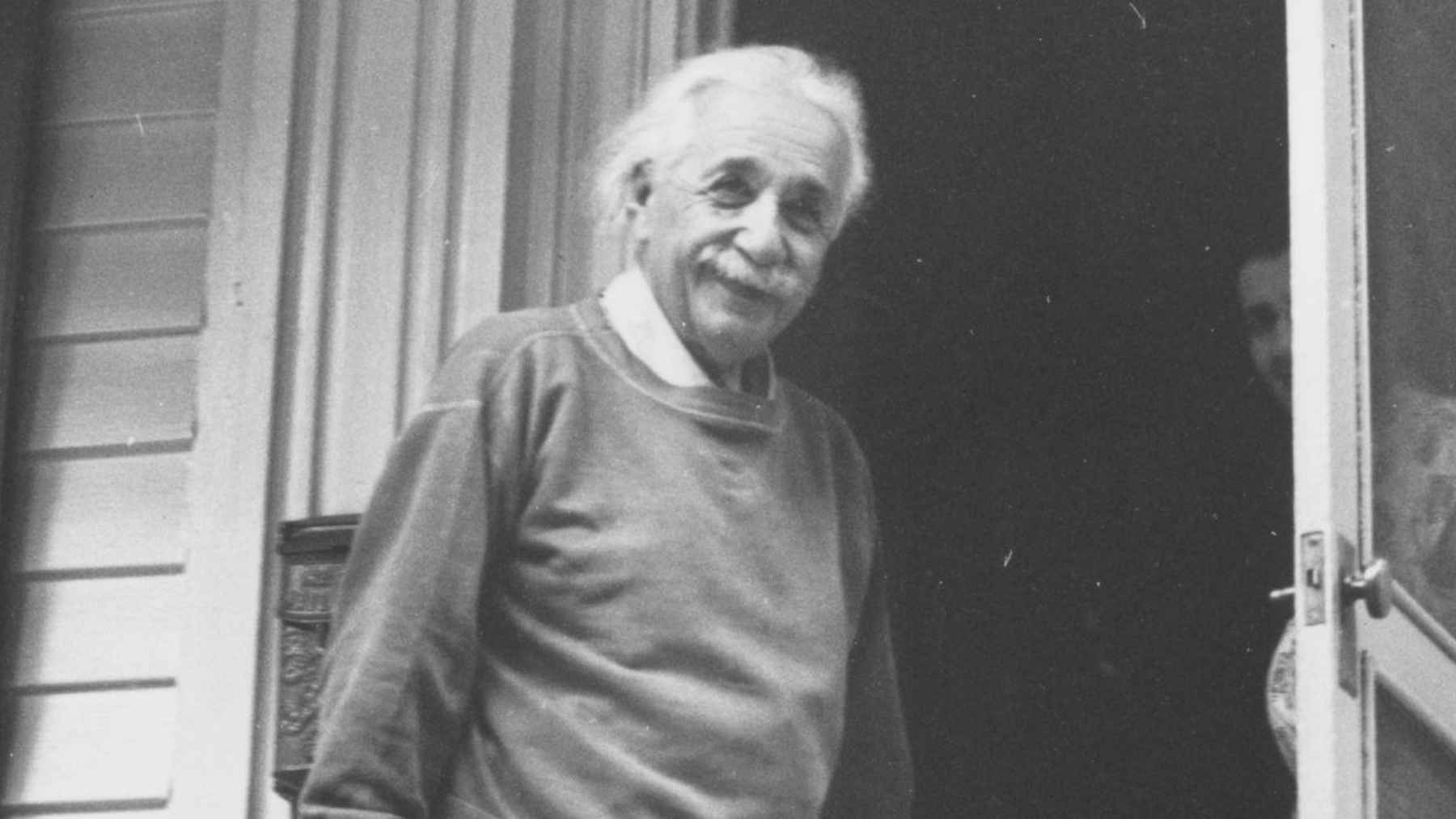
Albert Einstein’s best-known reflection on imagination is often printed on classroom walls and shared as a quick lesson about creativity. Yet the line was not an invitation to ignore books, facts, or hard study. It was a statement about what happens when established knowledge reaches its edge.
The German-born physicist was describing the ability to picture an answer before evidence was available, then let observation decide whether that picture survived.
That distinction matters today, when search engines and artificial intelligence can deliver information in seconds. Knowing more is useful, but asking a question nobody has asked can still change the direction of science.
The quote’s real origin
This saying can be traced to a magazine interview published on October 26, 1929. Journalist George Sylvester Viereck asked whether the scientist trusted imagination more than knowledge, prompting the reply, “Imagination is more important than knowledge. Knowledge is limited. Imagination encircles the world.”
The surrounding conversation changes the meaning. He had just recalled his confidence that observations of a total solar eclipse would agree with general relativity, his theory of gravity. He was talking about informed intuition, not daydreaming without evidence.
Imagination as a scientific tool
One of his most famous mental exercises began with a strange question. What would happen if someone could chase a beam of light and move beside it? A historical account says he began wrestling with that picture as a teenager.
This is called a thought experiment, which means testing an idea inside the mind before building equipment or collecting data.
He later pictured people inside sealed elevators to compare gravity with acceleration, another mental scene that helped shape general relativity. The picture opened the door, but mathematics and experiments gave it structure.
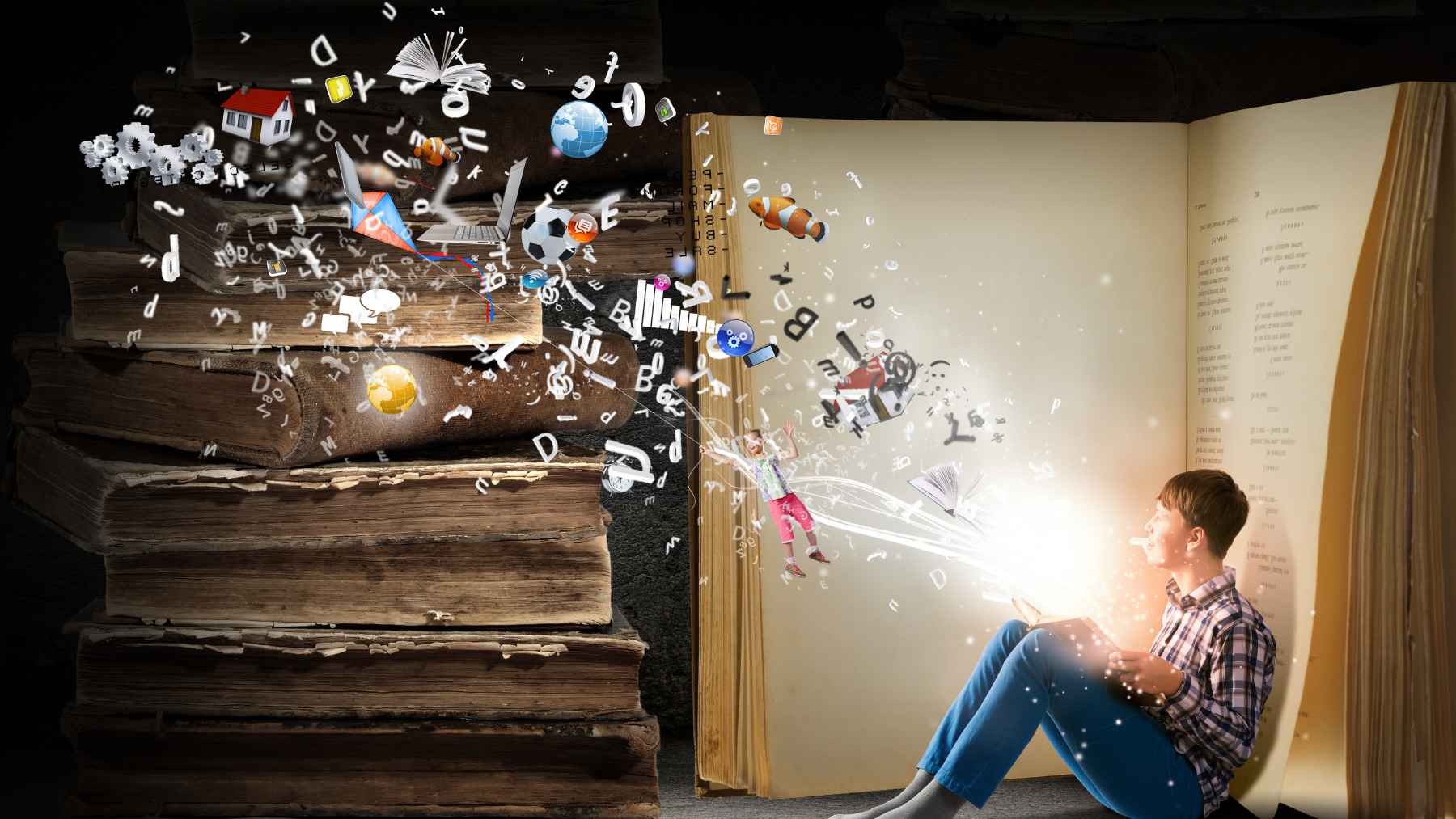
A young reader surrounded by symbols of knowledge and imagination illustrates Einstein’s view of creativity and scientific discovery.
Evidence came next
General relativity says that matter bends space and time, changing the path followed by light. During the eclipse of May 29, 1919, teams traveled to Príncipe off West Africa and Sobral in Brazil to photograph stars appearing close to the darkened Sun.
Weather and equipment spoiled many images, although seven of eight photographs from a backup telescope in Sobral captured stars and two Príncipe plates were usable.
The results supported the predicted bending of starlight. That sequence matters. Imagination proposed what nature might do, but measurement still had the final word.
Knowledge was never dismissed
His career offers little support for the idea that facts do not matter. The 1921 Nobel Prize in Physics recognized his work in theoretical physics, especially his explanation of the photoelectric effect, which describes how light can release electrons from matter.
That achievement grew from deep knowledge of existing physics and a willingness to challenge part of it.
A useful way to read the quote is to treat knowledge as a map and imagination as the question about what lies beyond its border. Without the map, a person may wander in circles. Without curiosity, the map never gets extended.
What brain science adds
Modern research gives that idea a biological foundation. Psychologist Daniel Schacter at Harvard University has reported that remembering past experiences and imagining future ones recruit many of the same brain regions.
The hippocampus, a structure important for memory, helps recombine stored details into possible scenes.
In practical terms, the mind rarely invents from nothing. It rearranges what it has learned, much like someone planning a new route by recalling familiar streets. That process can support a scientific hypothesis, a business idea, or a plan for handling a difficult conversation.
Why it matters in the AI age
A 2024 Science Advances experiment led by Anil Doshi of University College London and Oliver Hauser of the University of Exeter tested 293 writers and used 600 other people to evaluate their short stories.
Access to as many as five AI-generated ideas raised average novelty scores by 8.1 percent and usefulness scores by 9 percent. Stories written with one AI suggestion were also 10.7 percent more similar to one another than stories written without AI help.
There was a catch. The largest gains went mainly to writers who initially scored lower on creativity, while the work of stronger writers changed less. The tool helped individuals, but it also risked pulling many people toward the same answers.
The lesson for everyday life
So what does the quote ask of a student, worker, or anyone trying to solve a problem? Learn the facts first, then test their limits with questions such as “What are we assuming?” and “What else could be possible?” A new idea becomes valuable only when it can survive criticism, evidence, and revision.
At the end of the day, the physicist was not choosing between studying and imagining. He was describing a partnership in which knowledge supplies the building blocks and imagination tries a design that does not yet exist.
The original 1929 interview was published in The Saturday Evening Post.