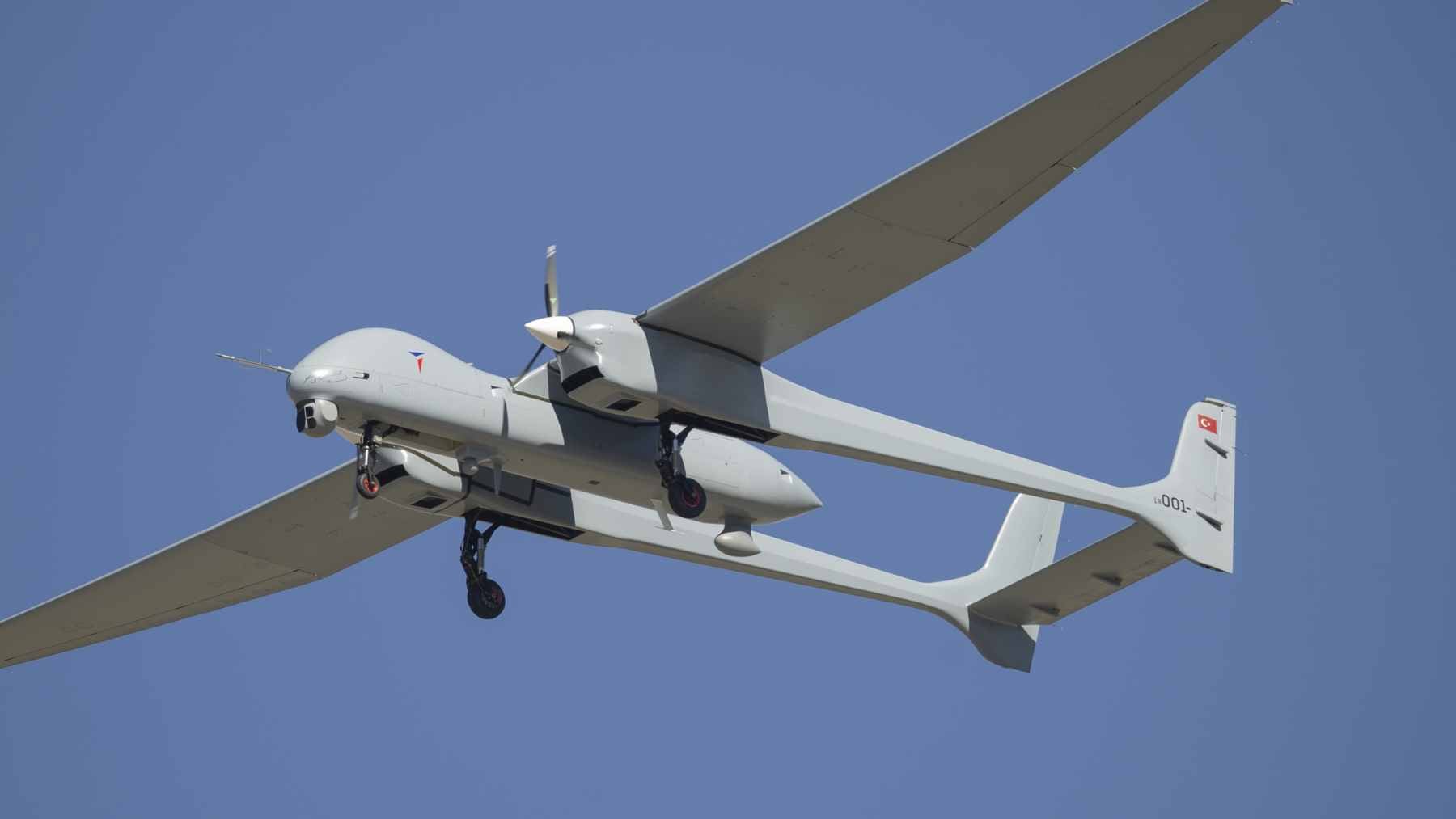
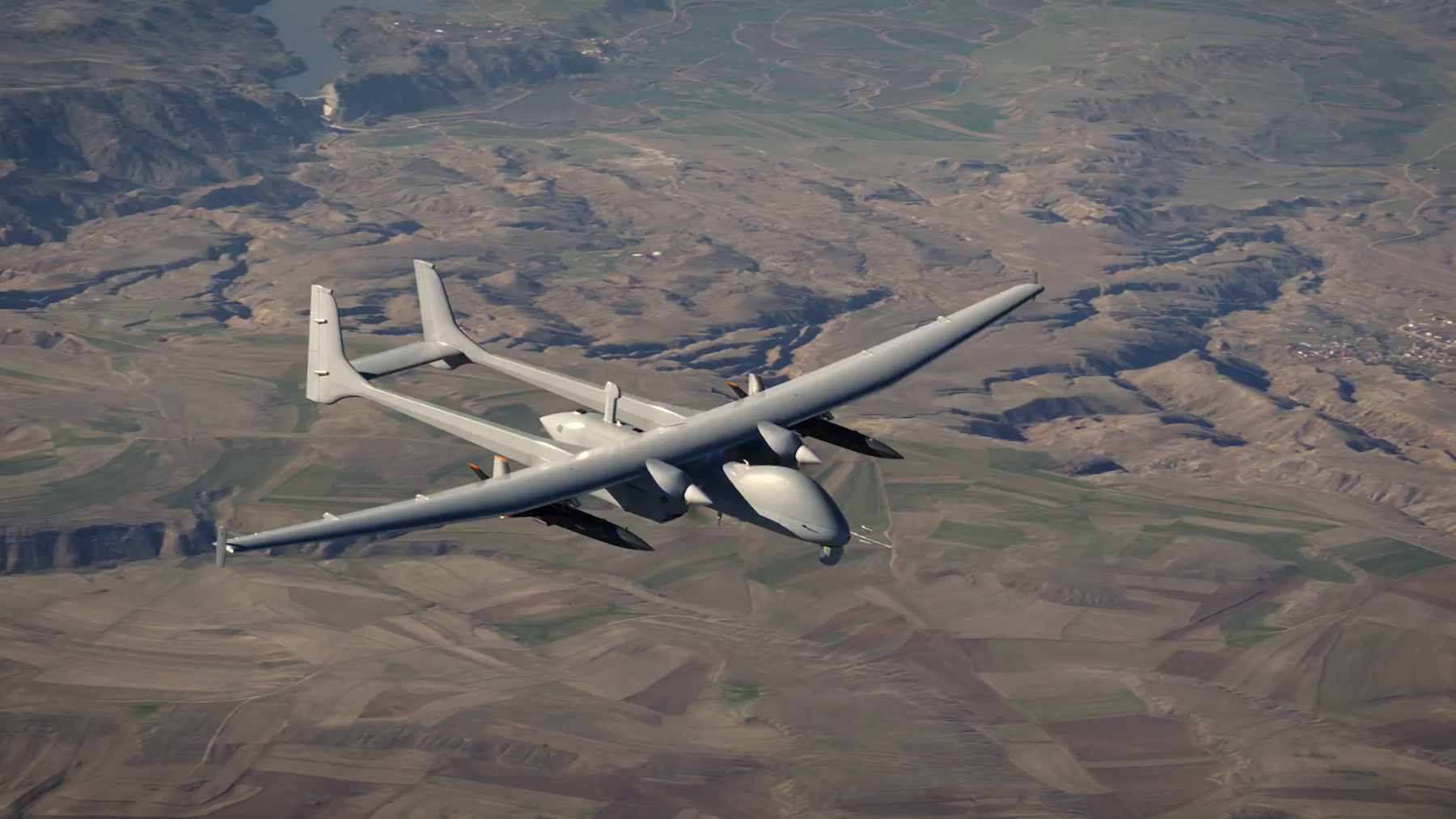
Turkey’s Aksungur drone has crossed an important line. It is no longer just a large unmanned aircraft that can watch, patrol, and strike from high altitude. In footage reported from March 10, 2026, Turkish Aerospace Industries showed the aircraft carrying two jet-powered Süper Şimşek drones under its wings, turning the bigger platform into a kind of flying launchpad.
That may sound like a small change from the outside. But the real story is that Turkey is moving from individual drones to an ecosystem, where one aircraft carries sensors, weapons, communications gear, and now smaller unmanned aircraft that can confuse radar, jam signals, or attack a target.
A flying launchpad takes shape
The Aksungur is a medium-altitude, long-endurance unmanned aircraft developed by Turkish Aerospace. In the March demonstration, it carried one Süper Şimşek under each wing, a setup that points toward layered missions rather than simple one-drone flights.
What makes this interesting? The larger drone can stay farther from the most dangerous air defenses, while the smaller jet drones move closer to the target area. That means the Aksungur could act as the patient carrier, while Süper Şimşek performs the risky sprint.
TurDef also reported that the two Süper Şimşek drones can be used as decoys, stand-in jammers, or kamikaze-style systems depending on configuration. That is the core shift–the aircraft is becoming part of a drone chain.
The numbers explain the strategy
Aksungur has the physical size to play that carrier role. Turkish Aerospace lists the drone with a wingspan of about 79 feet, a length of about 41 feet, a maximum takeoff weight of 7,275 lbs., and a payload capacity of more than 1,650 lbs.
It can remain airborne for up to 50 hours and operate as high as 40,000 feet, according to the manufacturer. That is the kind of endurance that changes a mission from a short visit into a long watch.
The engine matters, too. TEI says the PD170 turbodiesel engine produces 172 horsepower, uses fuel options including JP-8 and Jet-A1, and has a listed engine life of 3,600 hours. For Turkey, that is not just an engine spec, it is a step away from depending on foreign suppliers for one of the most sensitive parts of a military aircraft.
Why the sea matters
Long endurance is especially useful at sea, where the problem is not always speed, it is patience. A drone that can circle for many hours can help monitor coastlines, shipping routes, and wide stretches of open water where a crewed aircraft would eventually need to return.
The Turkish Navy received its first Aksungur in 2021, and Naval News reported that the aircraft was expected to strengthen naval reconnaissance because of its endurance and payload capacity. The same reporting noted Turkish work on anti-submarine warfare roles, including sonobuoy launch and monitoring.
That is where the platform starts to feel bigger than one aircraft. Aksungur can carry sensors for surveillance, radar, and signals intelligence, while also supporting missions that touch maritime security and even disaster response. The ocean is vast. Loiter time matters.
The smaller drone changes the risk
Süper Şimşek is built for a different kind of work. Turkish Aerospace describes it as a tactical UAV that can support deception and suppression of air defense systems, electronic warfare, target deception, and radar jamming. It can reach Mach 0.85, fly up to 35,000 feet, and travel about 559 miles in operating range.
That makes it useful for missions where commanders may not want to risk a larger aircraft. A small jet drone can appear bigger on radar, force an enemy system to react, or carry electronic warfare equipment into a dangerous area. Sometimes the goal is not to destroy something right away, but to make the other side reveal where it is.
Turkish Aerospace also says Süper Şimşek can be launched from unmanned aircraft such as ANKA III, Aksungur, and ANKA, or from a ground-based, rocket-assisted system. That flexibility is important because it means one small drone can fit into several launch concepts.
More than a military showcase
Aksungur’s story is not only about missiles and radar. Turkish Aerospace has also promoted the platform for civilian missions, including firefighting support, search and rescue, and damage assessment after disasters. The company said Aksungur began field service for Turkey’s General Directorate of Forestry for fire control and firefighting purposes.
That dual-use reality is worth keeping in mind. The same long-endurance design that helps a navy watch the sea can also help authorities keep eyes on a wildfire, a flood zone, or a damaged communications area after an earthquake. At the end of the day, endurance is endurance, whether the mission is military or environmental.
Still, the March flight pushes the military side to the front. The message is clear enough. Turkey wants buyers and rivals to see that its drone industry is no longer selling isolated aircraft, but integrated systems.
The export question
That matters for business as much as battlefield planning. Turkish drones have already found customers outside the traditional U.S. and European defense supply chain, often because they are cheaper, available, or less politically complicated to buy.
Anadolu Agency reported in 2023 that Turkish Aerospace had delivered two Aksungur drones to Kyrgyzstan, while Janes reported in 2024 that Chad had received at least one Aksungur UAV. Those are not huge fleets, but they show how the platform is reaching customers beyond Turkey.
There is a catch, of course. Long-endurance drones are valuable, but they are not invisible. Janes reported that an Aksungur UAV crashed in Kirkuk on August 29, 2024, after being almost certainly shot down by Iraqi air defenses, a reminder that unmanned aircraft still face serious risks in contested airspace.
A new phase for drone warfare
The Aksungur and Süper Şimşek pairing shows where unmanned aviation is heading. The advantage is no longer only about flying longer or carrying more weapons. It is about creating layers.
One drone can watch. Another can deceive. A third can jam or strike. Put them together, and the battlefield gets harder to read for the defender.
That is why this flight matters. Turkey is trying to build the whole toolkit, from the engine and airframe to the smaller expendable drones carried under the wing.
The official flight video was published on X by Turkish Aerospace Industries.