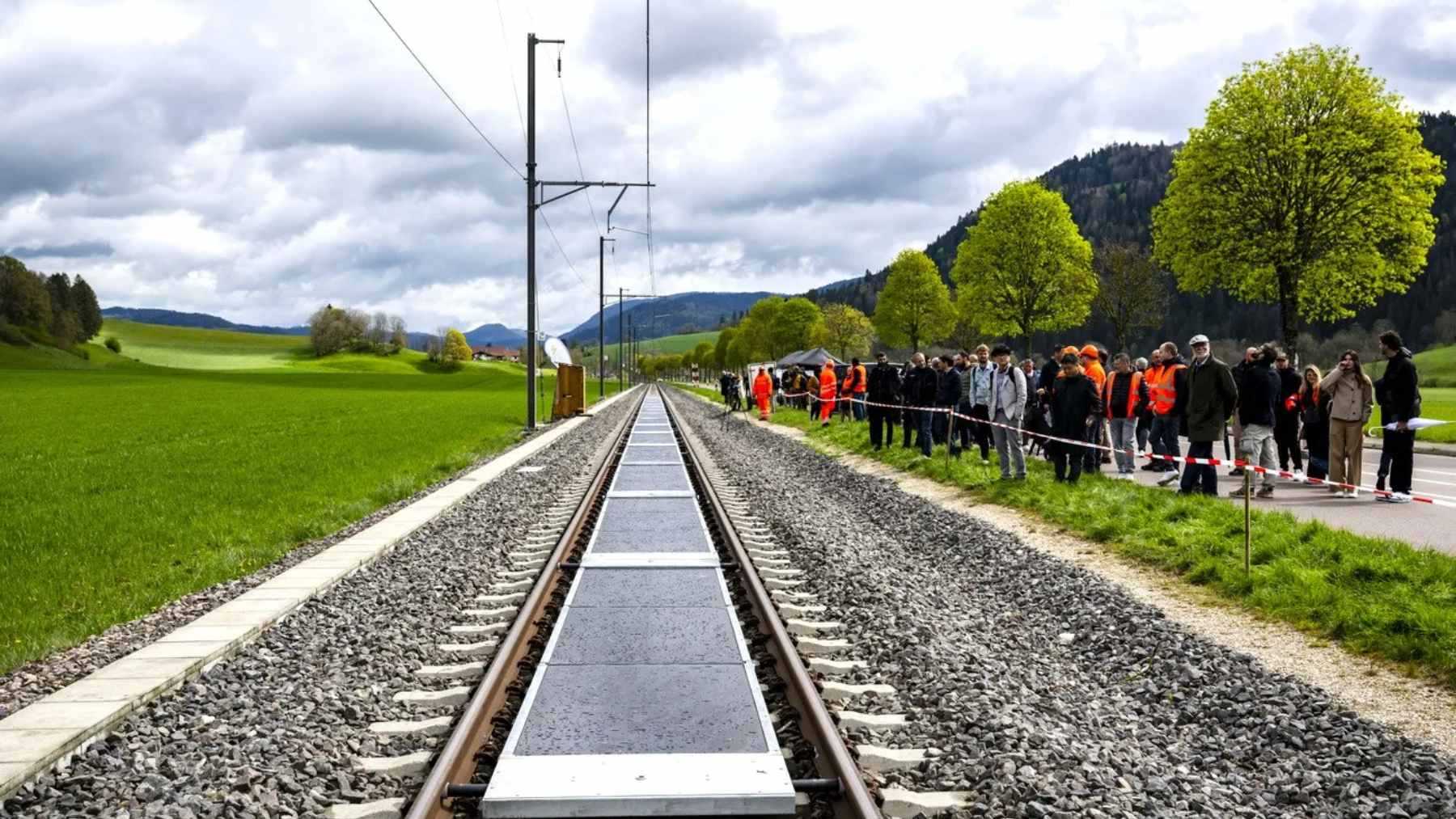
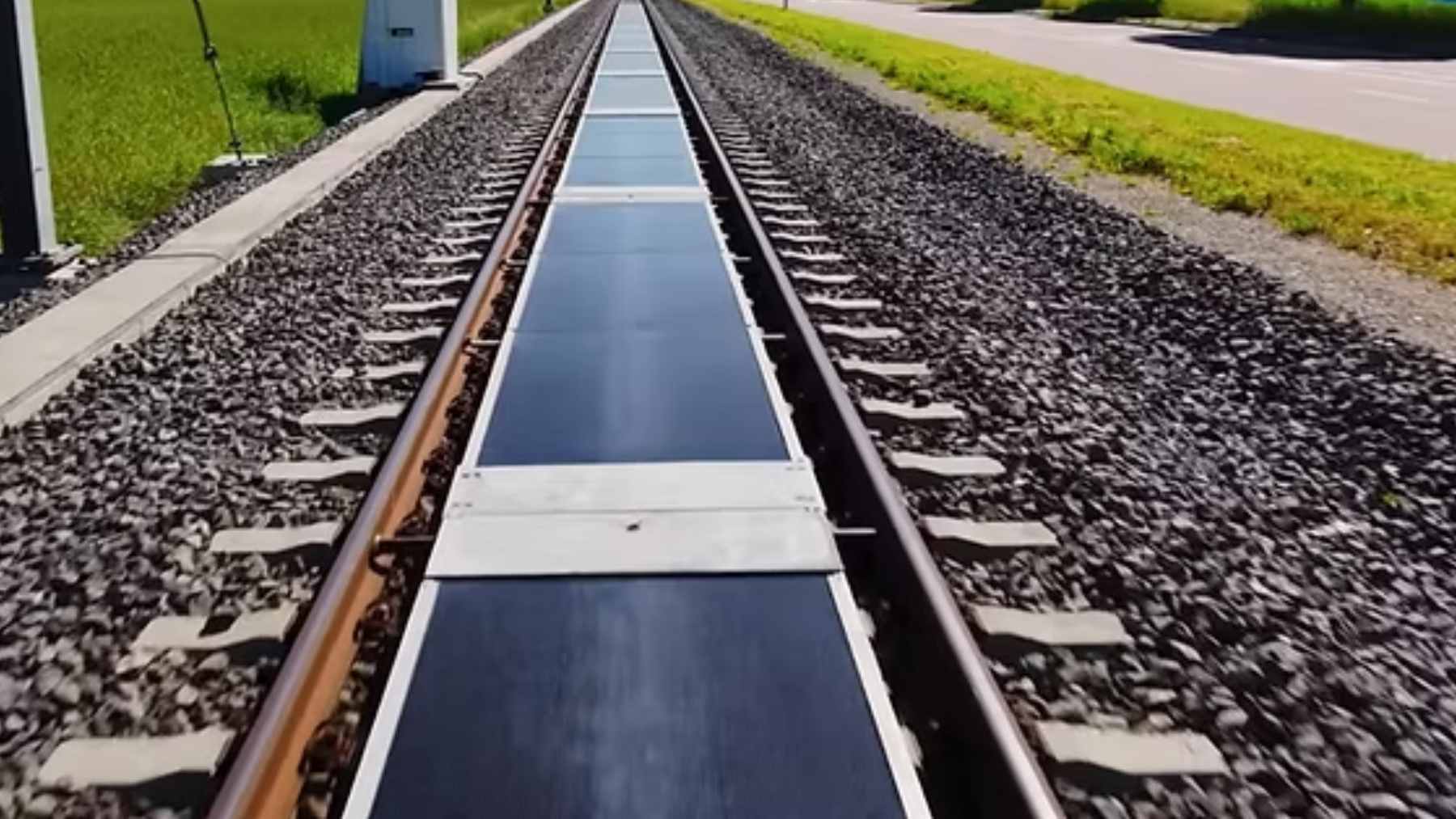
A working railway line in western Switzerland is now carrying passengers above and solar power below. Near the village of Buttes, Swiss startup Sun-Ways has placed 48 removable photovoltaic panels between the rails on about 330 ft. of active track, creating a small but closely watched clean energy pilot.
The installation is not going to power the country by itself. Its estimated annual output is about 16,000 kWh, enough for only a handful of homes, but that is not really the point. The bigger question is whether rail corridors can become solar corridors without taking over farms, forests, or mountain landscapes.
A solar farm under the train
Sun-Ways describes the Buttes project as a world first because the system is removable and installed on a rail line open to traffic. The panels sit in the unused strip between the rails, low enough to avoid interfering with trains but designed so workers can take them out when the track needs maintenance.
The pilot was inaugurated on April 24, 2025, and is scheduled to run for three years. SNCF, France’s national rail group, is working with Sun-Ways to study the results, including installation, glare, track inspection, maintenance impacts, energy output, and dirt buildup.
Why this is harder than it looks
At first glance, the idea seems almost too obvious. Train tracks often run through long, open corridors, and that space is already built on, fenced off, and exposed to sunlight for much of the day.
A railway is not a quiet rooftop, though. Panels placed between the rails must deal with vibration, dust, metal particles, snow, pressure waves from passing trains, and the constant need for fast inspections. One cracked panel or a maintenance delay could turn a clever climate idea into a rail operator’s headache.
That is why the removable design matters so much. Sun-Ways says its system can be installed or removed manually or by a specialized machine developed with Swiss rail maintenance company Scheuchzer, which the company says could eventually lay about 10,764 ft.² of panels in a day.
Regulators wanted proof
Swiss regulators did not simply wave this through. The Federal Office of Transport initially pushed back because it lacked enough technical references for the new system, and approval came only after prototypes, tests, measurements, and expert reviews.
That caution is not surprising. Railways are critical infrastructure, so even green technology has to earn its place there. Glare, fire risk, micro-cracks, cleaning, and emergency access are not side issues when trains are running over the equipment every day.
Sun-Ways says it has responded with stronger panels, anti-reflective features, and a design that allows removal for track work. Still, the Buttes pilot is where those promises meet rain, grit, winter, and daily operations. The trouble is, real life is always rougher than a lab.
The land problem behind solar power
Solar power is growing fast around the world, but where to put the panels is becoming a tougher political question. Rooftops help, but not every roof works. Large solar farms can be efficient, but they can also compete with agriculture, wildlife, and landscapes people care deeply about.
That tension is especially visible in Switzerland, where Alpine solar proposals have stirred debate. For the most part, Sun-Ways is trying to sidestep that fight by using land society has already altered, turning rail space into energy space.
Sun-Ways estimates that equipping much of Switzerland’s rail network, about 3,300 miles, could produce up to 1 TWh of electricity a year, or roughly 2% of the country’s power use. That number is an ambition, not a guarantee, because tunnels, shade, snow, switches, stations, and maintenance zones would all limit what can actually be installed.
Where the electricity goes
For now, the electricity from Buttes is being fed into the nearby distribution grid. TransN, the regional transport operator hosting the project, says the prototype is in service on its Neuchâtel to Buttes line and that the power is injected into a local distribution network.
Sun-Ways has bigger ideas for the future. Its long-term vision is to feed solar power directly into rail traction systems, the electrical networks that move trains, although that is still a long way from this small test site.
Could trains one day help power themselves from panels under their wheels? Maybe, to a limited extent. The more realistic near-term gain may be cleaner electricity for rail infrastructure, nearby grids, stations, signals, and other everyday needs that add up quietly in the background.
A small test with a big audience
SNCF has a practical reason to watch closely. The French rail group says it is France’s largest electricity consumer and second-largest property owner, which makes renewable energy on its own land a strategic business issue as much as an environmental one.
Other countries are likely to pay attention, too. Sun-Ways says new pilots are emerging in France, Belgium, Canada, and South Korea, with discussions also underway in China, Mexico, and the United States.
To sum it all up, the Swiss pilot is small, but it asks a very modern energy question. What if the next solar frontier is not a desert, a field, or a rooftop, but the narrow strip of gravel and steel that already cuts through towns and countryside?
The official statement was published on SNCF Group.