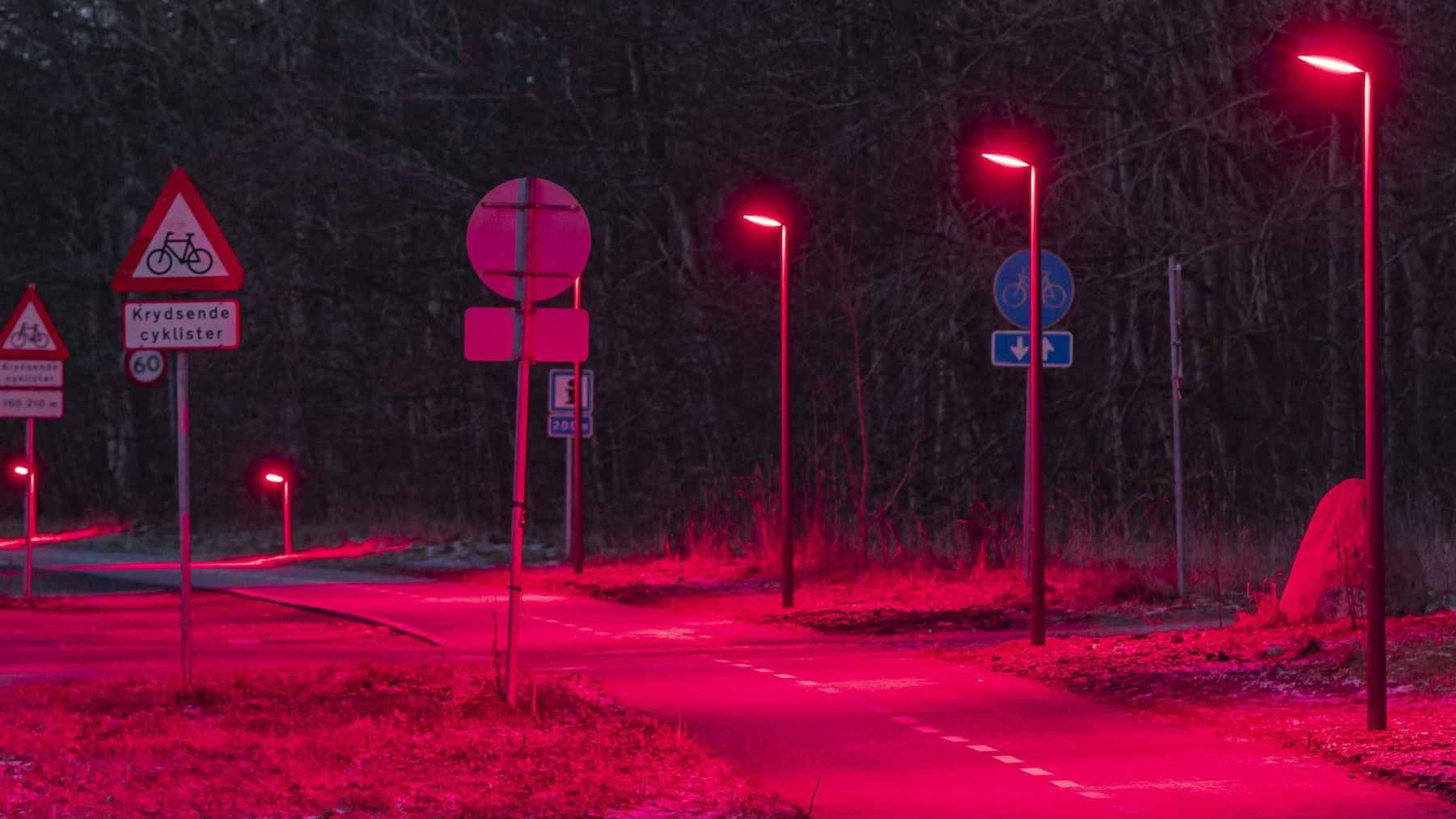
At first glance, the red glow along Frederiksborgvej in Gladsaxe looks like a warning from a movie scene. But this stretch outside Copenhagen is not trying to impress drivers, it is trying to make room for bats.
The Danish municipality replaced ordinary lighting near a known bat corridor with red-spectrum LEDs, a choice meant to reduce light pollution without leaving motorists and cyclists in the dark.
It sounds strange, sure, but the project points to a bigger question for modern cities. What happens when the lights that help people move at night quietly block animals from doing the same?
A road that glows red
The project focuses on Frederiksborgvej near Skovbrynet, where Gladsaxe says a bat colony lives close to the road. When the street lighting was renovated, the municipality said the light was carefully selected to disturb bats and biodiversity as little as possible while still supporting traffic safety for drivers and cyclists.
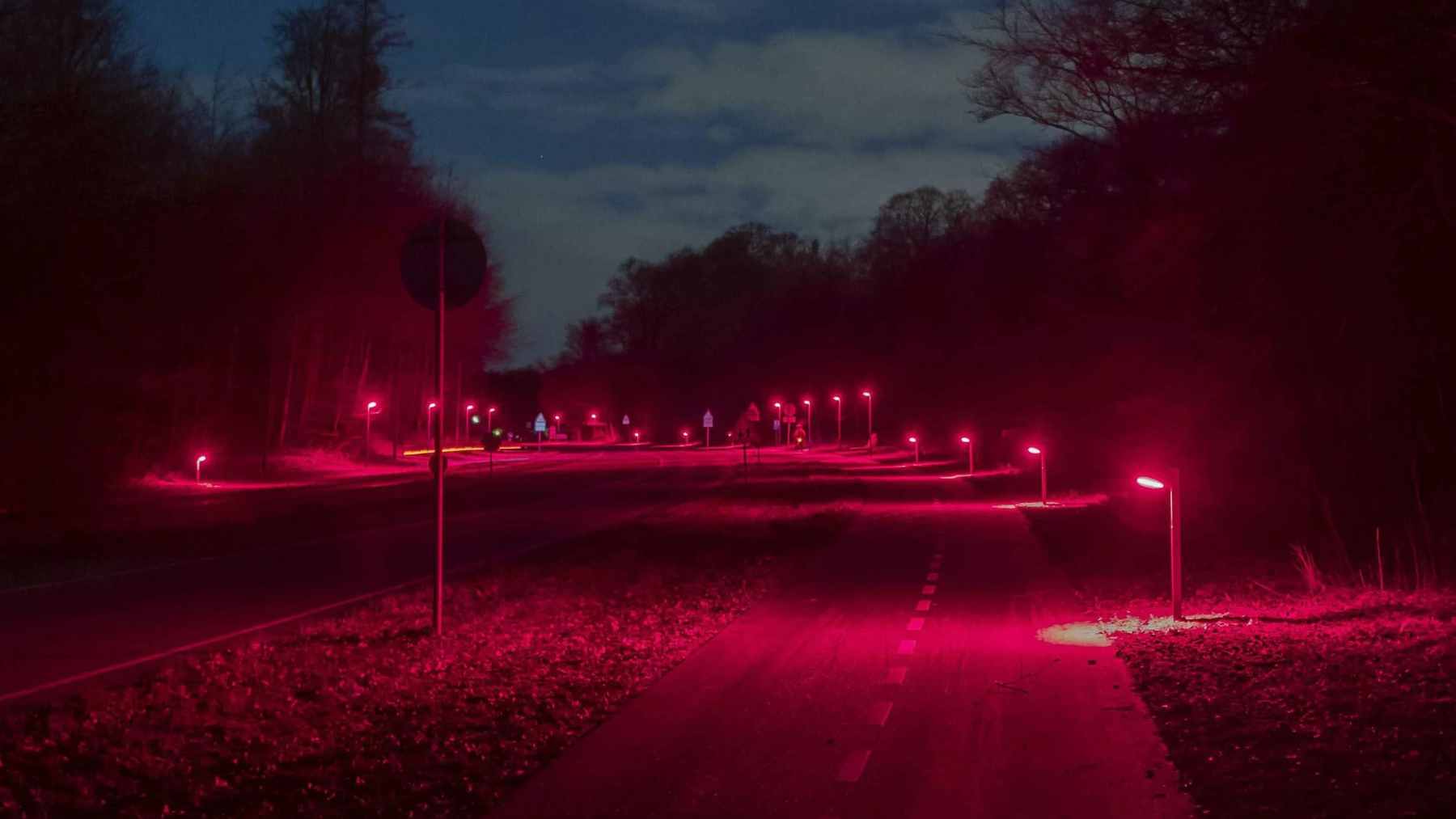
That means red lights where the bats are most exposed, not a blanket change across the whole city. Light Bureau, part of AFRY, describes the area as a roughly 0.4-mile stretch along Frederiksborgvej and the Farum cycle route, where several species of roosting and foraging bats are present.
The design is deliberately low and spaced out. It uses 30 bollards 3.3 ft. tall, placed 98 ft. apart, creating pools of red light with darker gaps in between. At crossings, 12 taller poles of about 11.5 ft. are used to improve visibility where people need extra help seeing the road.
Why bats matter here
Why would one streetlight matter to a bat? For many species, darkness is not just for atmosphere. It is part of the map they use to commute between roosting spots and feeding areas.
Gladsaxe’s official release says seven bat species have been recorded around Frederiksborgvej. None of the seven is considered threatened or red-listed, but the municipality notes that the common pipistrelle and the long-eared bat face the greatest risk of negative impact from roads in that area.
That is where ordinary lighting can become a quiet barrier. A road may look open to a driver, but bright white light can make some bats avoid the area, shrinking the space they can safely use. Not every habitat loss comes with bulldozers.
The science behind red light
The idea behind Gladsaxe’s red road is not just aesthetic. A Dutch research project found that light with shorter wavelengths, including blue, green, and white light, appears to have a stronger effect on bat behavior than longer-wavelength light such as red. Gladsaxe cited that research when explaining why red lighting was chosen for the bat area.
A 2017 study led by Kamiel Spoelstra tested bat activity under white, green, and red light in otherwise dark natural habitats. The paper found that slow-flying, light-shy Myotis and Plecotus bats avoided white and green light but were equally abundant in red light and darkness.
Spoelstra put it plainly. “We’ve found these bats to be equally active in red light and darkness,” he said in a Netherlands Institute of Ecology summary of the research. White and green light, on the other hand, reduced activity for those light-shy bats.
Safety was still part of the deal
The point was not to turn Frederiksborgvej into a dark nature reserve. Gladsaxe’s road engineer Jonas Jørgensen said the municipality wanted lighting that affected bats and nature as little as possible, but without compromising traffic safety. The official release adds that warm white light and higher poles are used at traffic nodes and cyclist crossings to improve visibility.
That balance matters because city lighting is always a compromise. People need to see crosswalks, bike lanes, and curves in the road. Bats need enough darkness to move, hunt, and avoid exposure.
Philip Jelvard, lighting designer at Light Bureau, said the red light should have both “functional value” and “symbolic value.” In his words, it should make passersby aware that this is “a special natural area” the municipality wants to protect.
Bigger than one red road
The red section is eye-catching, but it is part of a larger lighting upgrade. Gladsaxe said it planned to replace around 5,000 fixtures with more sustainable choices in cooperation with Light Bureau, Andel Lumen, and the EU-funded Lighting Metropolis Green Mobility program.
That energy piece is not a side issue. A project overview for Lighting Metropolis Green Economy said the work expected energy savings of at least 7.2 million kWh, while noting that only about 20% of municipal light sources in the region had been switched to energy-saving LED technology at the time.
Cities are where this problem gets bigger fast. The United Nations Development Programme says 4.2 billion people, or 55% of the world’s population, lived in cities in 2018, while cities occupy just 3% of Earth’s land but account for 60% to 80% of energy consumption and at least 70% of carbon emissions.
What cities can learn
The lesson is not that every road should suddenly glow red. That would be too easy, and probably wrong. The smarter takeaway is that lighting should fit the place.
Near parks, rivers, wetlands, forests, and known wildlife corridors, cities can use warmer colors, shielding, dimming, motion controls, lower poles, and wider spacing. At busy intersections or school crossings, brighter lighting may still be the safer call. The trick is knowing the difference.
At the end of the day, Gladsaxe’s red road shows that urban design does not always need a massive rebuild to help nature. Sometimes, it starts with asking whether the light is doing more than only helping us see.
The official statement was published on Gladsaxe Kommune via Ritzau.