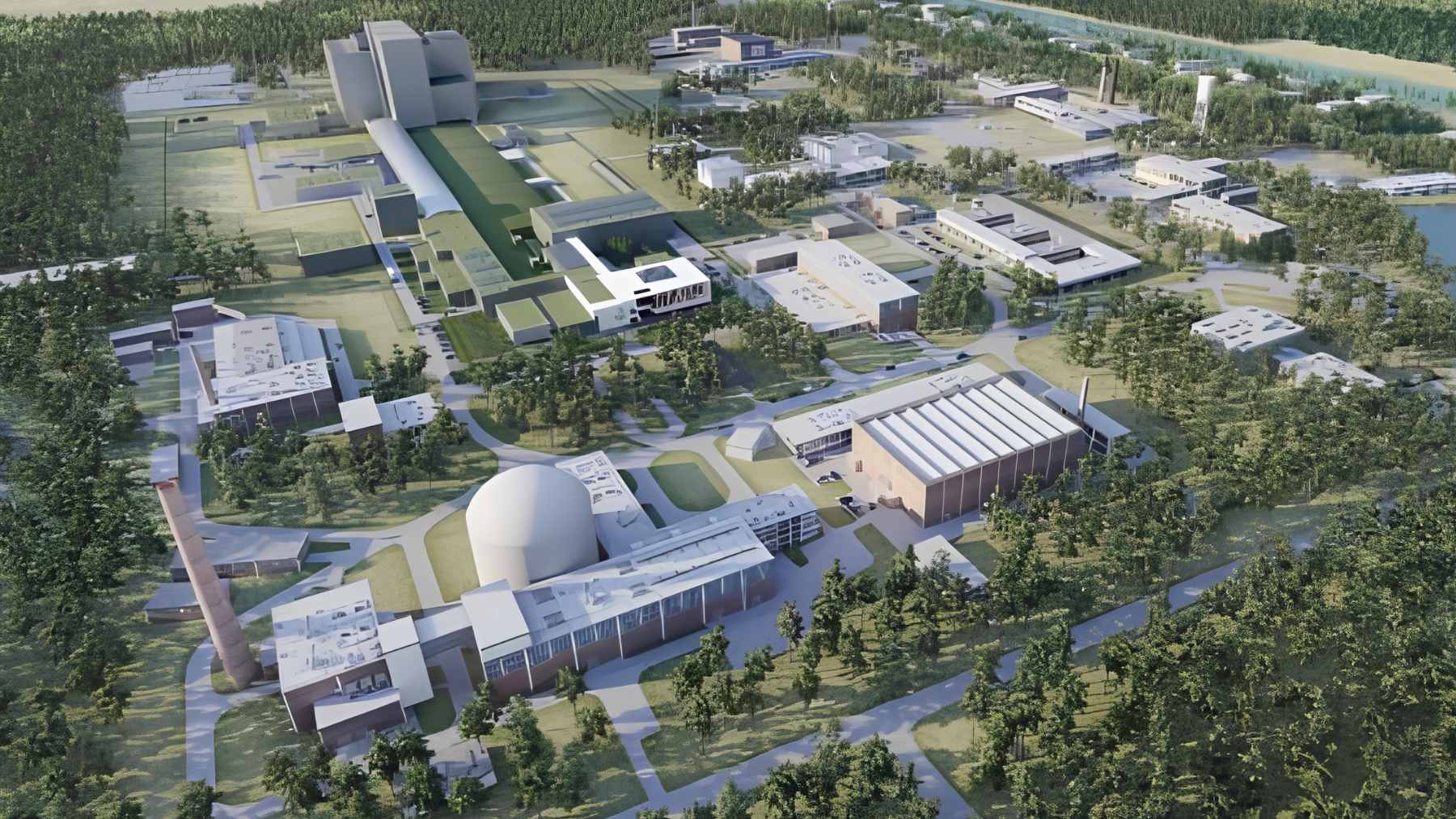
Construction on Belgium’s MYRRHA research reactor in Mol has been temporarily paused, according to reporting confirmed by a spokesperson for Energy Minister Mathieu Bihet and by MYRRHA IVZW, the body overseeing the project.
The stop comes less than two years after the June 2024 groundbreaking for the first phase, known as MINERVA.
Why should anyone outside the nuclear world care? Because MYRRHA is being pitched as an environmental tool as much as a science project, and it sits at the crossroads of waste management, advanced tech, and the everyday reality of cancer diagnostics that depend on radioisotopes.
A reactor powered by a particle accelerator
So what is MYRRHA, exactly? MYRRHA (Multi-purpose Hybrid Research Reactor for High-tech Applications) is designed as an accelerator-driven system where a particle accelerator sends protons into a target to create neutrons that sustain fission in a reactor core that stays subcritical on its own.
That subcritical design is not just a technical flex. The IAEA notes that if the accelerator stops, the chain reaction stops, and the facility is designed so decay heat can be removed by natural circulation without active systems.
The environmental argument is about time
Radioactive waste is a problem mostly because it lasts longer than any human institution. The IAEA explains that un-reprocessed spent fuel can remain radiotoxic above natural uranium ore levels for roughly 300,000 years, and waste containing minor actinides can still require about 10,000 years to return to natural levels.
MYRRHA’s core mission is to demonstrate transmutation of those minor actinides at engineering scale. In the IAEA’s description, reducing radiotoxicity could cut high-level waste volume by about 99% and reduce the storage timeline to around 300 years, but only if the technology works as intended at scale.
MINERVA is the first build, and the hard one
The pause matters because MINERVA is not a placeholder. A CERN-hosted overview describes it as a 100 MeV accelerator with two target stations, including an ISOL system linked to radioisotopes and a Full Power Facility aimed at fusion materials research.
This is also where the business math shows up. The same project material outlines €558 million ($648 million) budgeted for the first phase, including €287 million ($333 million) for MINERVA construction from 2019 to 2027, alongside additional funding for design work and operations through 2038.
Why the pause happened
A Belgian press roundup dated May 8, 2026 reported that construction is “stopped,” with confirmation attributed to the minister’s spokesperson and to MYRRHA IVZW. In separate reporting, MYRRHA IVZW has tied the delay to a federal reevaluation of Belgium’ nuclear strategy and sector funding, while stressing it is not a cancellation.
The stakes are big enough to make any finance ministry flinch. Public descriptions put the overall MYRRHA project estimate around €1.6 billion ($1.86 billion) and still point to full operation around 2038, so even a short pause can ripple through contracts, supply chains, and hiring plans.
Europe’s nuclear push is also a security story
Even with MYRRHA on pause, Belgium is trying to accelerate the wider nuclear ecosystem. On May 13, 2026, Bihet’s office announced a memorandum of understanding with the Netherlands covering research cooperation, workforce training, supply chain ties, and joint work on radioactive waste management and disposal.
The language is quietly strategic, and that matters for defense-style resilience as much as for climate policy. Bihet said “Future European nuclear projects require strong value chains, high-level expertise, and close cooperation,” and the same press release says nuclear buildouts can require about 10,000 workers at peak and around 5,000 on average.
What to watch next
The next milestone is less about physics than paperwork. Project supervisors have signaled that a government decision before summer could keep the schedule from slipping, with one message summed up as “If the government decides before the summer, there is no problem.”
If construction restarts, the real test will be whether MINERVA can stay on track toward early research activities by 2027, and whether funding partners remain committed long enough to reach the later accelerator expansion and reactor phases.
The press release was published on Mathieu Bihet’s official site.