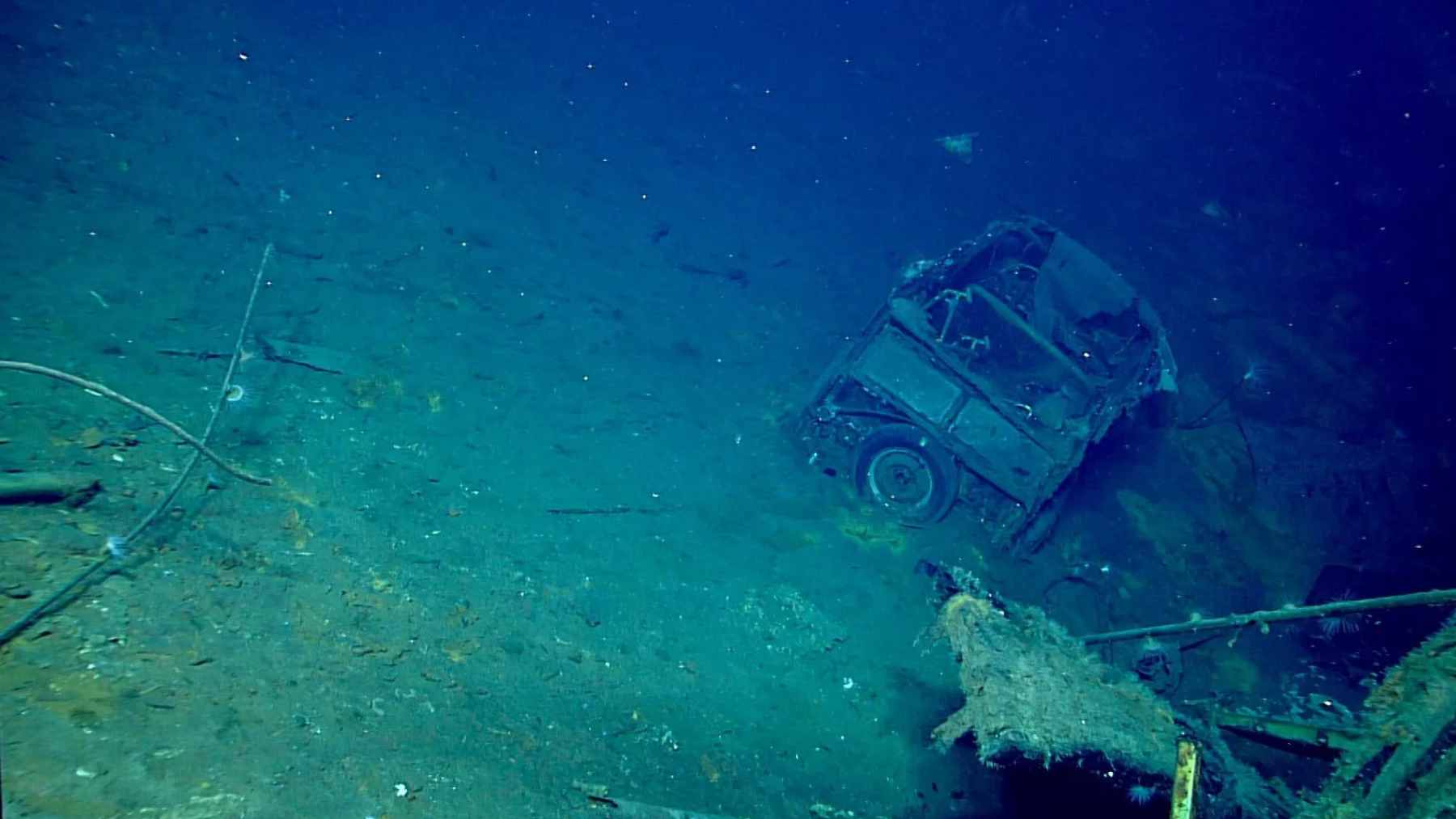
A civilian car sitting inside a World War II aircraft carrier is not the kind of thing deep-sea explorers expect to see. Yet that is exactly what The National Oceanic and Atmospheric Administration’s (NOAA) remotely operated vehicle Deep Discoverer found while surveying USS Yorktown, the U.S. Navy carrier sunk after the Battle of Midway in 1942.
The vehicle has been tentatively identified as a 1941 Ford Super Deluxe “Woody,” resting roughly 17,060 ft. below the Pacific surface.
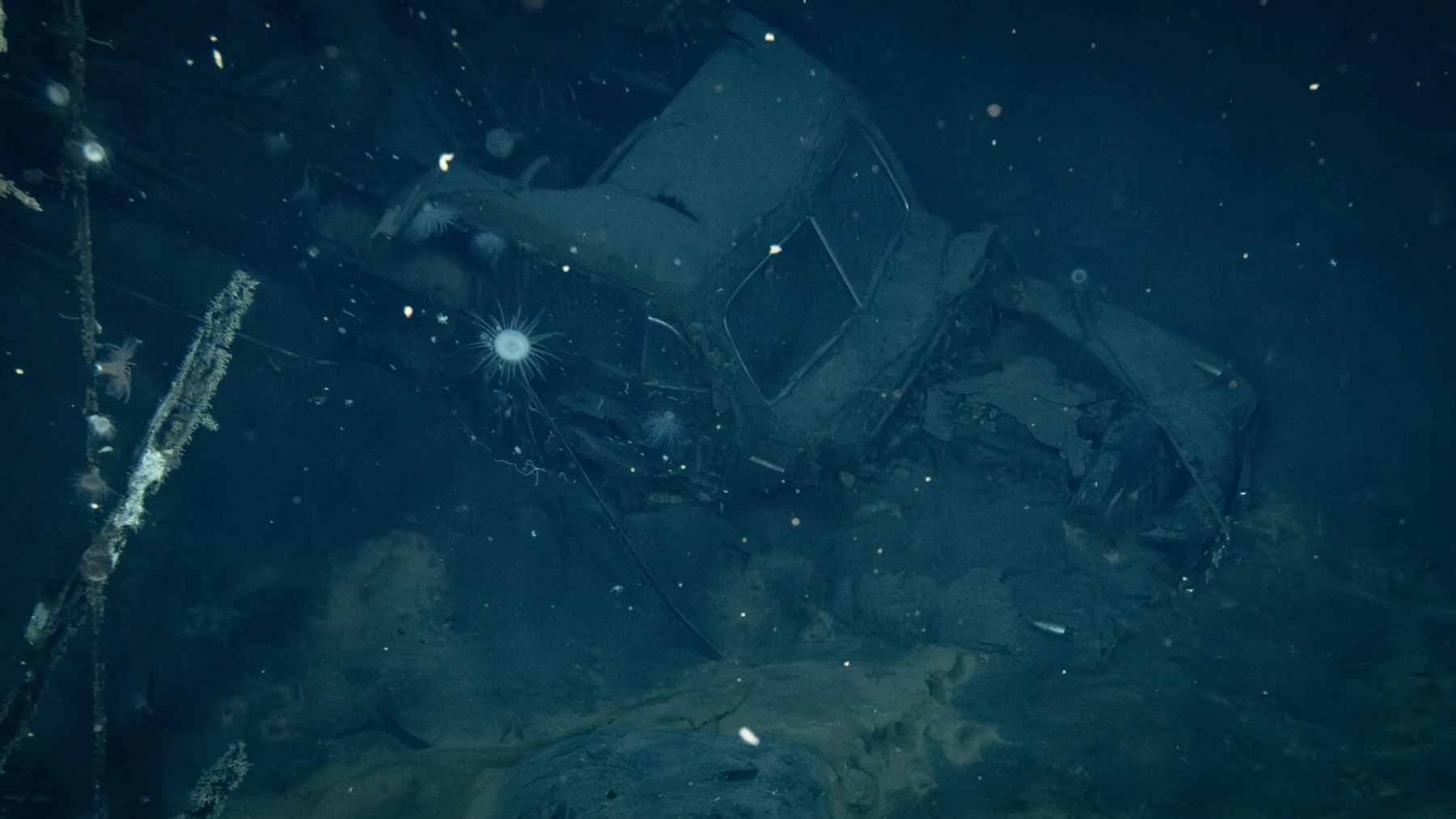
The surprise is not just that the car survived in any recognizable form after more than eight decades underwater. It is that key details are still visible, including the split windshield, chrome bumper, rectangular rear windows, and traces of the wood-framed body that gave the Woody its name.
What was it doing on a warship headed into one of the most important battles of the Pacific? That part remains a mystery.
A car in the deep
The discovery happened during NOAA’s April 2025 exploration of USS Yorktown as part of the Papahānaumokuākea ROV and Mapping expedition aboard NOAA Ship Okeanos Explorer. The dives were non-disturbance surveys, meaning the team documented the wreck without removing objects or altering the site.
During the April 19 dive, the team noticed the faint outline of an automobile while looking into the aft hangar deck from the port side of the carrier. A follow-up dive on April 20 gave researchers a clearer look, allowing contributors aboard the ship and onshore to study the car’s features.
Imagine watching a dark blue screen, waiting for twisted metal or aircraft wreckage, and then seeing what looks like white-wall tires. According to Ford’s official account, expedition coordinator Sam Cuellar recalled the moment as the outline sharpened, saying, “And then it clicked. Is that a car?!”
Why the Ford matters
At first glance, the Woody might seem like a quirky footnote, but it is much more than that. Cars on aircraft carriers were not the center of naval history, but this one hints at the everyday machinery that helped massive warships function when they were in port.
NOAA says the vehicle had “SHIP SERVICE ___ NAVY” written on part of its front plate. The lower line is obscured, but NOAA notes it could read “CV-5 NAVY” or “US NAVY,” which supports the idea that the car served some official ship or Navy function rather than being a personal keepsake.
Ford began mass production of the Woody in 1929, and the company later stopped producing civilian automobiles in early 1942 as U.S. industry shifted toward wartime manufacturing. That timing makes this particular vehicle feel like a small bridge between ordinary American life and total war.
A station wagon built for errands, supplies, and people suddenly became part of a carrier’s final story.
The biggest mystery
So how did it get there? The leading theory, cited in Ford’s official report, is that the Woody may have belonged to the Pearl Harbor Naval Shipyard and was likely driven aboard while Yorktown underwent rushed repairs after the Battle of the Coral Sea.
That theory fits the timeline, for the most part. Yorktown was damaged in May 1942, returned to Pearl Harbor, and was pushed back to sea quickly because U.S. commanders needed every available carrier before Midway. The car may simply have stayed aboard when the ship left port again.
That still leaves the more human question, however. Why was it not removed or tossed overboard when the ship was fighting to survive? NOAA’s own mission summary raises that point, noting that other equipment, including anti-aircraft guns and aircraft, was jettisoned as crews tried to correct Yorktown’s list.
Yorktown’s final mission
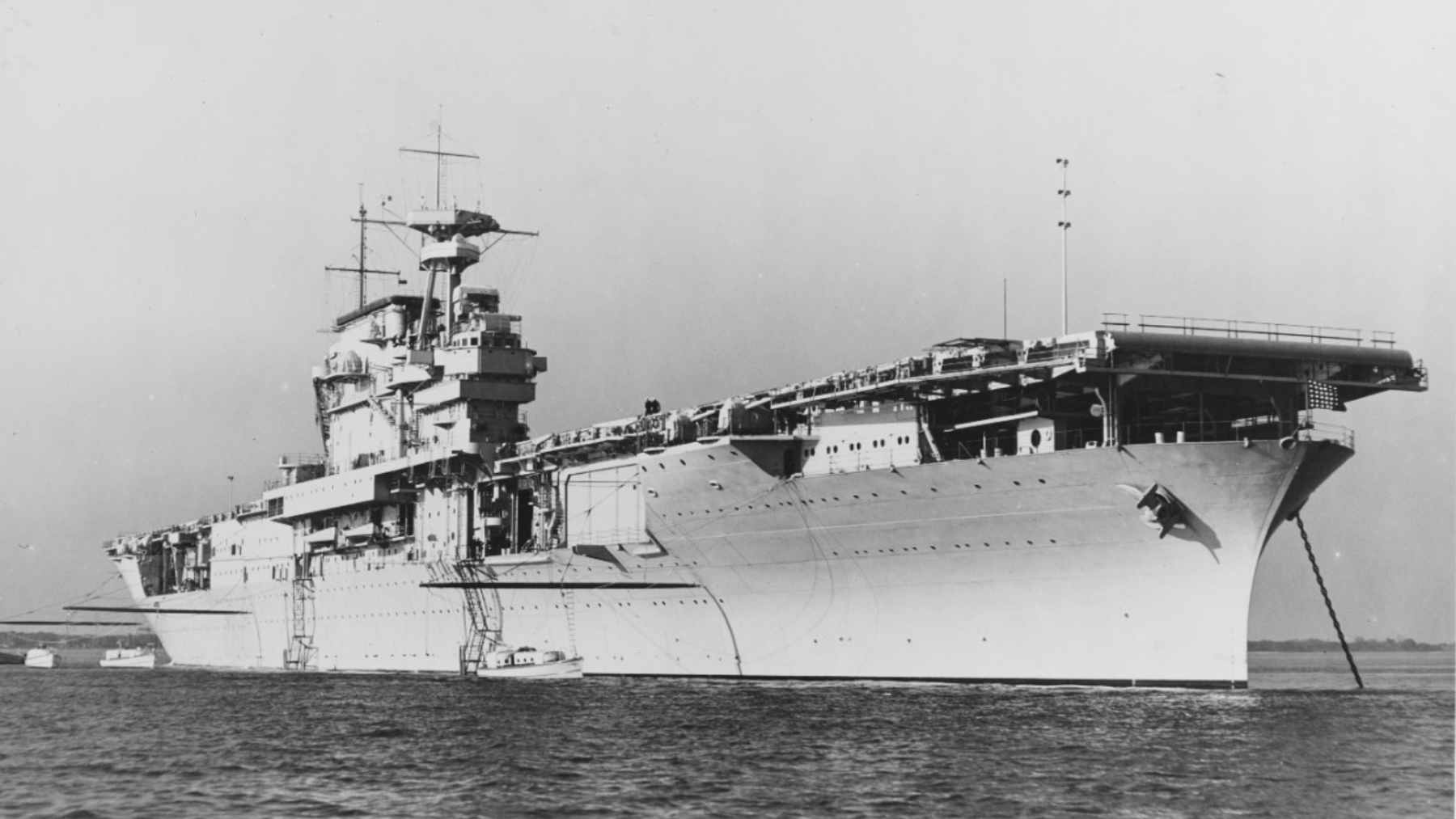
USS Yorktown was one of the most important American carriers in the early Pacific war. The Naval History and Heritage Command states that the carrier slipped below the waves just after dawn on June 7, 1942, during the Battle of Midway.
The ship had already been hit during battle, and salvage efforts were underway when Japanese submarine I-168 struck. The Navy’s Midway account says the submarine interrupted those efforts, torpedoing Yorktown and sinking destroyer USS Hammann.
That history gives the car an emotional weight it would not have in a museum parking lot. Down there, inside the hangar deck, it is not just a Ford. It is part of the same sealed time capsule as the aircraft, weapons, equipment, and personal traces left aboard when the carrier went down.
More than a wreck
The April 2025 dives did not only reveal the Woody. NOAA also documented a hand-painted mural called “A Chart of the Cruises of the USS Yorktown,” measuring 42 ft. by 12 ft. inside the ship’s No. 2 elevator shaft.
The team also surveyed at least three Douglas SBD Dauntless dive bombers in the hangar deck. One was seen inverted with a 500-lb. bomb still secured in its release cradle, a stark reminder that the wreck is not just historic debris, it is a battlefield site.
There is an ecological side, too. NOAA observed animals living on and around the wreck, including tubeworms, anemones, and a colorful red jellyfish that may be a new species. In practical terms, Yorktown has become both a memorial and a deep-ocean habitat.
A protected place
The wreck of USS Yorktown is managed as a protected sunken military craft by the Naval History and Heritage Command. NOAA also notes that it serves as the final resting place for many U.S. servicemen, which is why these missions are handled with care and restraint.
That matters. Deep-sea technology now gives researchers better cameras, better mapping tools, and a front-row seat to places that were once unreachable, but access is not the same as ownership. Some sites are meant to be studied, not disturbed.
For now, the 1941 Ford Woody will remain where it has been for more than 80 years, surrounded by darkness, marine life, and the wreckage of a carrier that helped change the course of World War II. A strange find? Absolutely, but also a powerful one.
The official mission feature was published on NOAA Ocean Exploration.