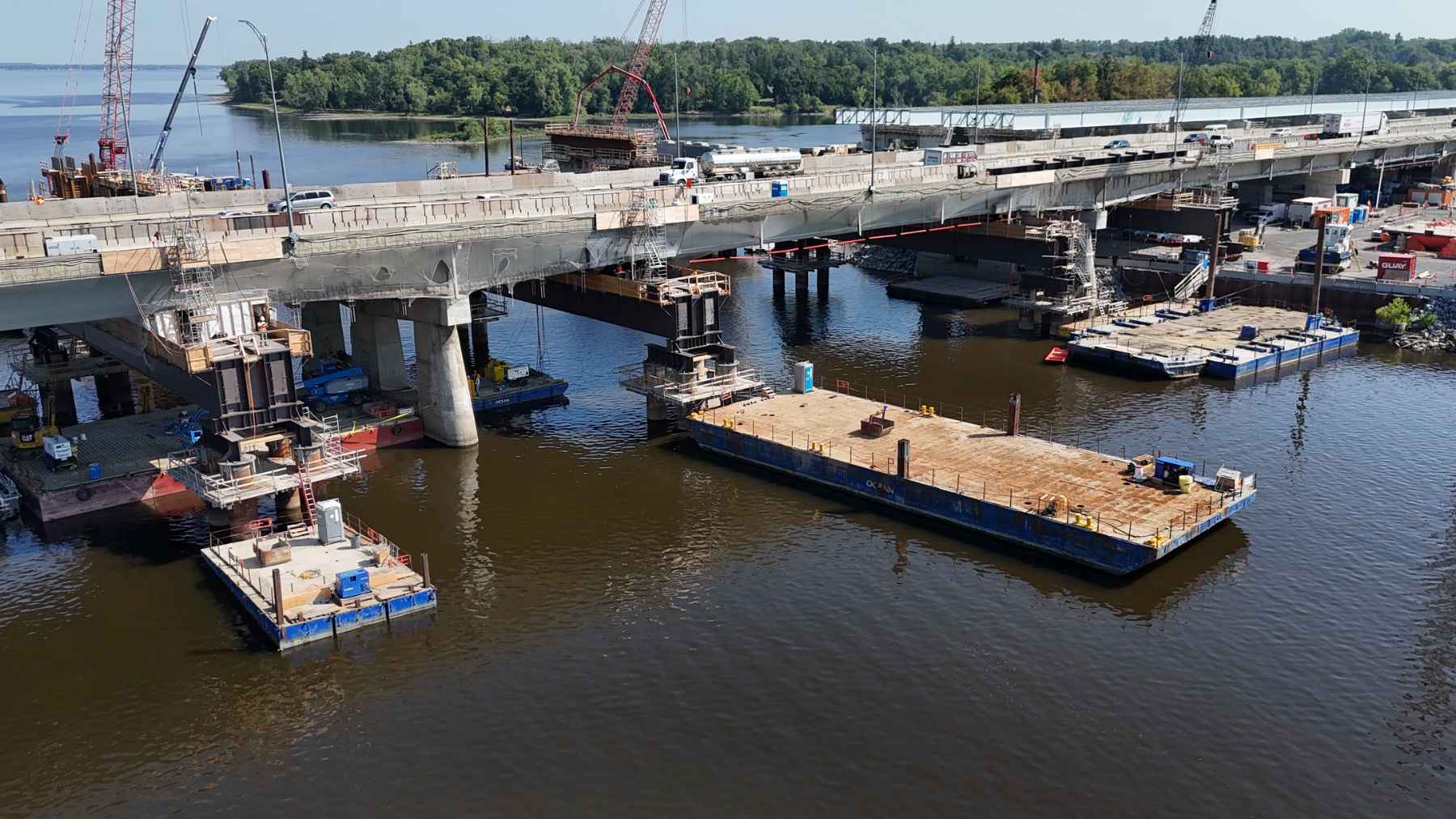
Building a major bridge over open water is hard enough. Doing it through Quebec winters, with crews working from barges while traffic continues nearby, turns every support into a test of engineering and logistics.
That difficult phase has now reached a major milestone. All 46 piers for the new Île-aux-Tourtes Bridge are complete, clearing the way for more deck and superstructure work as Quebec pushes toward opening the first new structure in late 2026.
A foundation on a huge scale
According to the project team, the piers consumed about 40,000 tons of concrete and 9,480 tons of reinforcing steel, all placed to support a crossing over Lake of Two Mountains.
Much of the job unfolded in a marine construction zone where barges could move underfoot, access was limited, and several work phases had to be coordinated at the same time. Winter added another layer of difficulty by making heavy materials harder to handle and place safely.
On paper, a pier has a straightforward role. It transfers the weight of the deck, vehicles, wind, and other forces into the foundations below, but each support must be positioned accurately enough for the beams and deck sections to line up above it.
What happens next
The job now shifts further into the part drivers can see taking shape. In the ministry’s latest monthly update, the westbound structure had 377 of 455 beams installed and 672 of 1,135 precast slabs placed.
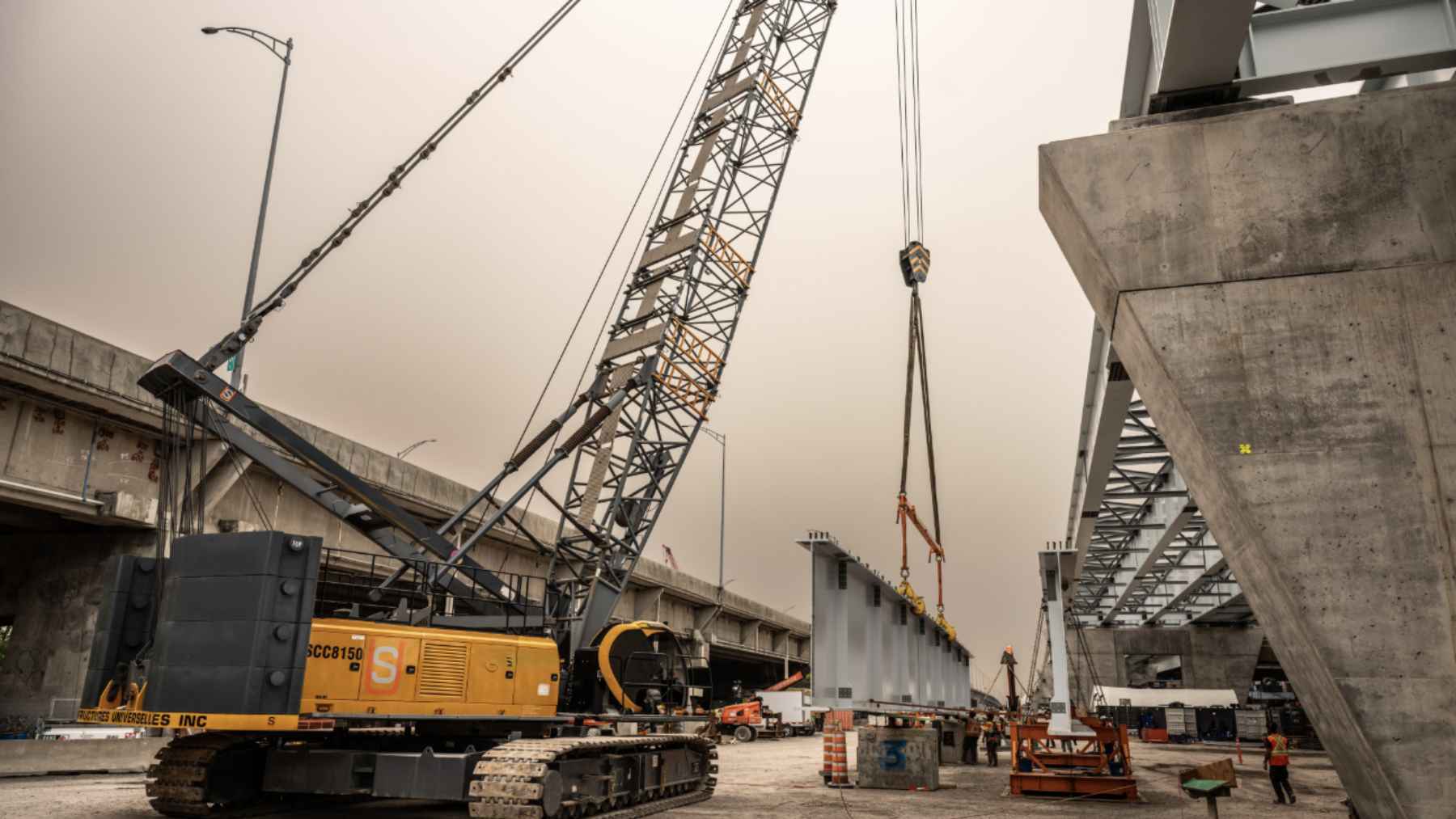
Work on the eastbound structure is less advanced, with 195 of 390 beams installed and its precast deck panels still to come. Both sides have completed their foundation piles, abutments, and piers, which means the basic support system is now in place from shore to shore.
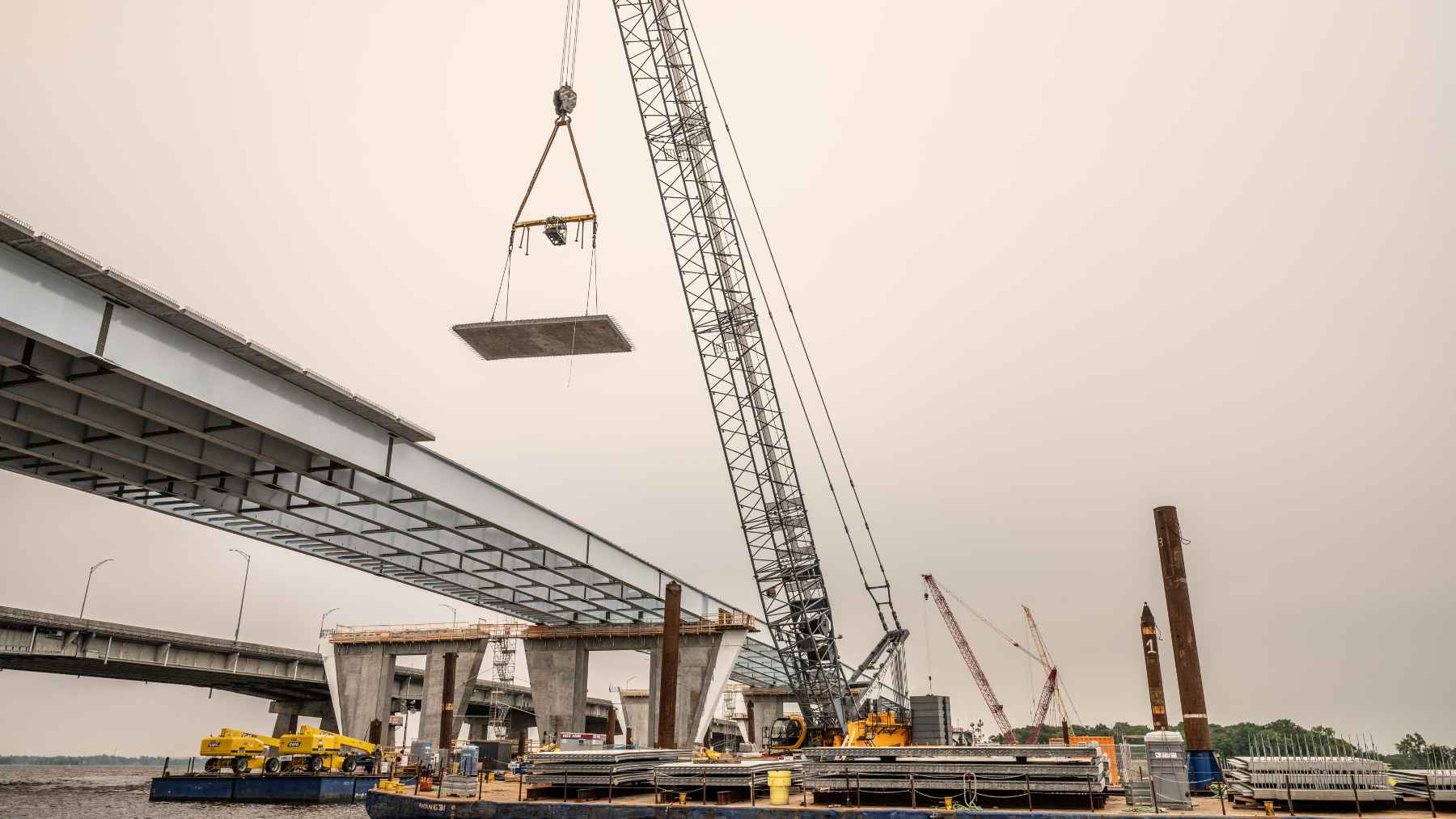
Why does that matter? Once the piers are finished, crews can focus more consistently on the horizontal structure, including beams, deck panels, barriers, paving, and road markings. The bridge starts looking less like a construction site in the water and more like a road.
A route that cannot afford uncertainty
Nearly 81,000 vehicles use the existing Île-aux-Tourtes Bridge every day, and about 11% of them are trucks. That makes the crossing a major link for commuters and freight moving along Highway 40 between Montreal and the Vaudreuil-Soulanges region.
The current bridge dates to the mid-1960s and continues to require regular inspections, beam and slab repairs, reinforcement, and targeted shoring. Five of its six lanes are currently open, while heavy vehicles face restrictions in the right lane in both directions.
For drivers, the issue is simple. A reliable bridge can mean the difference between an ordinary trip and a long morning of brake lights, while businesses need a corridor that can carry workers and goods without repeated surprises.
The environmental tradeoff
A project using this much concrete and steel comes with a sizable material footprint. Durability is essential, but the environmental test is whether the bridge can deliver a long service life while construction controls limit damage to the lake, nearby slopes, and surrounding habitat.
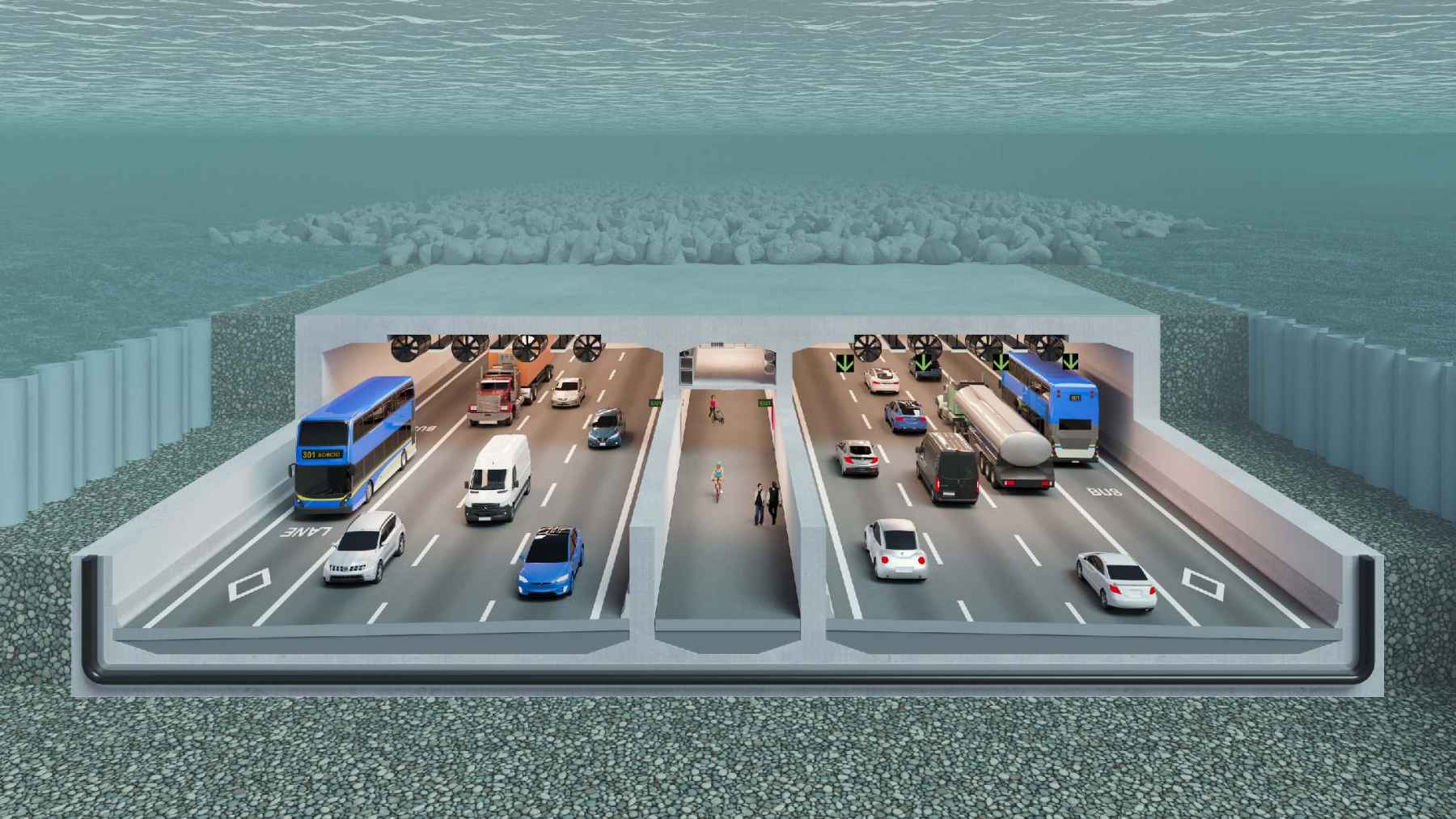
Quebec lists preserving the integrity of the surrounding environment as one of the reconstruction project’s formal objectives. The final crossing will also include wide shoulders designed for buses and a multi-use path, giving public transportation, cyclists, and pedestrians a place in infrastructure that has traditionally centered on cars.
Crews have also installed geosynthetic coverings on slopes near Highway 40 to control erosion during heavy rain. The material helps hold soil in place while newly seeded vegetation becomes established, a small detail compared with 46 giant piers, but an important one when runoff can quickly scar an exposed embankment.
Built for a harsher reality
The construction challenges offer a reminder that modern infrastructure has to work in conditions that are rarely neat or predictable. Cold weather, moving water, restricted access, and live traffic do not pause because a schedule looks good on paper.
That is where engineering discipline matters most. The completed piers are not just blocks of concrete in a lake, but the fixed points that allow hundreds of other components to be installed in sequence and checked against tight tolerances.
The milestone also carries a broader lesson for public works. Building for longevity can be expensive and resource intensive, but delaying replacement of a heavily used, aging link can bring its own environmental and economic costs through repeated repairs, congestion, and emergency interventions.
The finish line is still ahead
Quebec expects the first new structure to open in late 2026 with five lanes managed dynamically according to peak traffic. The second structure is scheduled to open in 2027, creating three permanent lanes in each direction.
After that, crews still have to dismantle the existing bridge. Its deconstruction is scheduled to finish in 2029, with final project work continuing into 2030, so completing the piers is a major checkpoint rather than the end of the job.
For now, one of the most technically difficult phases at water level is complete. What comes next will determine whether this massive investment delivers the safer, more dependable, and better-connected crossing Quebec has promised.
The official statement was published on the Île-aux-Tourtes bridge project’s official Facebook page.