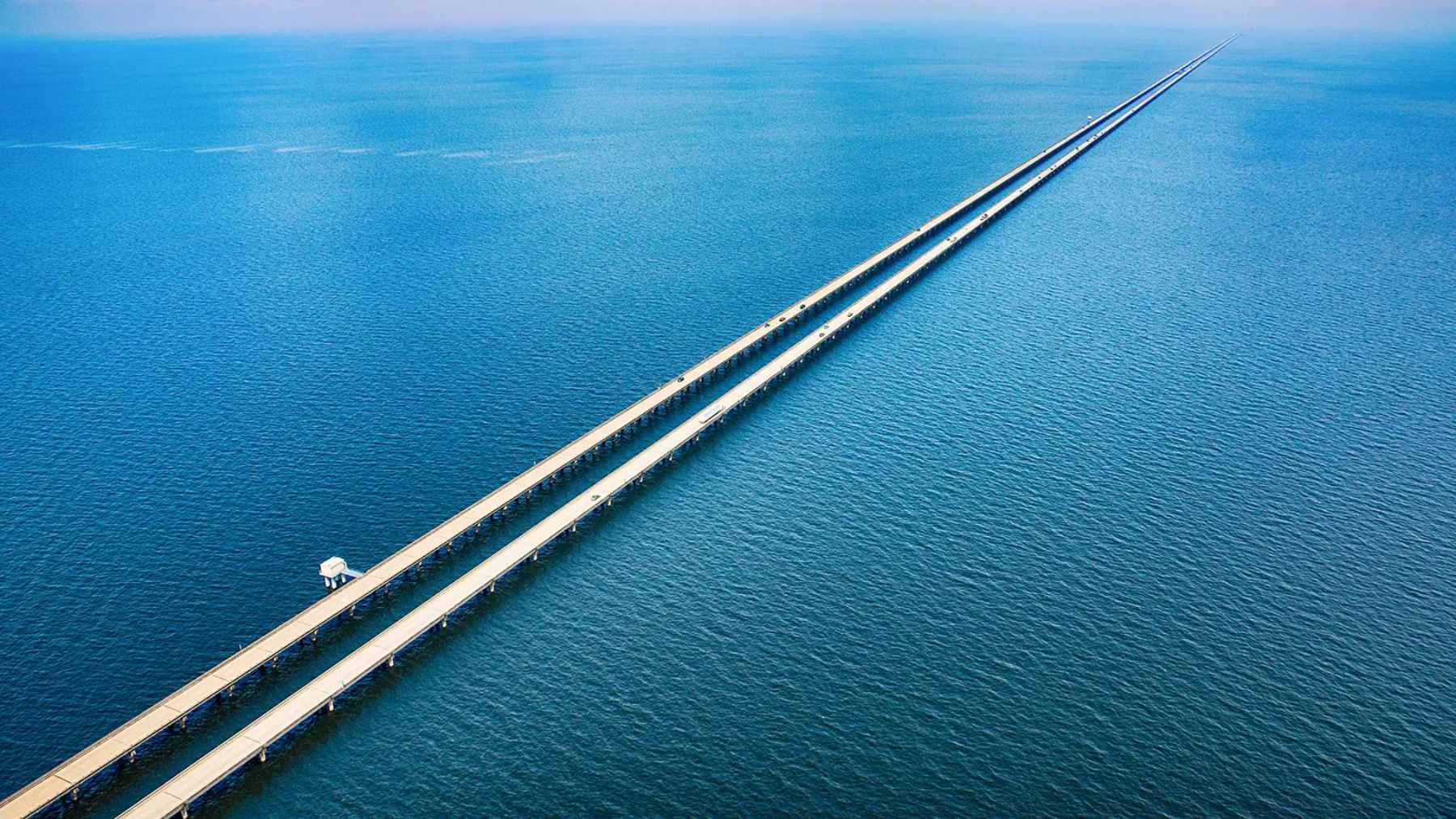
Drive far enough onto the Lake Pontchartrain Causeway and the land does something strange: it disappears. For miles, there is only sky, open water, and a thin strip of concrete carrying drivers across one of Louisiana’s most recognizable pieces of infrastructure.
That is why this bridge still stands out, even in an age of record-breaking megaprojects. The Causeway is not just the longest bridge in the United States. Guinness World Records lists the Second Lake Pontchartrain Causeway as the world’s longest bridge over water in the “continuous” category, at 23.87 miles.
A road over open water
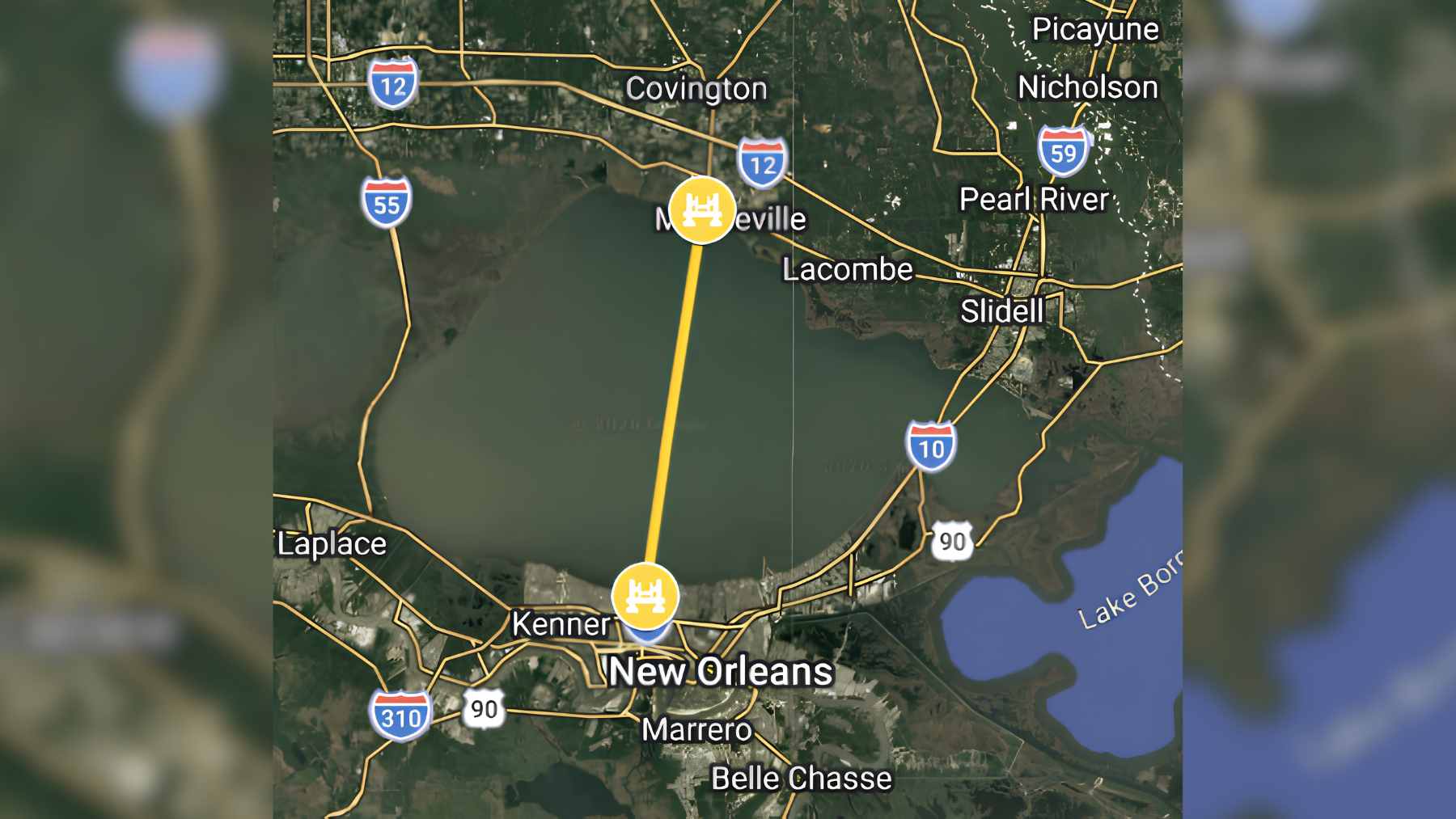
The Causeway connects Metairie, on the south shore near New Orleans, with Mandeville, on the north shore of Lake Pontchartrain. In practical terms, it turns what would be a long drive around the lake into a direct crossing over the middle of it.
That matters for thousands of commuters. The bridge is a daily route, a business link, and for many drivers, a slightly eerie reminder that Louisiana’s transportation network sits inside a landscape of water, marshes, and coastal risk.
Lake Pontchartrain itself is not a typical lake. The U.S. Geological Survey describes it as a shallow, brackish system covering nearly 630 miles², with an average depth of about 12 ft., fed by freshwater and saltwater from the Gulf of Mexico.
Built like an assembly line
The original span opened on August 30, 1956, after construction that moved with surprising speed. The American Society of Civil Engineers says the bridge took just 14 months to build and used “assembly-line, mass-production methods” for the first time in bridge construction.
That may sound ordinary today, but at the time it was a bold engineering choice. Crews repeated a simple design again and again, using prefabricated components that could be moved into place across the lake.
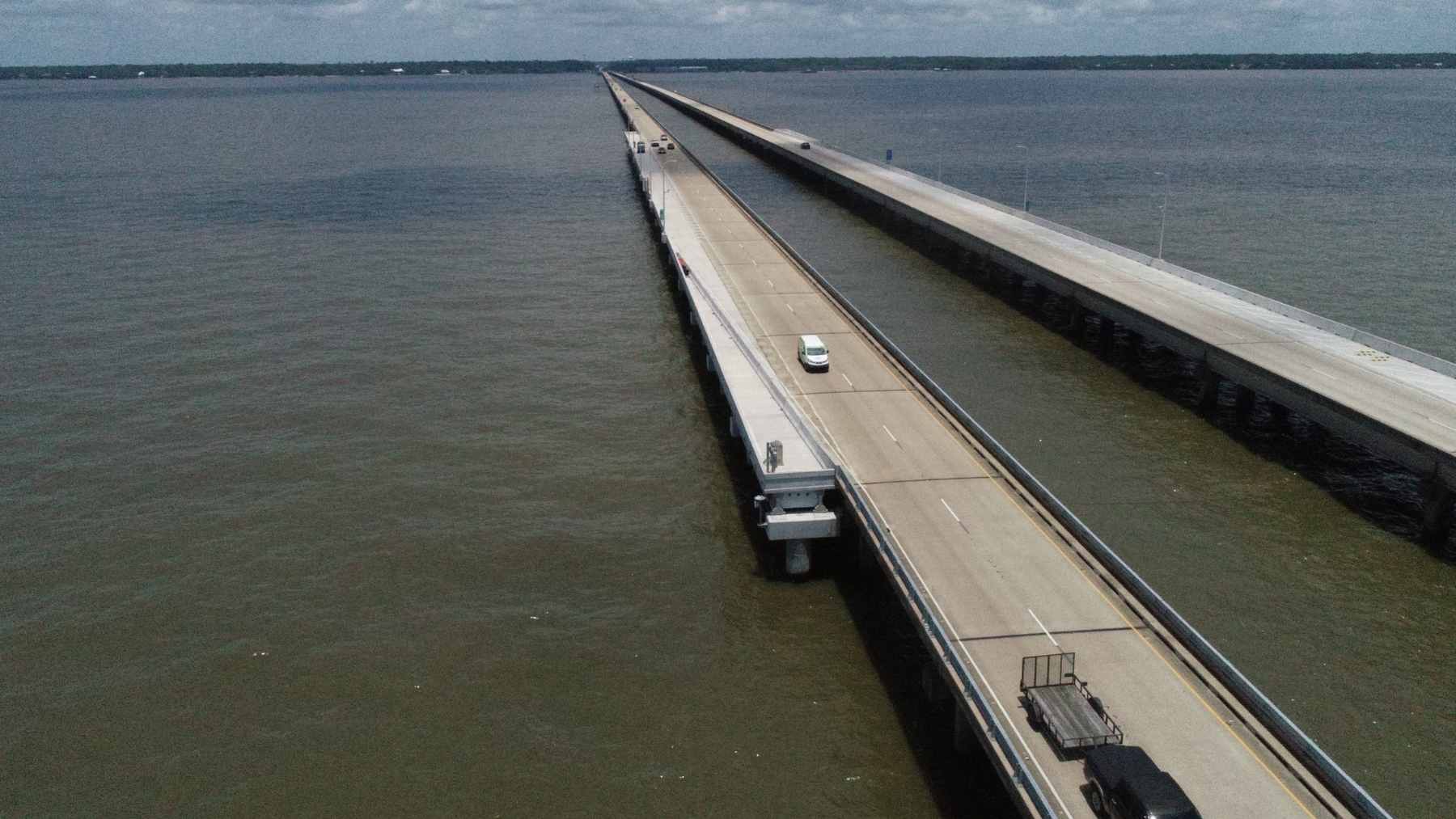
The official Causeway page says the southbound bridge has 2,246 spans and the northbound bridge has 1,506 spans. Most of the structure sits about 10 ft. above average lake level, close enough to the water that the crossing can feel almost like driving along the surface.
Why two bridges exist
The Causeway is really two parallel bridges, not one wide deck. The first carried two-way traffic, but growth on the north shore quickly made that setup feel too small.
A second span opened in 1969, giving the route more capacity and creating the version people know today. Guinness lists that second bridge as the record holder because of its 23.87-mile continuous length over water.
For drivers, the result is simple. One span handles southbound traffic and the other handles northbound traffic, with four total lanes crossing a stretch of water that can make even an ordinary commute feel unusually exposed.
The record gets tricky
Is it really the longest bridge in the world? The honest answer is, it depends on how the measurement is defined.
Some bridges have a greater total length, especially when land approaches, tunnels, or separate structures are counted. But Guinness separates “continuous” over-water bridges from aggregate-length crossings, and that is where the Louisiana Causeway keeps its title.
That distinction matters because the Causeway spends its record-setting distance over open water–no islands, no long land stretches, just concrete, lake, and horizon.
A fragile place below
The environmental angle is easy to miss from a car window. The bridge is impressive, but the water beneath it is part of a larger estuarine ecosystem that has been under pressure for decades.
The U.S. Geological Survey notes that the basin faces stress from runoff, sewage, industrial and agricultural discharges, shell dredging, oil and gas activity, hurricanes, subsidence, and saltwater intrusion. That is a lot for one body of water to absorb.
The Louisiana Coastal Wetlands Planning Protection and Restoration Act program also reports that the Pontchartrain Basin contains hundreds of thousands of acres of wetlands, while more than 66,000 acres of marsh have converted to water since 1932.
More than a commute
The Causeway is still a toll bridge. Current official toll information says tolls are collected only on the North Shore, with a standard two-axle vehicle under 7 ft. paying $3.40 with a tag or $6.00 by cash or credit card, plus a credit card fee when applicable.
That toll is part of the bridge’s everyday business model. The route must move commuters, handle maintenance, manage weather alerts, and keep traffic flowing across a place where a stalled car is not just inconvenient.
At the end of the day, that is what makes the Causeway more than a record. It is a piece of technology stretched across a living, changing ecosystem.
A bridge with a lesson
The Lake Pontchartrain Causeway shows what mid-century engineering could do when a region wanted a faster connection. It shortened travel, helped reshape north shore communities, and created one of the most unusual drives in America.
It also sits inside a coastal environment where water, land, weather, and infrastructure are always negotiating with each other, however–that is the bigger story. The bridge may look fixed, but the world around it is anything but.
The official bridge details were published on The U.S. Causeway.