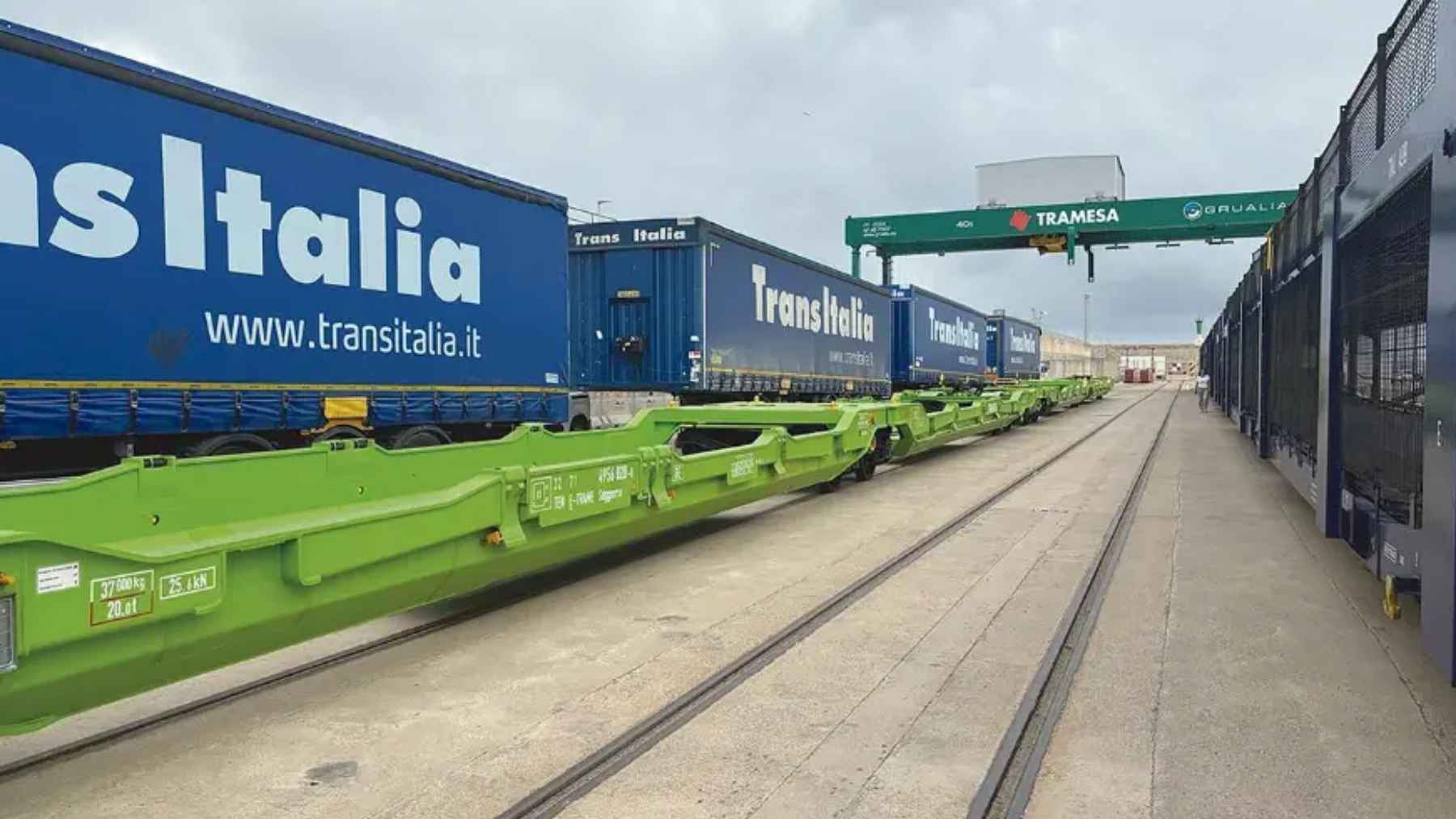
TransItalia is preparing to extend its rail-highway network from the Port of Valencia toward northern Spain, with Júndiz in the Basque province of Álava and Noáin in Navarra identified as key destinations. The plan would move truck semitrailers by train for the long-distance portion of the journey, leaving the road mainly for pickup and final delivery.
The most important point is that this is still a project, not an operating route. Yet the model has a real track record. Official calculations for the existing Valencia-Madrid service show an 85 percent greenhouse-gas reduction per semitrailer, while Spain is trying to raise rail’s freight share to 10 percent by 2030.
A freight corridor heading north
TransItalia already manages about 84,000 trailers a year between Spain and Italy through maritime services operated with Grimaldi. Its Valencia-Madrid rail highway now runs three times a week and carries 40 semitrailers in each direction on every circulation, while a newer Valencia-Entroncamento link connects the port with Portugal.
Now the company is looking north. Júndiz could provide a route toward France and Germany, while Noáin would strengthen access to Navarra and the Atlantic freight network. Commercial operations remain dependent on technical checks and Adif infrastructure work, so the project should still be treated as a plan rather than a finished railway.
How the rail highway works
The cargo often begins in Italy, where unaccompanied trailers board ships bound for Valencia. At the port, special equipment transfers the semitrailers onto rail wagons, and local tractor units handle the first and last road miles.
In practical terms, the cargo travels while the truck cab stays behind. Port Authority President Mar Chao summed up the concept when the Valencia-Madrid service launched, saying, “Trucks are getting on the train.”
The environmental payoff
The current Valencia-Madrid corridor offers the clearest evidence for the model. Valenciaport says the service can take more than 10,000 trucks off the road each year and reduce greenhouse-gas emissions by 85 percent per semitrailer under a calculation certified to ISO 14064-2.
The port also estimates annual savings of about 17,600 U.S. tons of carbon dioxide. A comparable emissions forecast for the planned northern corridors has not yet been included in the available project details.
That matters. The climate benefit will depend on how many trains run, how full they are, and how many long-distance truck miles they truly replace. A lightly loaded service would not deliver the same payoff.
Spain has a freight rail problem
Rail carries less than 5 percent of freight in Spain, according to the Transport Ministry, and the government’s “Mercancías 30” strategy aims to lift that share to 10 percent by 2030. Why does that matter? A transport system dominated by long truck journeys is harder to decarbonize and more exposed to highway congestion.
The Valencia-Madrid line shows what a practical shift can look like. Each train can take 40 semitrailers in each direction, replacing dozens of long highway trips while still allowing trucks to do the flexible local work they handle best.
One corridor will not close the national gap. But repeating the model at ports, inland terminals, and international gateways could create the network effect Spain needs.
Cameras and clearance come first
Before a loaded semitrailer can travel north by rail, engineers must confirm that it fits safely along the entire route. TransItalia plans tests between Zaragoza and Júndiz using a camera-equipped train to verify the loading gauge, meaning the free space available around the train.
This work may sound highly technical, but it is the difference between an announcement and a service that can actually run. The existing Valencia-Madrid line required Adif to adapt the route for P400 semitrailers, a clearance profile used for tall road trailers carried by train.
Noáin is already moving in the right direction. Adif opened its expanded intermodal terminal there on July 21, 2026, with capacity for up to eight trains a day and 60,000 intermodal units a year, compared with 13,710 units in 2025. The agency also said the site is prepared for future rail-highway services.
A new Valencia logistics base
TransItalia is also planning a new platform in the Port of Valencia’s Logistics Activities Zone. The development includes a roughly 108,000-square-foot warehouse, offices, and a large parking area designed to centralize the company’s Spanish operations.
Construction is expected to begin in the first quarter of 2027. The planned investment is about $6.8 million at the European Central Bank’s July 22, 2026 reference rate. The facility could support higher traffic volumes, but its environmental value will come from efficient operations and full trains, not from the building alone.
What happens next
The next milestones are practical ones. Watch for successful clearance tests, a confirmed operating timetable, more frequent Portugal services, and evidence that the trains are running close to capacity.
For businesses, the appeal is straightforward. Rail can reduce long highway runs and pressure on driver availability while keeping trucks free for local delivery. For communities, fewer heavy vehicles can mean less congestion, noise, and air pollution along major road corridors.
At the end of the day, this is not a futuristic transport experiment. It is a relatively simple idea built on ships, trains, terminals, and shorter truck journeys, and northern Spain may soon become its next major test.
The latest official press release on Noáin’s readiness was published on Adif.