A hidden tunnel under a road or rail line is not the kind of danger most people picture on their morning drive. But underground voids can weaken soil, shift loads, and create quiet risks beneath transportation routes and other critical facilities.
Now, researchers at the Department of Energy’s Oak Ridge National Laboratory in Tennessee have demonstrated a new acoustic method that flips the usual search strategy.
Instead of sending signals from the surface down, the team sent sound from below the target upward, producing a telltale response that could help reveal hidden underground structures before they become a bigger problem.
A sound signal from below
For decades, tunnel detection has mostly started at the surface. Engineers send signals into the ground, then study how those signals bounce, fade, or shift as they move through soil and rock.
ORNL’s team tried the opposite. Led by researcher Mike Kass, the group placed the acoustic source beneath a possible tunnel and measured the vibrations above ground, a change designed to catch scattered energy that surface methods may miss. Kass said the aim was to improve detection by “capturing signal scatter.”
It sounds simple enough. In practice, it could give infrastructure crews another tool for seeing what is happening under pavement, tracks, and sensitive facilities without relying on guesswork.
Why surface tools can fall short
Finding a tunnel from above is hard because the ground is not a clean laboratory setup. Soil layers vary, moisture changes, clay can absorb or distort signals, and underground spaces are often messy.
Traditional tools include seismic surveys, ground-penetrating radar, and electrical resistivity. ORNL notes that those technologies can be limited in clay-rich soils or complex subsurface environments, especially when engineers need both range and detail.
That is the trade-off. Higher-frequency signals can pick up small cavities but fade quickly underground, while lower-frequency signals can travel farther but often miss finer features. So ORNL’s team looked for a new angle, literally.
How the field test worked
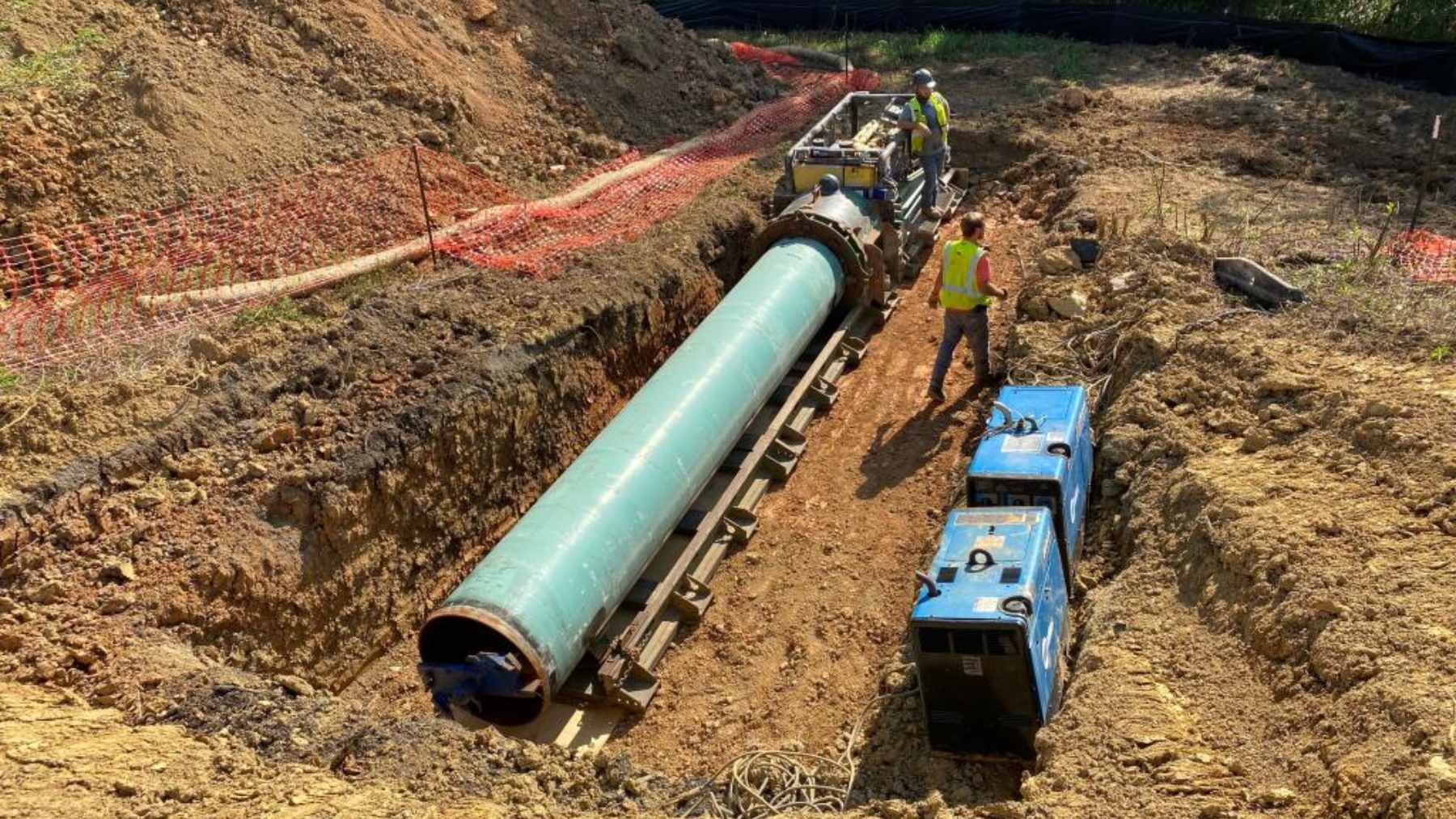
To test the idea under real-world conditions, the researchers built a steel tunnel on ORNL’s campus in Oak Ridge, Tennessee. The tunnel measured 40 ft. long and was buried roughly 10 ft. below the surface.
The team then placed an acoustic source into vertical boreholes as deep as 30 ft. below ground. On the surface, they set up geophones, which are highly sensitive vibration sensors, to record how sound moved through the soil before and after the tunnel was installed.
That before-and-after comparison mattered. It allowed the scientists to separate the normal behavior of the ground from the changes caused by the buried tunnel.
The clue was a subharmonic signal
The key result was a distinct subharmonic signal. In plain English, that means the tunnel created a lower-frequency acoustic response when sound waves bent around it.
Those waves were picked up by sensors at the surface. Charles Finney, a senior research and development researcher at ORNL, said later measurements showed the response appeared “only when the tunnel was present.”
For the most part, that is the exciting part of the discovery. The signal did not simply show up everywhere. It appeared consistently when the tunnel was there and when the sound came from below, which makes it potentially useful as a tunnel signature.
A tool for infrastructure and security
Why does this matter beyond the lab? Because roads, railways, utilities, and critical facilities depend on the ground beneath them staying stable.
A hidden tunnel or void can alter ground stability and create a risk below transportation routes and buildings. ORNL says the method could help identify concealed underground features that threaten roads, rail lines, and facilities by creating hidden spaces beneath them.
For highway departments, rail operators, logistics companies, and defense-related sites, early detection can make a big difference. This could mean targeted inspections instead of broad disruption, and planned maintenance instead of an emergency repair after the ground has already moved.
An environmental side to the technology
There is also a quieter environmental angle here. Better subsurface detection can help crews focus excavation where it is actually needed, rather than digging broadly just to find out what is below.
That does not make the technology a magic underground camera. But if it can reduce unnecessary digging, road closures, and repeated surveys, it could help cut disruption in neighborhoods, rail corridors, and sensitive land around infrastructure.
At the end of the day, the method is about seeing hidden risks earlier. And when the ground under a road, bridge approach, or rail bed is involved, earlier is usually better.
Borrowed from oil and gas science
The approach was inspired by vertical seismic profiling, a technique commonly used in oil and gas exploration. In its traditional form, sensors in boreholes record energy waves generated from the surface.
ORNL reversed that setup. The sound source went below the target, while the sensors stayed above, allowing researchers to measure vibrations that had interacted with the buried tunnel.
That small reversal is the big idea. Instead of asking what the ground looks like from the top down, the method asks what changes when sound has to travel up and around a hidden structure.
What happens next
The team is not done. ORNL says researchers plan to test the method in different soil types, refine signal analysis, and study whether timing and signal strength can create more detailed underground images.
The findings are detailed in the Department of Energy technical report “Advancing Tunnel Detection Via Vertical Acoustic Profiling,” authored by Michael Kass, Charles Finney, Omar Marcillo, Monica Maceira, and Derek Splitter. The report was published in 2025 and listed with the DOI 10.2172/3012495.
So, no, America’s roads are not suddenly being scanned by a sci-fi tunnel detector. This research points to a practical future where sound, sensors, and smarter signal analysis help engineers find what the eye cannot see.
The official statement was published on Oak Ridge National Laboratory.