
A wall that holds a picture, a tool, or a classroom panel without a drill sounds like a small convenience at first. But in construction, small conveniences can become big business if they reduce damage, rework, noise, dust, and waste.
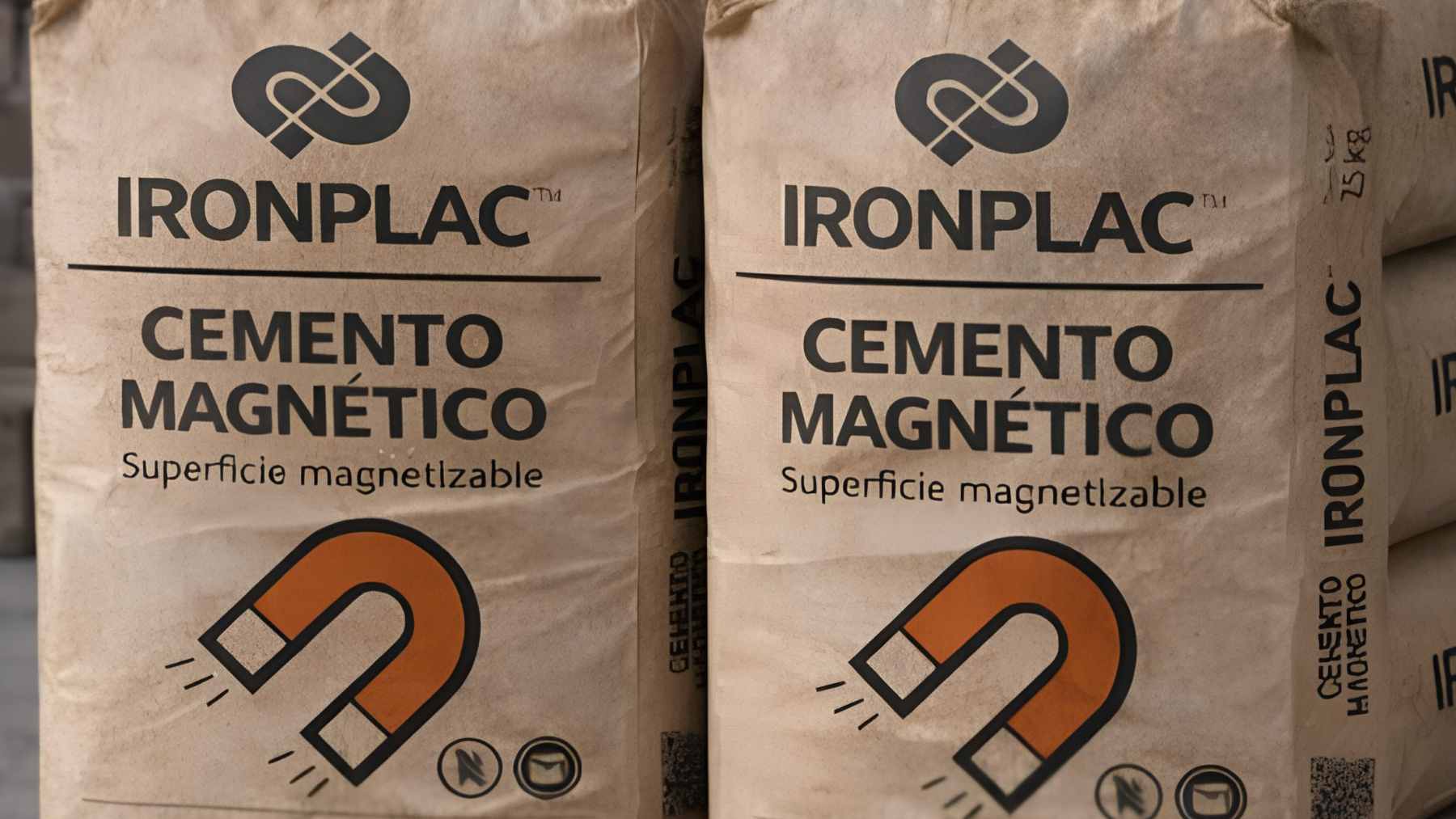
That is the promise behind Ironplac, a magnetizable construction finish developed by Argentine inventor Marco Agustín Secchi, 29. The material is designed to let objects with magnets attach to walls without nails, screws, or anchors, although the project is still moving from pilot tests toward a broader commercial product.
What Ironplac does
Ironplac is described as a magnetizable construction system for architecture and industrial integration. Its official description presents it as a way to turn rigid surfaces into configurable ones, which is a simple phrase with a very practical meaning.
In everyday life, that could mean moving a picture frame without leaving a scar in the wall. In a workshop, it could mean shifting tools around as the job changes, instead of locking everything into one fixed layout forever.
The system is meant for both wet construction and dry construction, including finishes, panels, cement-based surfaces, and coatings. In practical terms, it is not trying to replace the wall, it is trying to make the wall do more.
Not an active magnet
The most important detail is also the easiest one to misunderstand. Ironplac is not being presented as an electric system, and the wall itself is not supposed to behave like a giant magnet.
According to Secchi’s explanation reported by Xataka México, the wet-construction version is prepared with water and applied like a fine finishing plaster. He also said it is “100% passive” and “does not emit any magnetic field.”
So, what actually sticks? The object does the work. A frame, knife rack, tool holder, panel, or accessory needs a magnet, while the treated wall provides the hidden magnetizable layer that lets it hold.
Why builders care
Anyone who has rented an apartment knows the small drama of wall holes. The drill comes out, dust falls on the floor, the anchor goes in crooked, and months later somebody has to patch and paint it.
That may sound minor, but it adds up in schools, offices, labs, stores, workshops, and rental homes where spaces change often. A wall that can be reconfigured without repeated drilling could save time for maintenance crews and make rooms easier to adapt.
For builders and architects, the business case will come down to trust. A clever demo gets attention, but a construction product has to prove that it works again and again, under real use, with real costs.
The environmental angle
Ironplac should not be treated as a climate breakthrough in itself. Based on the public information available so far, there are no published emissions figures showing that it has a smaller carbon footprint than conventional wall finishes.
Still, the construction sector has a waste and emissions problem that is hard to ignore. The United Nations Environment Programme (UNEP) reported that buildings were responsible for 34% of global energy demand and 37% of energy and process-related carbon dioxide emissions in 2022.
There is also the debris issue. The U.S. Environmental Protection Agency estimated that 600 million tons of construction and demolition debris were generated in the United States in 2018, more than twice the amount of municipal solid waste produced that year.
Small changes matter
No one should pretend that a magnetizable coating will solve construction waste by itself. That would be too neat, and the numbers do not support that kind of claim.
Adaptable interiors can still matter, though. Fewer holes can mean fewer patches, fewer replacement surfaces, fewer plastic anchors, and less repainting in places where layouts are constantly shifting.
At the end of the day, what Ironplac is trying to do is fairly down-to-earth. It takes a wall, one of the most ordinary parts of a room, and asks whether it can become part of the room’s storage and organization system.
The science behind it
Magnetic behavior in cement-based materials is not science fiction. A 2026 paper in Results in Engineering examined cementitious composites made with magnetic sand and magnetite powder for technical uses such as wireless power transfer systems.
That study was not about hanging family photos or workshop tools. Still, it shows that researchers are already exploring how magnetic mineral ingredients can change what cement-based materials are able to do.
Ironplac’s angle is different because it is aimed at everyday spaces. Instead of a specialized infrastructure application, it turns the same broad materials idea toward homes, offices, classrooms, and work areas.
What still needs proof
For now, Ironplac remains a promising pre-commercial material. The Argentine Association of Structural Engineers reported that the project has functional prototypes, practical validations in real settings, laboratory tests, and an intellectual property process underway.
The next questions are less exciting, but more important. How much weight can it safely hold over time, what happens with humidity, how does repainting affect performance, and how much will it cost compared with ordinary finishes?
There is also the patent side. WIPO explains that the Patent Cooperation Treaty is an international system that helps innovators seek patent protection in multiple countries, but that does not mean a finished product is already approved for sale everywhere.
A wall with a new job
The most interesting part of Ironplac is not the magnet itself. It is the idea that a wall could become flexible without becoming electronic, expensive, or complicated to use.
Maybe the first real users will be workshops, design studios, classrooms, or rental properties where change happens all the time–that makes sense. These are the places where one more hole in the wall is never just one more hole.
If Ironplac proves durable, affordable, and easy to install, drilling a wall just to hang a frame could eventually feel like an old habit rather than a necessity.
The official project description was published on the Ironplac website.