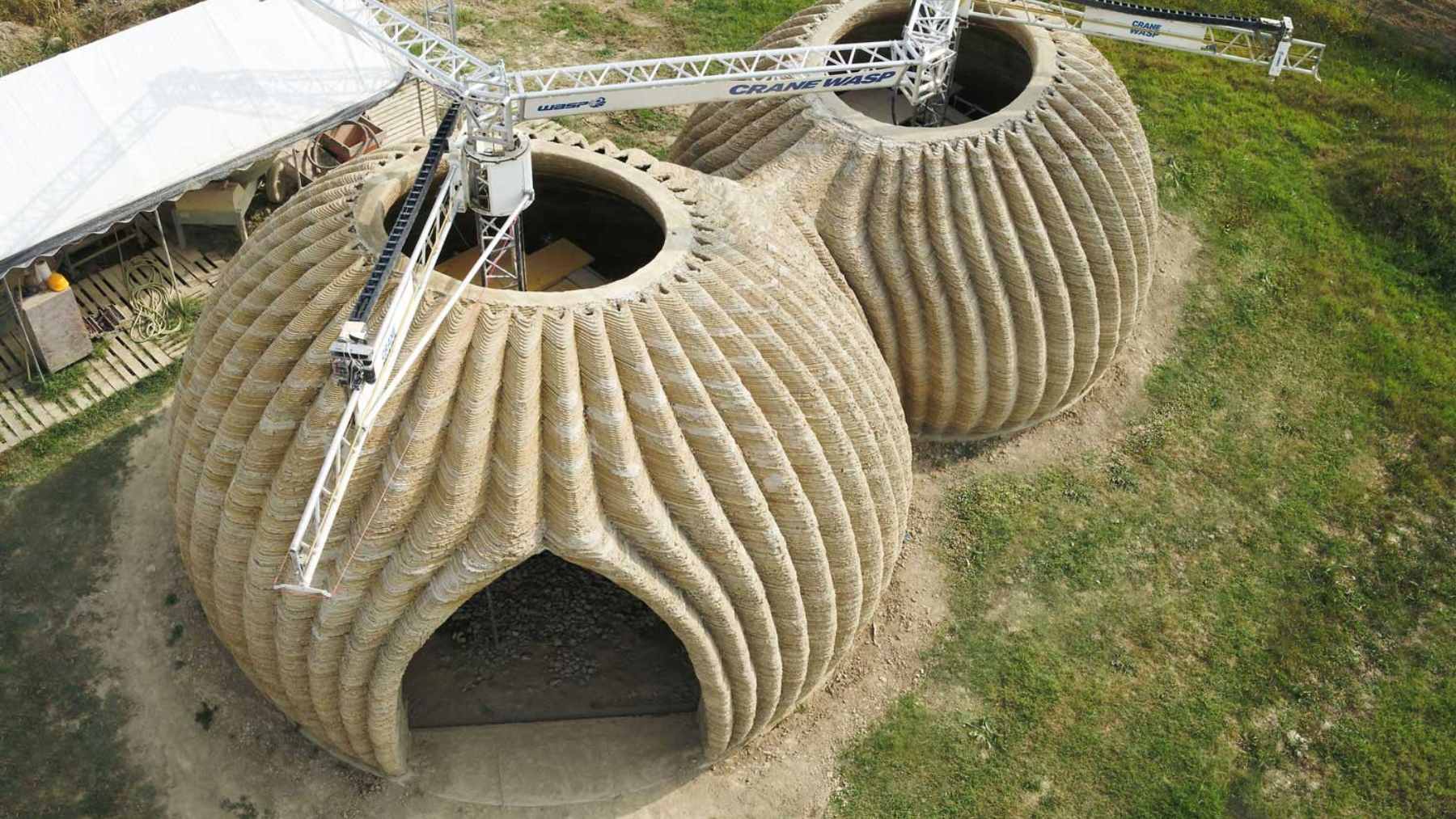
A house in Italy is putting one of construction’s oldest materials back in the spotlight, but with a very modern twist. TECLA, a 3D printed home created by Mario Cucinella Architects and Italian 3D printing company WASP, was built with local raw earth instead of conventional bricks, showing how mud, robotics, and digital design can work together in a real structure.
The prototype is about 646 ft.² and was printed in roughly 200 hours in Massa Lombarda, in the Ravenna area of Italy. At first glance, it looks like something from a science-fiction village.
Look closer, though, and the idea is surprisingly familiar. People have built with earth for thousands of years. TECLA simply asks a new question: what happens when an ancient material meets a computer-controlled construction site?
Printing with earth
TECLA replaces large-scale concrete work, ceramic blocks, and traditional brick walls with layers of raw earth applied directly on-site. The material is pushed through robotic arms that follow a digital model, building the shell step by step instead of assembling it from separate pieces.
That sounds simple, but the precision matters. WASP says the structure involved 350 layers, each about 0.47 inches thick, along with about 93 miles of extrusion and roughly 2,119 ft.³ of natural materials. The company also lists 7,000 machine codes used during the process.
In practical terms, the house is not just “made of mud” in the casual sense. The soil has to behave like a construction material, holding its shape after extrusion while remaining workable enough to pass through the printer.
A home shaped like two domes
The finished prototype is made from two rounded, connected volumes. Inside, the layout includes a living area, kitchen, sleeping space, bathroom, and built-in elements that are shaped as part of the structure.
That is one of the more interesting parts of the project. Instead of printing a shell and then treating the interior as a separate job, TECLA blurs the line between wall, finish, and furniture. The house is, to a large extent, printed as one continuous idea.
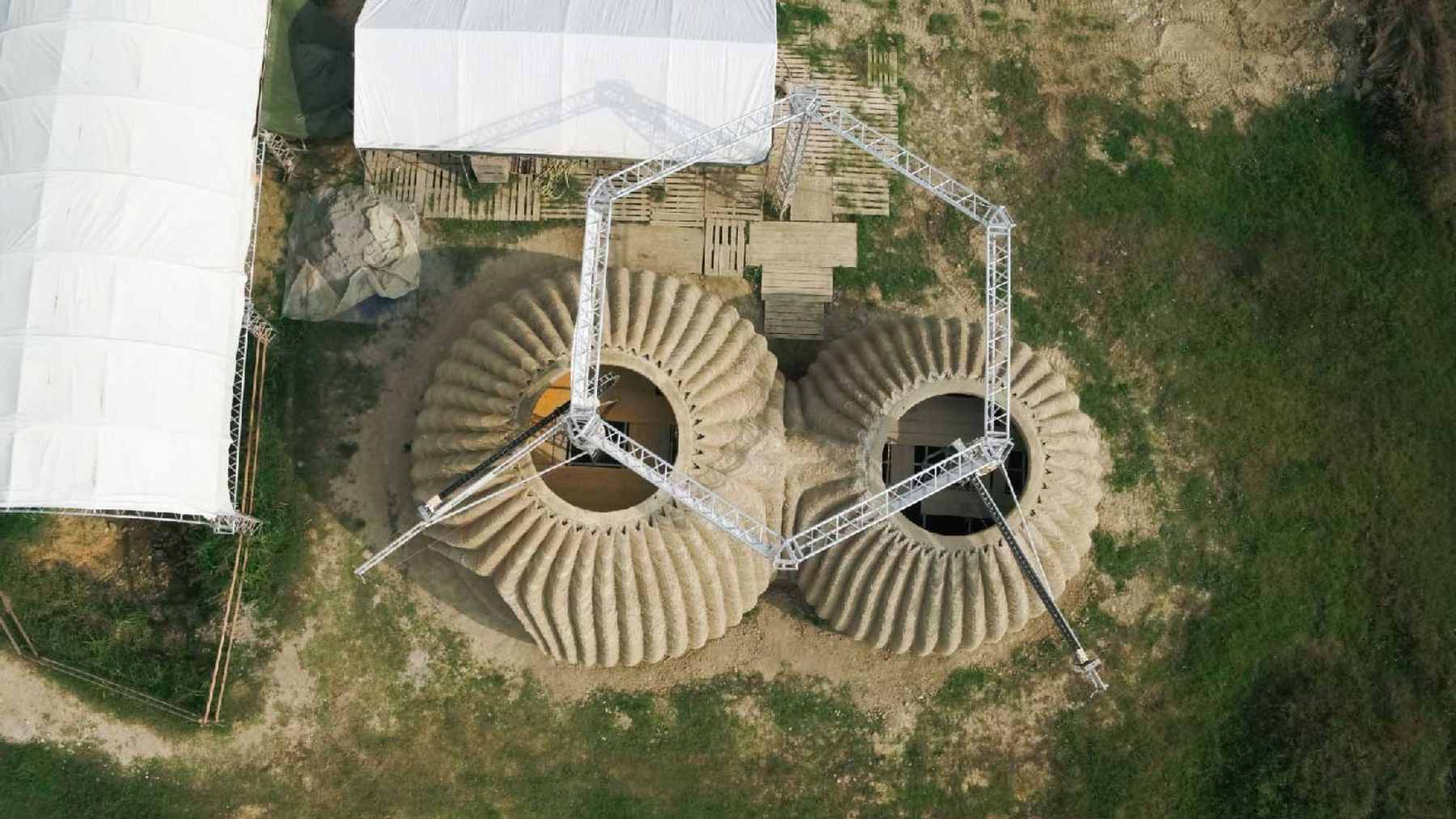
The dome shape is not just for show. Curved shells can distribute loads efficiently, while the layered pattern can be adjusted for ventilation, shading, thermal mass, and internal comfort. At the end of the day, the form is doing some of the work.
The soil still has to pass the test
Using earth from the site does not mean any pile of dirt can become a house. Before printing, the soil must be studied, mixed, and adjusted so it can move through the equipment and stay stable as each new layer is added.
That step is crucial because the home is not poured all at once. It rises slowly, layer by layer, which means the material has to support its own weight while the structure is still unfinished.
Mario Cucinella Architects describes TECLA as a prototype that combines vernacular building practices, climate studies, bioclimatic principles, and natural local materials. The studio says the project was developed with WASP to explore “0-km green housing,” meaning housing made with materials sourced from the immediate area.
Less waste, less hauling
One of TECLA’s biggest environmental arguments is not flashy at all. It is simply about moving less stuff.
Conventional construction often depends on a long chain of extraction, manufacturing, shipping, cutting, assembling, and disposing of leftover material. TECLA points in another direction, using local raw earth and digital instructions to place material only where the design needs it.
Mario Cucinella Architects says local materials can shorten the supply chain, while 3D printing can reduce waste and scrap. That does not make the prototype a ready-made solution for every neighborhood, but it does show why the building industry is watching this kind of experiment closely.
Old methods meet robotics
The name TECLA comes from “technology” and “clay.” It also nods to Italo Calvino’s fictional city of Thekla, a place that always seems to be under construction.
The look of the house captures that same mix of past and future. Its rounded earthen forms resemble ancient shelters, but the clean, stacked lines reveal the hand of robotics and software.
WASP says TECLA was built using multiple Crane WASP printers working together, with two synchronized printing arms controlled by proprietary software. According to the company, the system was designed to optimize movements, avoid collisions, and allow simultaneous operation.
Not a housing revolution yet
It would be easy to call TECLA the future of housing and leave it there. The more accurate view is a little more careful.
The project is still a prototype, not a mass-market home that can be ordered and installed anywhere. Real-world use would depend on local building codes, soil quality, weather, structural testing, available equipment, and technical approvals.
Still, the experiment matters. Much of 3D printed construction has focused on concrete or industrial mixes. TECLA shows another path, one where the building material could come from the ground beneath the job site rather than from a distant factory.
Why builders are paying attention
The construction sector is under pressure to cut waste, reduce emissions, and build faster without lowering safety standards–a tough combination. Anyone who has seen a home renovation produce dumpsters of scrap knows how much material can disappear before a building is even finished.
TECLA does not solve all of that. But it gives architects and engineers a practical test case for circular building, digital fabrication, and local material use.
There is also a social angle. The designers connect the concept to housing emergencies, disaster response, and communities that might need shelter with fewer outside resources. That idea still needs real validation, but the direction is clear enough.
What TECLA really proves
The most important part of TECLA may be the shift in thinking. A house does not always have to begin with truckloads of bricks, blocks, and cement. Sometimes, the starting point might be the soil already on the land.
This is not nostalgia, it is a technical challenge. The old material needs modern testing, robotic control, and careful design before it can become a safe building.
For now, TECLA stands as a striking Italian prototype rather than a finished answer to the housing crisis. But as a proof of concept, it opens the door to homes that use fewer transported materials, create less waste, and treat local earth as a serious construction resource.
The official statement was published on WASP.