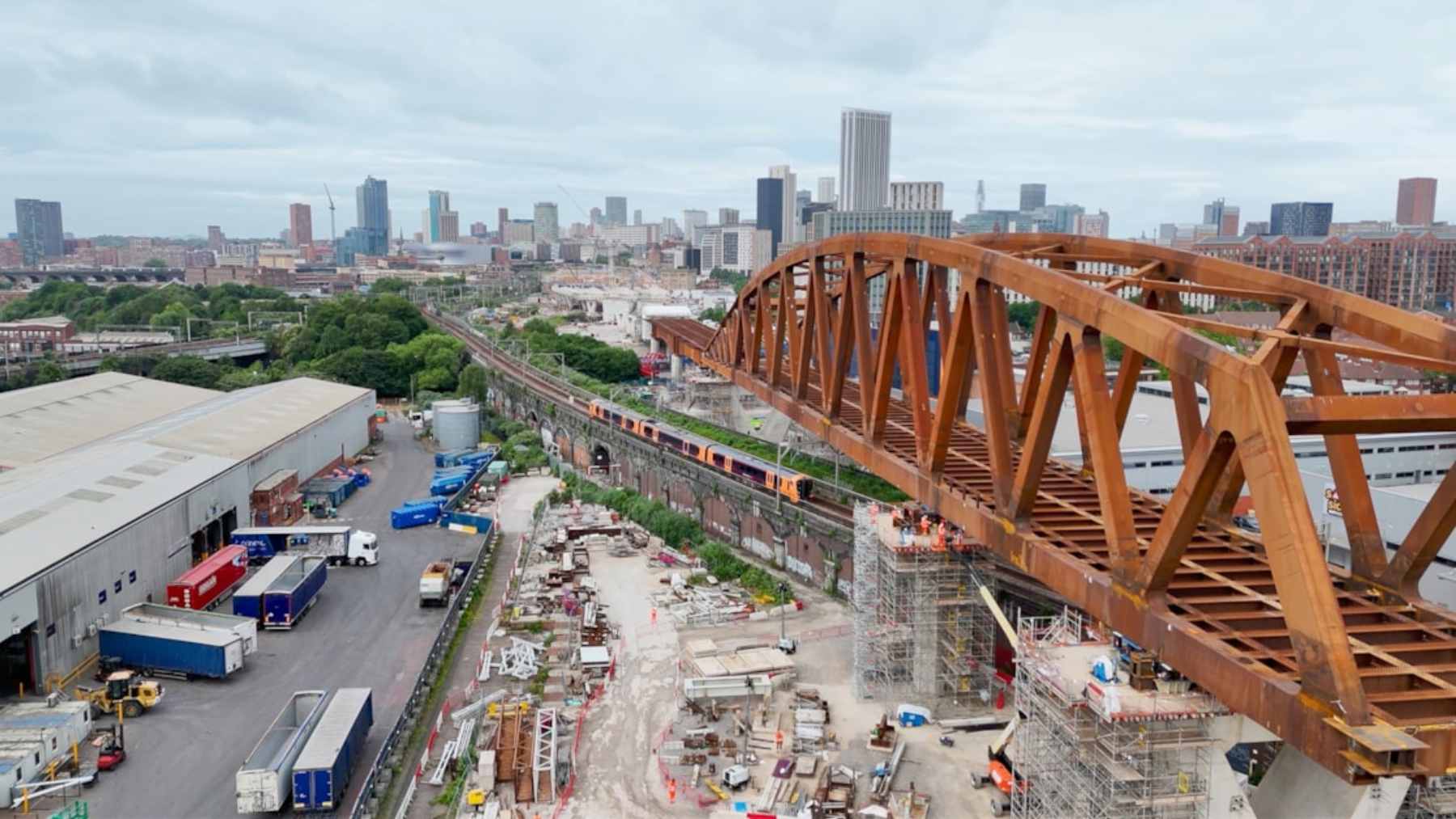
The biggest moving part in Birmingham’s High Speed 2 skyline has finally landed where it belongs. After a delay linked to complex welding work and a shortage of skilled welders, engineers slid the Curzon 2 viaduct into place above the city’s Cross City rail line, locking a roughly 4,630-ton steel structure onto its permanent supports.
This is not just another construction milestone. The 492-ft.-long bridge is one of the clearest examples of the trade-off built into modern green infrastructure, where huge amounts of steel, labor, planning, and patience are needed now so a rail system can carry cleaner, higher-capacity travel later.
A giant above Birmingham
Curzon 2 is now part of the final approach into Birmingham Curzon Street Station, where future HS2 trains will enter the city center. At its highest point, the structure rises about 131 ft. above the ground, close to the height of a 10-story building.
Why should anyone outside a rail engineering office care? Because this one bridge clears one of the most technically demanding pieces of the Birmingham route, and it sits over an existing railway that still has to keep everyday passengers moving.
How it moved
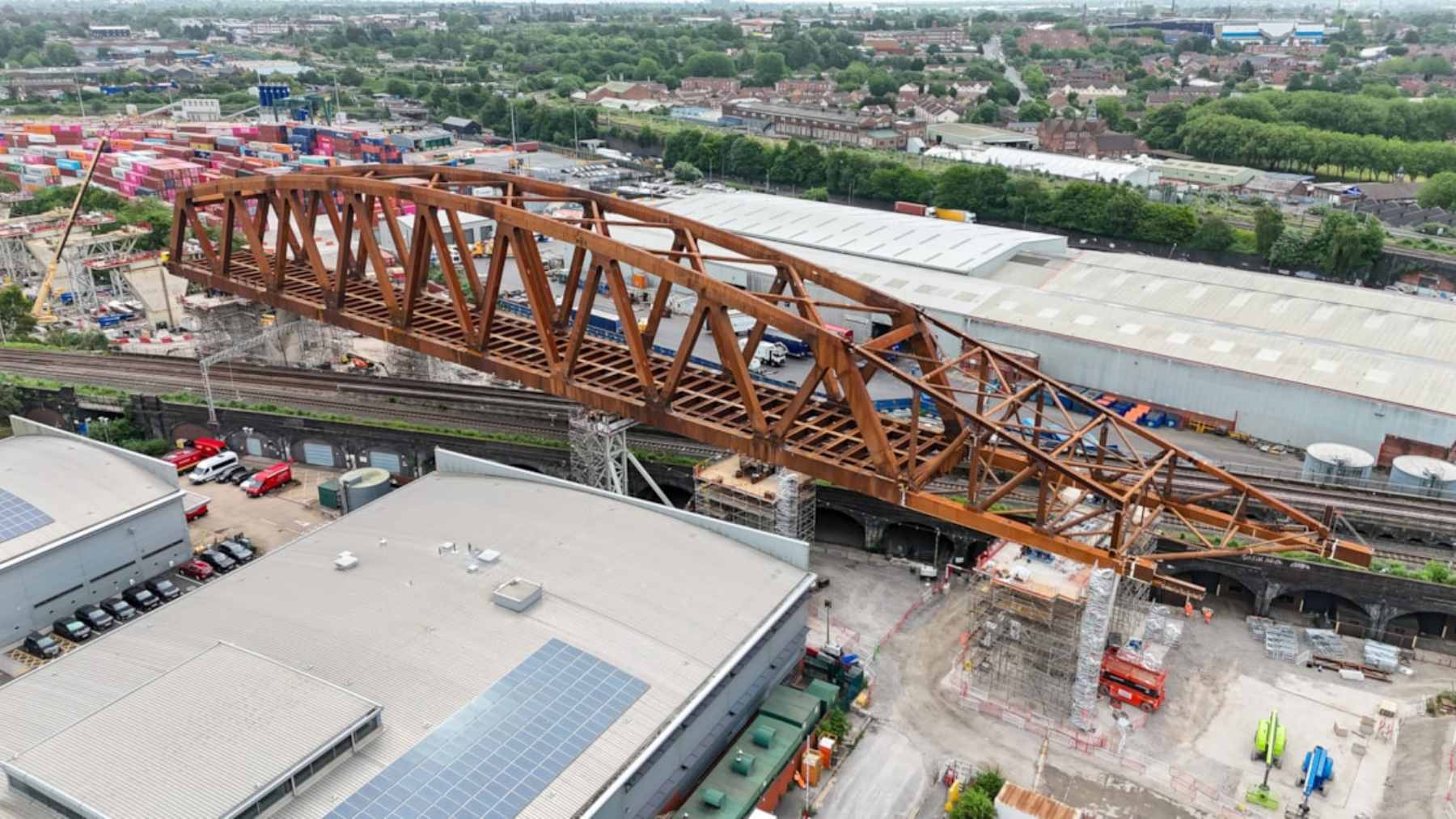
The bridge was shifted about 590 ft. in a three-stage operation, a slow-motion move that sounds almost impossible when you picture the weight involved. First came a 164-ft. push toward the railway boundary, then a 305-ft. move across the Cross City line, followed by a final 121-ft. push onto permanent bearings.
Engineers used a strand-jacking system with two cables beneath the bridge to pull it forward and a third cable acting as a brake. In plain English, it was less like lifting a bridge and more like sliding a giant steel table into place without letting the cups fall over.
The welding problem
The launch had been expected last year, but the team hit a familiar problem in big infrastructure projects. The job needed highly skilled welders, and the industry-wide shortage of those workers helped push the operation back by nearly a year.
A workforce of 250 engineers, welders, and apprentices spent three years building the superstructure on a tight site between the River Rea and the operating railway. Onder Akin, senior project manager for Balfour Beatty VINCI, called it “an incredible challenge,” a short phrase that probably understates the pressure on the ground.
Steel with a purpose
The bridge uses a distinctive weathering steel truss, with 670 individual steel sections welded together into its triangular Warren truss form. Some of those steel sections weighed up to 94 tons before being shipped from Martifer’s facilities in Portugal for assembly by the Balfour Beatty VINCI joint venture.
Weathering steel is not just about looks. In suitable environments, it develops a protective rust-like patina that can reduce the need for painting and future maintenance, although experts warn that good detailing and inspection still matter.
The greener question
This is where the environmental story gets more complicated. HS2 says its trains will run on zero-carbon electricity, and it argues that extra rail capacity can help shift people and freight away from roads.
By HS2’s own figures, one extra freight train can remove up to 76 trucks from roads, which would cut traffic, carbon emissions, and air pollution. That is the cleaner promise, but it only matters if the railway is delivered well and used heavily once it opens.
Less disruption mattered
Network Rail said the Cross City line between Birmingham New Street and Lichfield Trent Valley closed for three days, from Friday, May 29, through Sunday, May 31, so engineers could complete a key part of the installation. Services resumed on Monday, June 1.
The complex installation used what Network Rail described as a “fully restrained” engineering method, developed by HS2 and supported by Network Rail. That method allows remaining sections to be moved even after trains resume, which helps reduce disruption for passengers.
Part of a bigger route
Curzon 2 is one of five connected viaducts on the Curzon approaches, a stretch of elevated railway running for just under one mile into Birmingham’s new HS2 terminus. The wider group includes Duddeston Junction, Curzon 1, Curzon 2, Lawley Middleway, and Curzon 3.
HS2 says these structures are being designed around a difficult urban setting, crossing existing rail corridors, waterways, and roads before connecting with the station. It is a bit like threading a needle through a working city, except the needle is made of steel and weighs thousands of tons.
What comes next
The bridge is a win for the Birmingham section of HS2, but it does not erase the bigger uncertainty around the project. In May 2026, HS2 said the government had announced the railway would take longer and cost more than previously set out.
First services between Old Oak Common in west London and Birmingham Curzon Street are now expected between May 2036 and October 2039, according to HS2’s latest project update. The full scheme, including Euston and Handsacre Junction, is estimated to open between May 2040 and December 2043.
Why it matters
For Birmingham, Curzon 2 is already changing the skyline. For HS2, it is proof that difficult engineering work can still move forward, even after delays, labor shortages, and public frustration.
For the environment, the lesson is more careful. Cleaner transport does not appear by magic, and giant projects like this carry their own construction footprint before they deliver any benefit.
The official statement was published on Network Rail Media Centre.