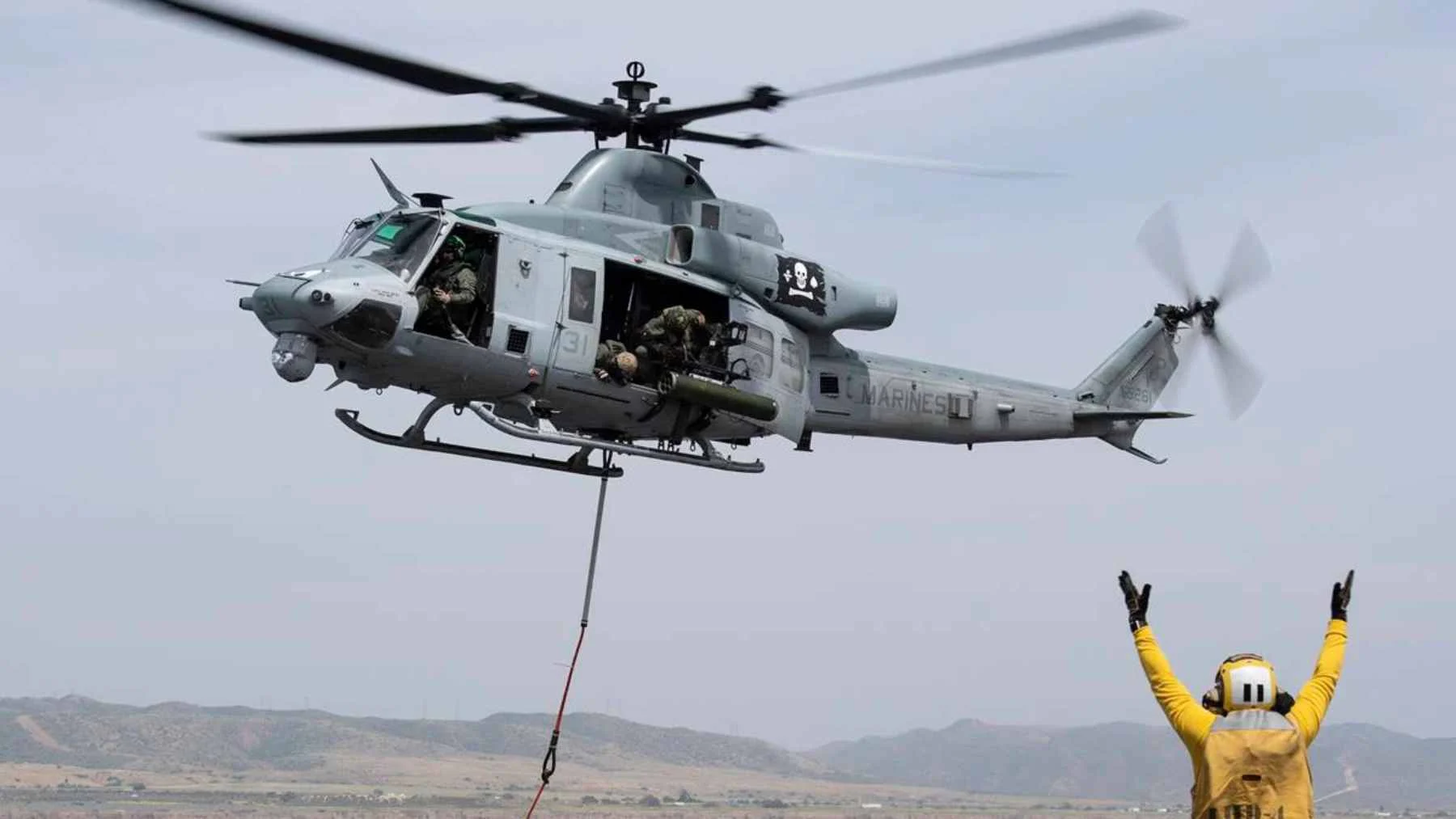
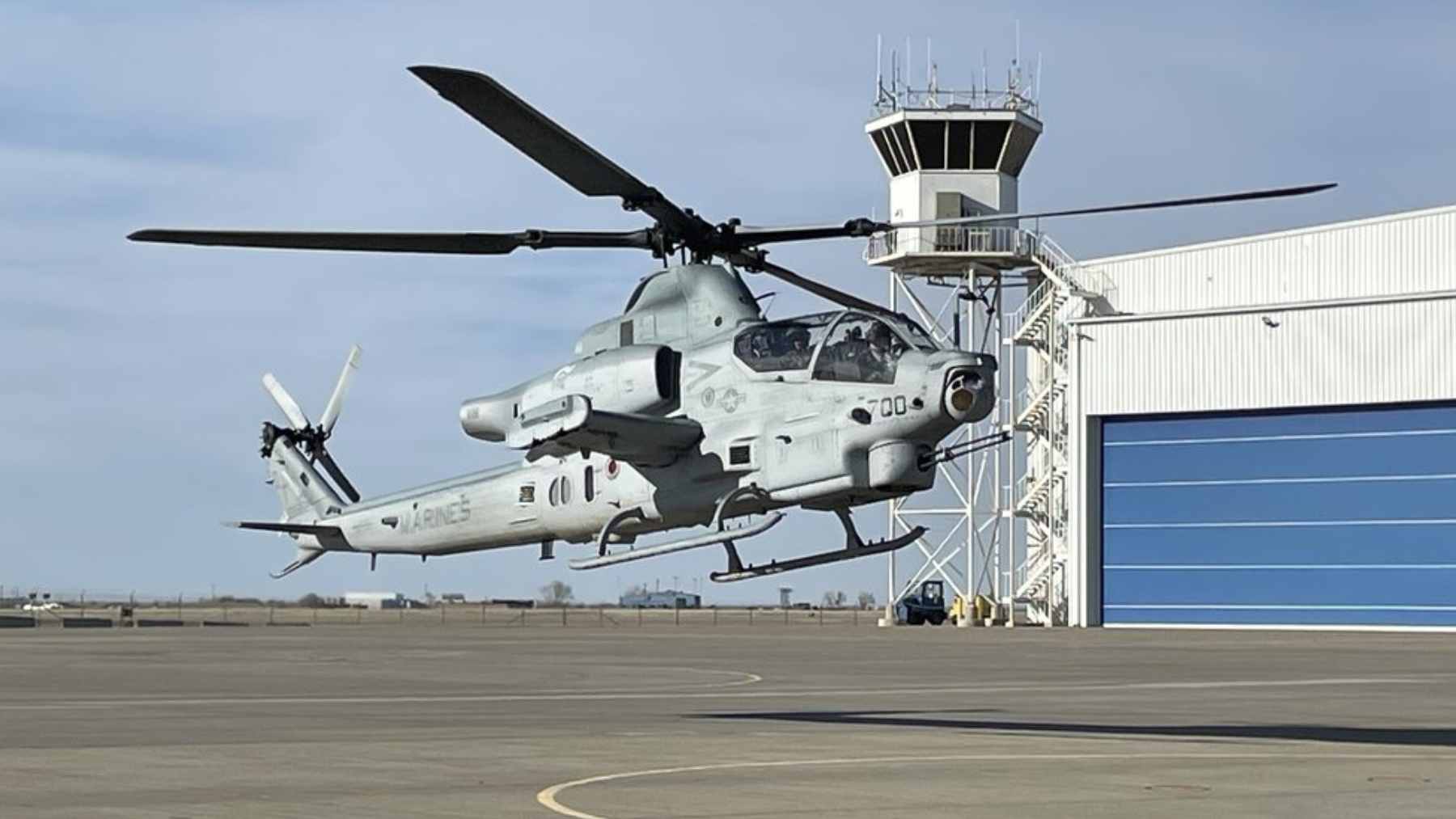
The U.S. Marine Corps has tested a new way to use helicopters, and it could reshape how troops strike targets without sending aircraft as close to danger. In a recent exercise at Marine Corps Air Ground Combat Center Twentynine Palms in California, Marines used H-1 helicopters as airborne launch and control platforms for first-person-view drones.
The idea is simple, but powerful. Instead of treating a helicopter only as a gunship, transport, or close-air-support aircraft, the Marines are exploring whether it can also serve as an “airborne mothership” and a flying drone command post.
That could give commanders a cheaper, more flexible option on the battlefield, while also raising a harder question about the environmental footprint of modern war.
A helicopter becomes the relay
The exercise involved Marines from Marine Light Attack Helicopter Squadron 169, Marine Aircraft Group 39, 3rd Marine Aircraft Wing, and the 3rd Light Armored Reconnaissance Battalion, 1st Marine Division. They tested the UH-1Y Venom and AH-1Z Viper, two modern H-1 helicopters already used by the Marine Corps.
During the event, Marines deployed an FPV drone from a moving helicopter. They also tested a handoff in which ground forces launched a Neros Archer FPV drone, then passed control to a specialized operator team inside a UH-1Y Venom flying miles away.
In practical terms, the helicopter became a relay in the sky. Its altitude and mobility helped maintain the line-of-sight connection needed to guide the drone toward a target.
Why distance matters
Why put a drone team in a helicopter at all? For the most part, it comes down to range, survivability, and speed.
Small FPV drones are useful because they can be precise and relatively inexpensive. But they are limited by batteries, payload weight, signal range, and terrain that can block control links. A helicopter flying above the ground can help stretch that connection farther than a ground operator often could.
That matters in contested airspace. The Marine Corps said the concept is designed to counter more sophisticated air defense systems that force helicopters to operate from greater distances, reducing their ability to support troops up close.
The Archer drone at the center
The Neros Archer is already part of the Marine Corps’ growing attack-drone push. A September 2025 Marine Corps message said the service was rapidly increasing its fielding of attack drones and needed more trained operators to keep up.
That same guidance said the Marine Corps Warfighting Laboratory would begin fielding the Neros Archer with Defense Innovation Unit funding. The goal, according to the service, was to help Marines develop tactics, techniques, and procedures for low-cost, expendable drone systems at scale.
Neros Technologies later announced a multi-million-dollar Marine Corps delivery order for Archer Strike FPV drones, along with operator training and support across the Fleet Marine Force. The company said the order included kinetic-strike capable FPV systems.
A cheaper strike, not a harmless one
The Marines are not presenting this as a clean or peaceful technology–it is a combat system. Still, there is an environmental angle that cannot be ignored.
Large munitions can be expensive, destructive, and logistically heavy. A smaller drone strike may, in some cases, reduce the need to use a larger weapon against a smaller target. The Marine Corps said the approach gives commanders a scalable, cost-effective option without risking aircraft or using expensive munitions for every target.
That does not make drone warfare harmless. Batteries, electronics, plastics, metals, damaged vehicles, unexploded ordnance, and battlefield debris all leave a mark. At the end of the day, the question is not whether war can be green, it is whether militaries can limit unnecessary destruction when conflict happens.
Less risk for aircrews
For Marine aircrews, the safety argument is direct. If a drone can close the final distance to a target, the helicopter does not always have to.
Sgt. Matthew Pocklington, a UH-1Y crew chief, said the concept lets drones hit the enemy “rather than putting our Marines in harm’s way.” That is the heart of the experiment.
The official release also said the small and precise nature of the drones may help minimize collateral damage in complex environments. That is a cautious claim, not a guarantee. Precision depends on training, intelligence, weather, signal stability, rules of engagement, and the operator’s judgment.
The bigger military shift
This test is part of a much broader U.S. military move toward manned-unmanned teaming. The White House’s 2025 drone executive order called for expanding domestic drone production, strengthening supply chains, and helping the Department of Defense procure and train with low-cost, high-performing drones made in the United States.
The Pentagon followed with a July 2025 memo saying drones are “the biggest battlefield innovation in a generation” and that combat units should be armed with low-cost drones built by American engineers and AI experts.
That is where the H-1 test fits. It is not just about one helicopter and one drone. It is about teaching older, proven aircraft to work with newer, cheaper systems in a fight where speed and adaptation can matter as much as firepower.
What happens next
The hardest part may not be launching a drone from a helicopter. It may be training enough Marines to use these systems safely, legally, and effectively.
Marine Corps guidance says a permanent training framework for lethal tactical employment of attack drones had not yet been approved as of September 2025. Until that framework is complete, the service is relying on interim instruction, train-the-trainer models, simulators, and controlled operating rules.
For now, the test at Twentynine Palms shows where Marine aviation may be heading. Helicopters could become less like single platforms and more like airborne hubs, launching, relaying, and controlling drones that do the most dangerous work.
The official statement was published on 3rd Marine Aircraft Wing.