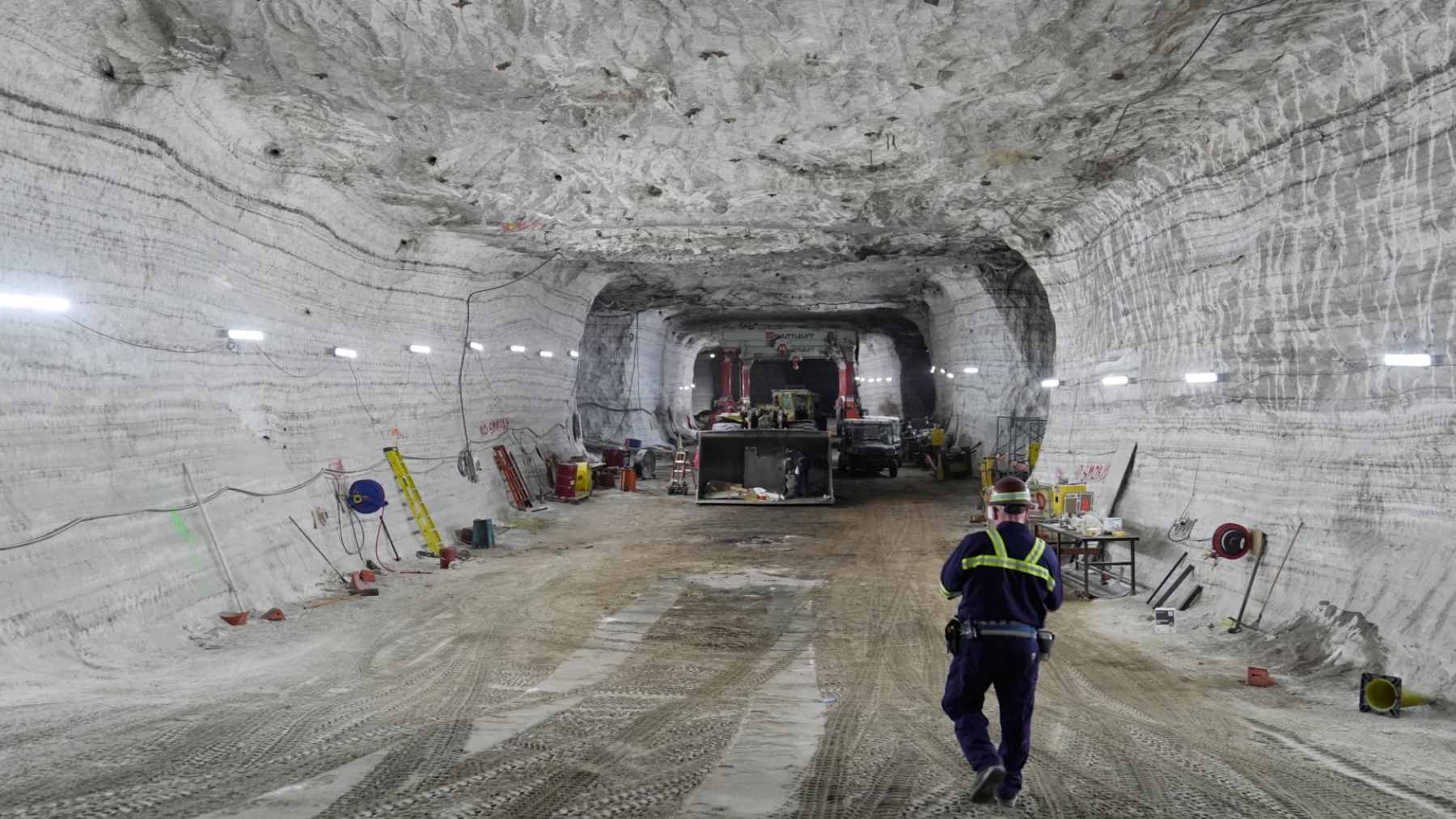
If your morning commute stayed mostly drama-free after the last snowstorm, there is a good chance you were riding on the work of a mine you will never see. Roughly 1,800 feet below Lake Erie, the Whiskey Island salt mine in Cleveland ships rock salt across the Northeast and Great Lakes as a colder, snowier winter drains municipal stockpiles.
This underground surge is also a reminder that road salt is both a safety tool and a slow-moving pollutant. The challenge for cities, logistics planners, and even emergency readiness teams is learning how to keep roads safe while putting fewer chlorides into rivers, reservoirs, and groundwater.
Inside Whiskey Island’s salt mine
The mine is a sprawling set of rectangular caverns carved from ancient salt deposits, accessed from an industrial strip right beside downtown Cleveland. It opened in the 1960s and runs year-round, using drilling and blasting to break the rock, while pillars of salt are left behind to support the ceiling.
Cargill says output is about 3 million to 4 million tons a year, but even that can feel tight in a winter that refuses to let up. In the words of spokesperson Emily Tangeman, “Our teams have been working overtime since September to support customers across the snowbelt.”
Why demand runs hot in a cold winter
Salt demand is not driven only by blockbuster blizzards. Frequent smaller storms can be worse for inventory, because they push repeated treatments that keep traffic moving but steadily empty storage domes and barns.
On a national scale, the numbers are big even in an average year. The U.S. Geological Survey estimates domestic salt production at about 40 million tons in 2025, with highway de-icing accounting for about 37% of total salt consumed.
That matters for business and for public budgets, because salt is not just “there” when you need it. The same USGS snapshot puts the total value of U.S. salt sold or used by producers in 2025 at about $2.6 billion, and it also shows the United States still relies on imports for a meaningful share of apparent consumption.
The environmental price of clear roads
Anyone who has watched rust creep along a wheel well already knows salt has a second bill. EPA’s New England program notes that rock salt can corrode cars, trucks, bridges, and roads, contributing to roughly $5 billion in annual repairs in the United States, and it can infiltrate nearby surface and ground waters.
Water chemistry is where the tradeoff gets uncomfortable. EPA’s secondary drinking water standard lists a guideline of 250 mg/L for chloride because higher levels can create a salty taste, and EPA’s national aquatic life criteria for chloride are 230 mg/L as a four-day average and 860 mg/L as a one-hour average (not more than once every three years on average).
And the long-term trend line is moving the wrong way. A USGS analysis found chloride levels increased substantially in 84% of urban streams studied, with some sites showing the highest levels during winter but increases across seasons over time.
Smarter de-icing, powered by data
The good news is that “less salt” does not automatically mean “less safe.” Pre-wetting is one of the simplest wins, because dampening salt helps it stick to pavement instead of bouncing into the ditch, and field experience summarized by the University of Washington’s TRAC center suggests typical savings of 25% to 30% less salt when pre-wetted salt is used.
There are also smaller benefits that add up, especially for groundwater. The Cary Institute notes that pre-wetting salt before application can reduce salt infiltration to aquifers by about 5%, which is not a silver bullet, but is meaningful at scale.
Then there is the tech stack, which is starting to look a lot like logistics software. FHWA has highlighted how pavement and weather sensors can improve the timing of winter maintenance operations, and Minnesota case studies suggest that pairing decision support with GPS-based vehicle tracking can cut salt use dramatically while saving money.
Winter mobility is critical infrastructure
Salt is also a proxy for something bigger: the ability of a region to keep moving during a shock. Ambulances, utility crews, supply trucks, and sometimes National Guard units all need passable routes when the weather turns, and a city that runs out of de-icer is making a readiness decision whether it realizes it or not.
The supply chain side matters beyond roads, too. USGS notes that the chemical industry accounts for about 42% of total salt sales, because brine is a key feedstock for products like chlorine and caustic soda, and those building blocks run through everything from water treatment to manufacturing.
So the Lake Erie mine is not just a curious underground world, it is a snapshot of how climate volatility, infrastructure wear, and environmental limits collide in one gritty mineral.
The official data sheet was published on U.S. Geological Survey.