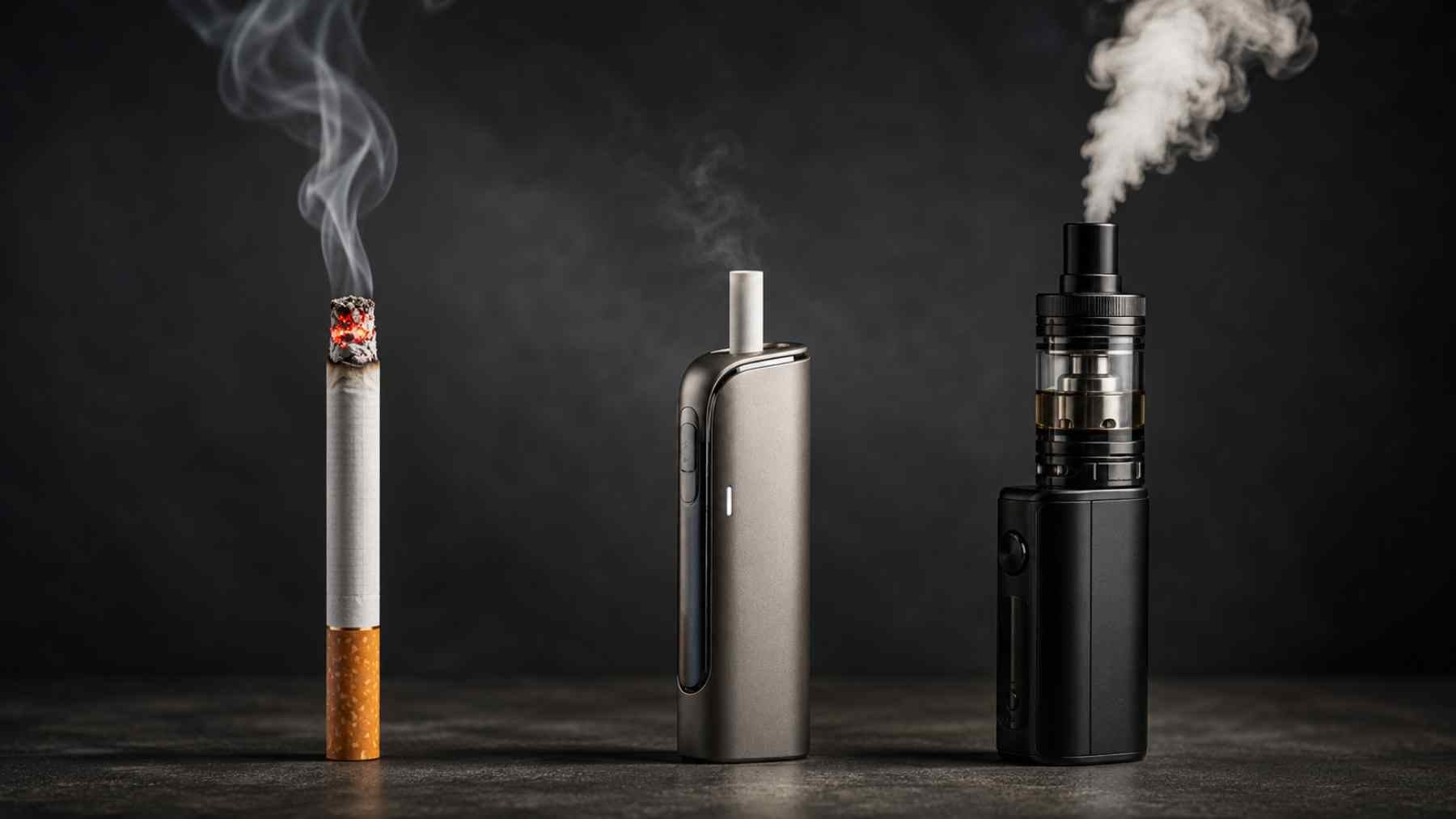
The debate over vaping, heated tobacco, and traditional cigarettes has circled back to a basic question. Are all nicotine products equally risky, or is the biggest danger still the smoke created when a cigarette burns?
A new scientific review by cardiologists Silvio Festinese and Dimitris Richter argues that combustion remains the key issue for cardiovascular harm. Their conclusion is careful, not carefree. Adults who fully switch from cigarettes to combustion-free products may reduce exposure to toxic substances, but that does not make vaping or heated tobacco safe.
What the review found
The review looked at clinical trials, observational studies, crossover studies, and cohort data on e-cigarettes and heated tobacco products. The authors reported that switching from combustible cigarettes to these alternatives can significantly reduce exposure to harmful and potentially harmful chemicals, including carbon monoxide and some carcinogens.
That matters because cardiovascular disease remains closely tied to smoking. Still, the review also warns that nicotine-containing products can have acute cardiovascular effects, and that long-term data are still limited. In other words, lower exposure is not the same as no exposure.
The authors screened 891 records and included 24 studies in the final review. Those studies covered biomarkers of exposure, cardiovascular function, disease outcomes, and major adverse cardiovascular events.
Why combustion matters
Traditional cigarettes burn tobacco, and that burning process creates smoke filled with chemicals that can damage the heart and blood vessels. The review notes that cigarette smoke contains more than 7,000 harmful and potentially harmful constituents.
Nicotine is still addictive, and it can briefly tighten blood vessels, raise demand for oxygen, and affect the cardiovascular system. But the review states that nicotine’s role in cardiovascular toxicity appears relatively limited compared with carbon monoxide, oxidizing gases, and other toxic chemicals in cigarette smoke.
That distinction is not just a lab detail. For an adult smoker, fully replacing cigarettes is very different from adding a vape while continuing to smoke. Half-switching keeps the fire in the picture.
The FDA draws a narrow line
In the United States, the Food and Drug Administration has allowed certain IQOS heated tobacco products to be marketed with reduced-exposure information. The authorized language says, “The IQOS system heats tobacco but does not burn it,” and that switching completely from cigarettes to IQOS significantly reduces exposure to harmful or potentially harmful chemicals.
The FDA renewed modified risk granted orders for several IQOS products on April 17, 2026. That renewal is important because it shows the agency is still allowing a specific reduced-exposure message under its modified risk tobacco product pathway.
But the FDA’s line is narrow. In a related FDA statement on IQOS 3, the agency said the action “does not mean this product is safe” and added that there are no safe tobacco products. That is the part consumers should not skip.
What changed in smokers
One trial discussed in the review included nearly 1,000 participants, with 496 continuing their preferred cigarettes and 488 switching to a tobacco heating system for six months. Smokers who switched showed statistically significant improvements in five of eight biomarkers, including carboxyhemoglobin and NNAL, a tobacco-specific carcinogen marker.
The review says those changes moved in a direction consistent with what is typically seen after smoking cessation. That sounds promising, especially for people who have tried to quit and struggled. But it still depends on complete switching, not casual mixing.
What does that mean in everyday life? Less toxic exposure may show up in the numbers doctors watch, but it does not turn a nicotine habit into a healthy habit. Not even close.
Why WHO remains cautious
The World Health Organization has taken a more restrictive view. In a statement on heated tobacco products and the FDA’s IQOS decision, WHO said reducing exposure to harmful chemicals does not make heated tobacco harmless or automatically translate into reduced health risk.
WHO also warns that e-cigarette emissions can contain nicotine and other toxic substances that may harm users and people exposed secondhand. It says nicotine is highly addictive, can affect fetal development, and can harm brain development in children and adolescents.
The youth issue is not a side note. WHO estimated in 2025 that more than 100 million people worldwide were vaping, including at least 15 million adolescents ages 13 to 15. A product that may be discussed as harm reduction for adult smokers can become a very different public health problem when it ends up in a teenager’s backpack.
What smokers should know
For people who do not smoke, the advice is simple. Do not start vaping, do not start heated tobacco, and do not start using nicotine just because a product is marketed as less harmful.
For adult smokers, the picture is more nuanced. The best health choice is still to quit tobacco and nicotine altogether, and WHO continues to recommend cessation support such as brief advice from health professionals, quit lines, nicotine replacement therapies, and mobile-based cessation programs.
Still, the review adds weight to a growing argument in tobacco science. If a smoker cannot or will not quit, completely moving away from combustible cigarettes may reduce exposure to some of the substances most closely tied to cardiovascular damage. The key words are “completely” and “not risk-free.”
The bottom line
This is not a green light for vaping. It is also not evidence that all nicotine products carry the same burden as burning tobacco.
The most practical takeaway is clear enough. Combustion appears to be a major driver of smoking-related cardiovascular harm, but regulators and health agencies still disagree on how far reduced exposure should shape public advice.
The study was published on Advances in Clinical and Experimental Medicine.